
Last week I attended the launch of Sue Davies’ lovely little book, Life on the Desert Edge: Memories of Beit Emery a memoir of her time at the British dig house at Saqqara. ‘Beit’ is Arabic for ‘house’ and Bryan Emery, who worked at the site on and off for decades, was one of the great figures of twentieth century archaeology in Egypt; he knew Howard Carter, worked with John Pendlebury at Armant, discovered the X-Group burials at Ballana and Qustul, led the British efforts during the UNESCO rescue campaign in Nubia, and spent the last years of his life on a quest to find the tomb of Imhotep at Saqqara (he failed in that but in the process uncovered some huge tombs of the right period and an entire ‘Sacred Animal Necropolis’ containing the burials of thousands and thousands of animal mummies).

Bryan Emery in the courtyard of the house named after him at the time of his discovery of the Sacred Animal Necropolis. Image from the Saqqara Sacred Animal Necropolis (SAQ-SAN) sub-archive. SAQ-SAN.SLI.E.010. Available online via the Society’s archive at flickr.com. Courtesy of the Egypt Exploration Society.
The house was home to numerous British missions over many decades up to the first of this century when it was reclaimed by the Supreme Council of Antiquities. It was originally slated for demolition soon afterwards, and Sue told me at the launch last week that it no longer existed. No, I told her, I had visited in 2015 and taken photographs, and tried to go again in 2021 with a film crew – we were shooed away but I was sure it was still there, wasn’t it..? On checking Google Earth, I found that Sue was right, it is no more. But Google Earth also allows you to view older images and from these I could tell it had survived until 2022 or 2023, so I wasn’t quite as wrong as I had feared either. It doesn’t matter, the building has gone and so Sue’s wonderful book is now the closest anyone can come to experiencing it.
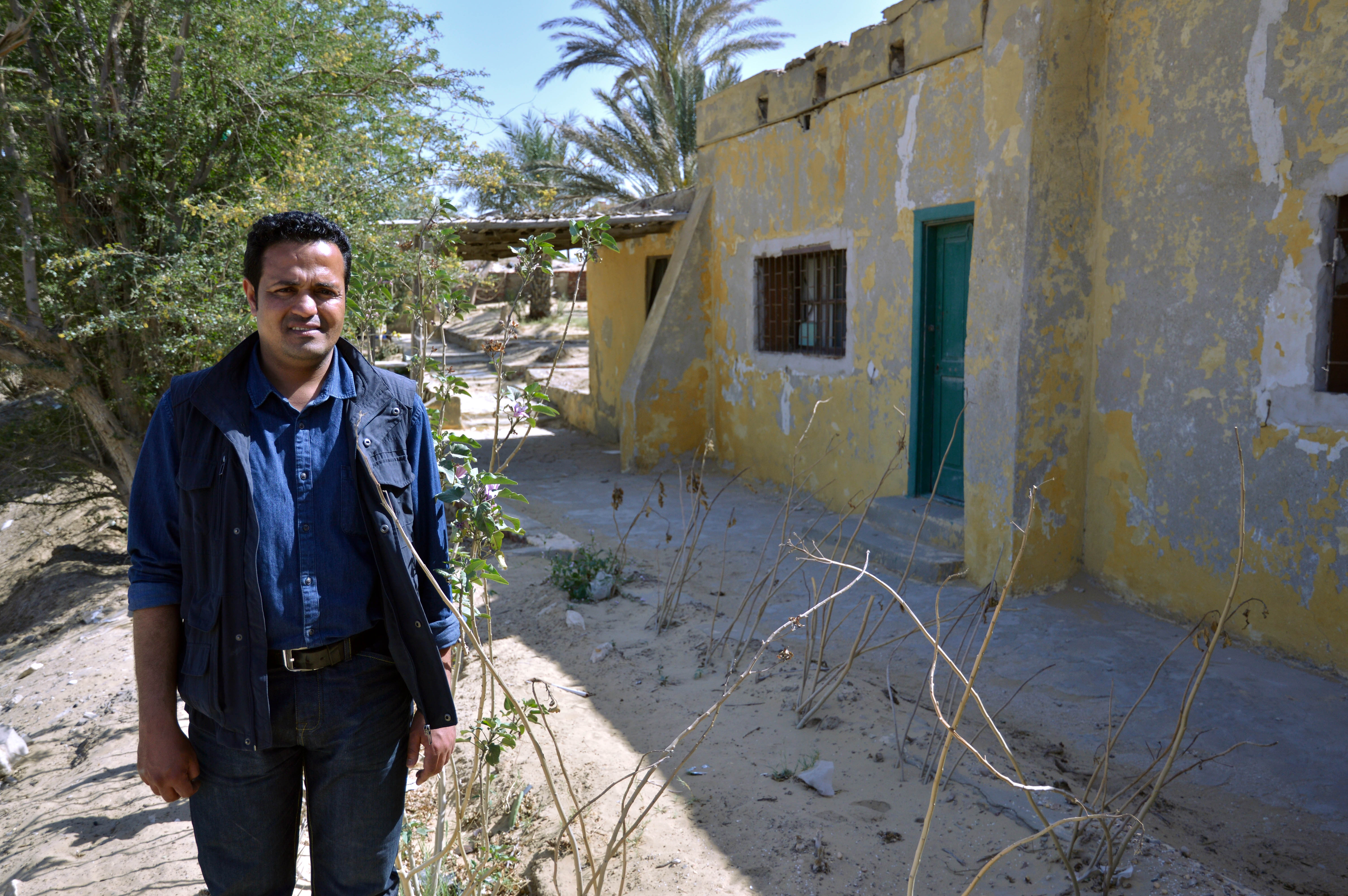
My photo of the EES’ then Cairo representative, Dr Essam Nagy, outside Beit Emery in 2015. I was on a somewhat lunatic adventure trying to follow Emery’s quest for the tomb of Imhotep at the time – see here.
I was lucky enough to visit the house while it was still in use but only once, in 2005, while the EES Survey of Memphis team led by David Jeffreys was mid-season. But reading Sue’s book, I wish I’d been able to spend more time there. Her account is utterly charming, with vivid descriptions of the work, the house, the staff, including Gabr el-Khuruby, colleagues from other missions including the legendary Jean-Phillipe Lauer, and the local population in the surrounding villages of Saqqara itself, Abusir, Mit Rahina and so on. I remember meeting Gabr, who came to be mentioned in EES Committee meetings, as ‘fodder for Gabr’s donkey’ used to appear in the Survey of Memphis budget every year, much to everyone’s amusement.
There’s a great romance, for me anyway, to Sue’s stories of coping with a spartan life in the desert, of striding across the sands in the early-morning mist, of moonlit walks home from another mission’s house, and of a very British ‘make-do’ way of getting on with things. Sue’s book brings the whole experience to life in a way that archaeological reports do not, and reminds me very much of the classic accounts of this kind including Mary Chubb’s Nefertiti Lived Here or Dilys Powell’s Villa Ariadne. It makes me thankful to have experienced something similar in houses elsewhere in Egypt, but I wish I’d been able to spend more time at Beit Emery.
Full disclosure, Sue is a friend, but even so I’m not going to be shy in recommending this book, which you can order here. I gather the proceeds will be going to the Petrie Museum so it’s all for a good cause too!

Harry Smith the day I interviewed him for the EES’ Oral History Project in 2009.
The book is also a celebration of Sue’s long collaboration with Professor Harry Smith, Emery’s successor as (Amelia) Edwards Professor of Egyptology at UCL and director of the Saqqara work, who died last year: https://www.theguardian.com/science/2024/nov/07/harry-smith-obituary
Harry was another of the giants of our field, and another friend. I didn’t feel the need to say anything publicly when he died last year knowing that, as he was such a great and celebrated figure, others would pay him far better tributes than I could. But for the record, he was one of the sweetest and most modest people you could ever hope to meet despite his gargantuan achievements as an archaeologist and a linguist (most Egyptologists are one and not the other, few are both), and as an author, a teacher and a mentor. Shortly after I started working for the EES I was looking for a topic for a paper to present at the third Current Research in Egyptology (CRE) conference and decided to make use of the slides of Professor Jack Plumley, a Copticist who has succeeded Harry’s teacher, Stephen Glanville, as professor of Egyptology at Cambridge, which had just arrived at the Society’s offices. Plumley’s main connection to the EES was that he’d been director of its excavations at Qasr Brim in Nubia. The trouble was I knew very little about Nubia or the Society’s work there so my boss, Patricia Spencer, suggested I ask Harry, who had directed the very last archaeological survey of Lower Nubia before it was flooded, and worked with Emery at Buhen before rejoining him at Saqqara.

Harry Smith (L) and Aly Hassan aboard the Nubian Survey boat in 1961. Available online via the EES’ archive at flickr.com. Courtesy of the Egypt Exploration Society. Further information and photos are here.
Despite my being a total know-nothing, and Harry one of the most senior figures in the field, he graciously agreed to meet me in the EES’ favourite pub, The Lamb on Lamb’s Conduit Street in Bloomsbury. We both had fish and chips (which Harry paid for) and he told me one great story after another. I got several lectures and a short article out of that conversation. A few years later, at Sue’s suggestion I think, I interviewed Harry again, this time on tape, for the EES’ Oral History Project and you can hear some of those same stories in Harry’s distinctively careful and understated voice via the EES’ YouTube channel, e.g. here and below:
I was delighted when, a few years, ago, Harry published a written account of his time working in Nubia, Nubian Memoirs – another great read.
Over the years, we stayed in touch, and almost up to the very end of his life Harry was still writing short notes in his instantly recognisable handwriting, often in reply to queries I had sent most recently about Emery’s search for Imhotep, the story of which formed the first chapter of my Lost Tombs book. Recently I came across an incredibly touching message that Harry had written when my mother died in 2010. I treasure these notes now. How lucky I am to have known him. And Sue! And how lucky we are now to have Sue’s account of her work with Harry and the house they, Emery and so many others lived and worked in.
 Dr Chris Naunton
Annoyingly listed by Amaz
Yes, so I noticed although unhelpfully it’s ‘currently unavailable’!
I’ve managed to buy a copy through Chris Beetles (https://chrisbeetles.com/books) – in fact I’d rather support an independent business than large multinational such as Amazon etc. His price is the same as the (unavailable) list price on the Amazon and Waterstone sites.
David
Oh, these look good. And Beetles came up trumps!
Excellent!