Life on the Desert Edge, by Sue Davies

Last week I attended the launch of Sue Davies’ lovely little book, Life on the Desert Edge: Memories of Beit Emery a memoir of her time at the British dig house at Saqqara. ‘Beit’ is Arabic for ‘house’ and Bryan Emery, who worked at the site on and off for decades, was one of the great figures of twentieth century archaeology in Egypt; he knew Howard Carter, worked with John Pendlebury at Armant, discovered the X-Group burials at Ballana and Qustul, led the British efforts during the UNESCO rescue campaign in Nubia, and spent the last years of his life on a quest to find the tomb of Imhotep at Saqqara (he failed in that but in the process uncovered some huge tombs of the right period and an entire ‘Sacred Animal Necropolis’ containing the burials of thousands and thousands of animal mummies).


Bryan Emery in the courtyard of the house named after him at the time of his discovery of the Sacred Animal Necropolis. Image from the Saqqara Sacred Animal Necropolis (SAQ-SAN) sub-archive. SAQ-SAN.SLI.E.010. Available online via the Society’s archive at flickr.com. Courtesy of the Egypt Exploration Society.

The house was home to numerous British missions over many decades up to the first of this century when it was reclaimed by the Supreme Council of Antiquities. It was originally slated for demolition soon afterwards, and Sue told me at the launch last week that it no longer existed. No, I told her, I had visited in 2015 and taken photographs, and tried to go again in 2021 with a film crew – we were shooed away but I was sure it was still there, wasn’t it..? On checking Google Earth, I found that Sue was right, it is no more. But Google Earth also allows you to view older images and from these I could tell it had survived until 2022 or 2023, so I wasn’t quite as wrong as I had feared either. It doesn’t matter, the building has gone and so Sue’s wonderful book is now the closest anyone can come to experiencing it.


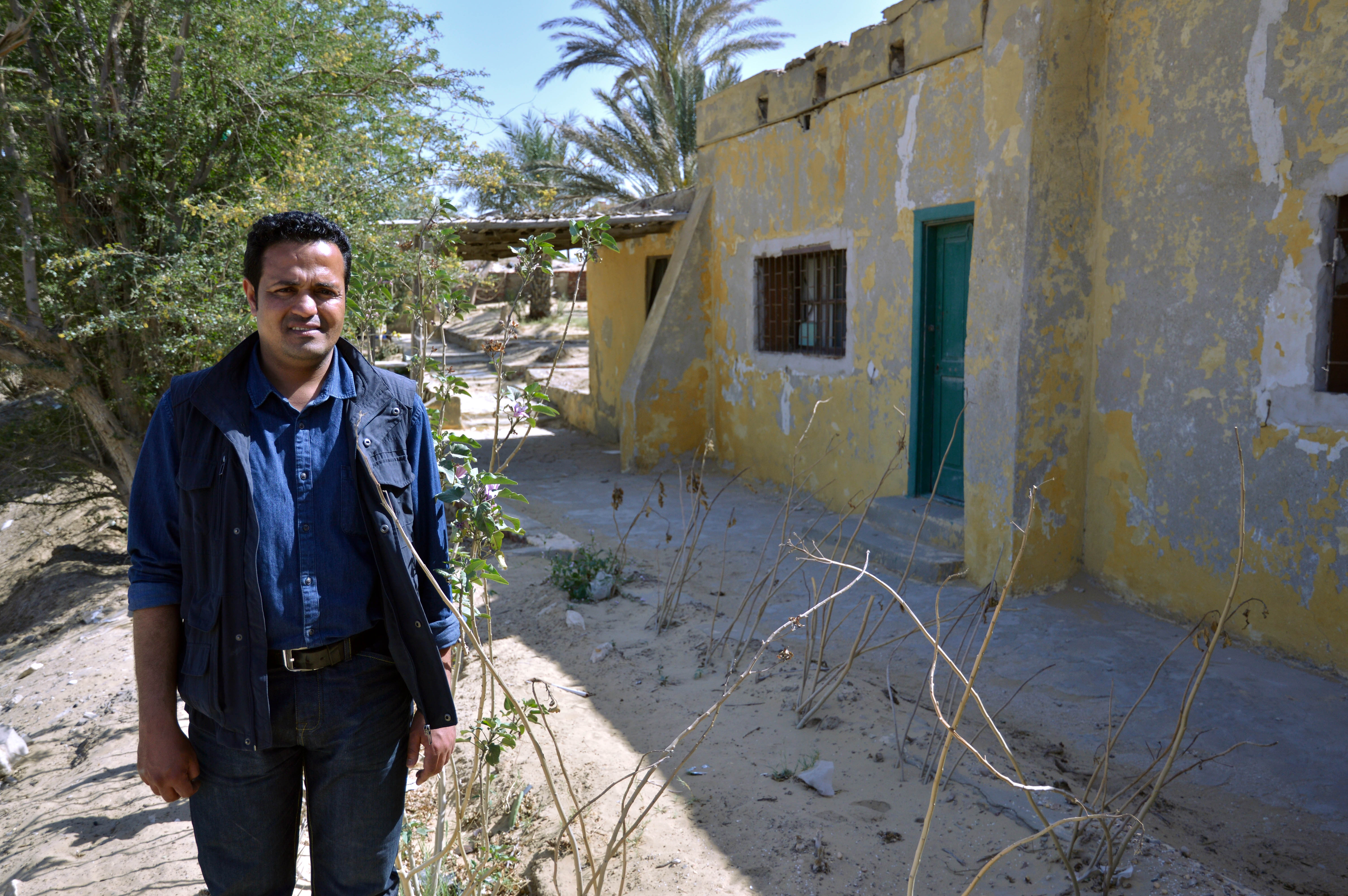
My photo of the EES’ then Cairo representative, Dr Essam Nagy, outside Beit Emery in 2015. I was on a somewhat lunatic adventure trying to follow Emery’s quest for the tomb of Imhotep at the time – see here.

I was lucky enough to visit the house while it was still in use but only once, in 2005, while the EES Survey of Memphis team led by David Jeffreys was mid-season. But reading Sue’s book, I wish I’d been able to spend more time there. Her account is utterly charming, with vivid descriptions of the work, the house, the staff, including Gabr el-Khuruby, colleagues from other missions including the legendary Jean-Phillipe Lauer, and the local population in the surrounding villages of Saqqara itself, Abusir, Mit Rahina and so on. I remember meeting Gabr, who came to be mentioned in EES Committee meetings, as ‘fodder for Gabr’s donkey’ used to appear in the Survey of Memphis budget every year, much to everyone’s amusement.

There’s a great romance, for me anyway, to Sue’s stories of coping with a spartan life in the desert, of striding across the sands in the early-morning mist, of moonlit walks home from another mission’s house, and of a very British ‘make-do’ way of getting on with things. Sue’s book brings the whole experience to life in a way that archaeological reports do not, and reminds me very much of the classic accounts of this kind including Mary Chubb’s Nefertiti Lived Here or Dilys Powell’s Villa Ariadne. It makes me thankful to have experienced something similar in houses elsewhere in Egypt, but I wish I’d been able to spend more time at Beit Emery.

Full disclosure, Sue is a friend, but even so I’m not going to be shy in recommending this book, which you can order here. I gather the proceeds will be going to the Petrie Museum so it’s all for a good cause too!


Harry Smith the day I interviewed him for the EES’ Oral History Project in 2009.

The book is also a celebration of Sue’s long collaboration with Professor Harry Smith, Emery’s successor as (Amelia) Edwards Professor of Egyptology at UCL and director of the Saqqara work, who died last year: https://www.theguardian.com/science/2024/nov/07/harry-smith-obituary

Harry was another of the giants of our field, and another friend. I didn’t feel the need to say anything publicly when he died last year knowing that, as he was such a great and celebrated figure, others would pay him far better tributes than I could. But for the record, he was one of the sweetest and most modest people you could ever hope to meet despite his gargantuan achievements as an archaeologist and a linguist (most Egyptologists are one and not the other, few are both), and as an author, a teacher and a mentor. Shortly after I started working for the EES I was looking for a topic for a paper to present at the third Current Research in Egyptology (CRE) conference and decided to make use of the slides of Professor Jack Plumley, a Copticist who has succeeded Harry’s teacher, Stephen Glanville, as professor of Egyptology at Cambridge, which had just arrived at the Society’s offices. Plumley’s main connection to the EES was that he’d been director of its excavations at Qasr Brim in Nubia. The trouble was I knew very little about Nubia or the Society’s work there so my boss, Patricia Spencer, suggested I ask Harry, who had directed the very last archaeological survey of Lower Nubia before it was flooded, and worked with Emery at Buhen before rejoining him at Saqqara.


Harry Smith (L) and Aly Hassan aboard the Nubian Survey boat in 1961. Available online via the EES’ archive at flickr.com. Courtesy of the Egypt Exploration Society. Further information and photos are here.

Despite my being a total know-nothing, and Harry one of the most senior figures in the field, he graciously agreed to meet me in the EES’ favourite pub, The Lamb on Lamb’s Conduit Street in Bloomsbury. We both had fish and chips (which Harry paid for) and he told me one great story after another. I got several lectures and a short article out of that conversation. A few years later, at Sue’s suggestion I think, I interviewed Harry again, this time on tape, for the EES’ Oral History Project and you can hear some of those same stories in Harry’s distinctively careful and understated voice via the EES’ YouTube channel, e.g. here and below:

I was delighted when, a few years, ago, Harry published a written account of his time working in Nubia, Nubian Memoirs – another great read.

Over the years, we stayed in touch, and almost up to the very end of his life Harry was still writing short notes in his instantly recognisable handwriting, often in reply to queries I had sent most recently about Emery’s search for Imhotep, the story of which formed the first chapter of my Lost Tombs book. Recently I came across an incredibly touching message that Harry had written when my mother died in 2010. I treasure these notes now. How lucky I am to have known him. And Sue! And how lucky we are now to have Sue’s account of her work with Harry and the house they, Emery and so many others lived and worked in.

Thank you, Ken Kitchen

Professor Kenneth Kitchen, the great scholar of ancient Egypt and the Near East passed away recently.


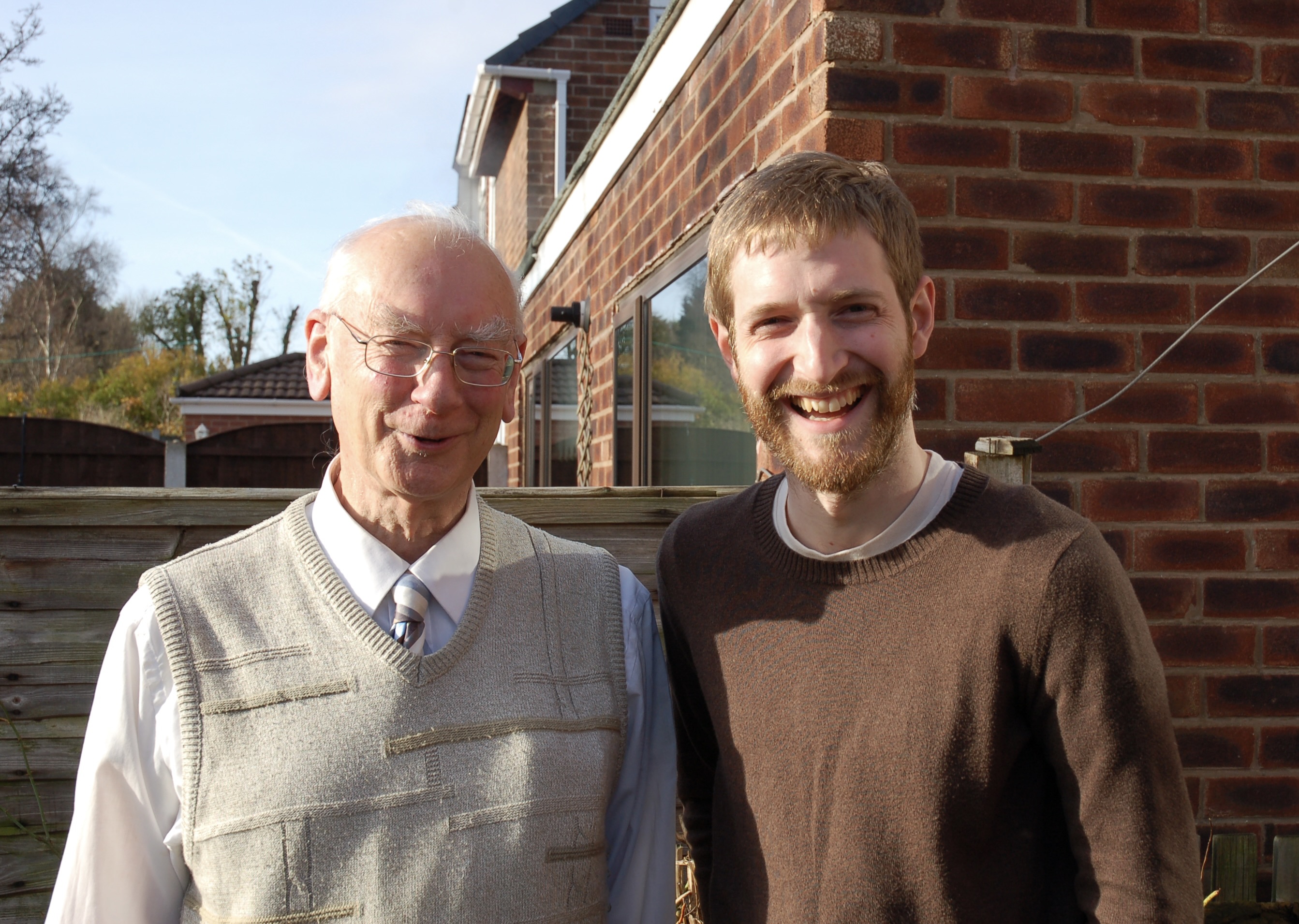
Me and Ken in his back garden in Woolton, Liverpool in November 2008.

I’ve been fortunate enough to get to know, to some extent, most professional Egyptologists in the UK in the last 25 years or so. Sadly we have lost some very highly regarded members of the community in the last year or two including Professors Barry Kemp, Geoffrey Martin and Harry Smith. I knew them all personally. Others have written eloquently about their lives and achievements and doubtless much will be written about Kenneth Kitchen (see e.g. here). In his case I wanted to add a personal appreciation to let the world know that I will be forever grateful to him for the support he gave me at a very difficult moment, without which I’m not sure I’d still be doing Egyptology.

Ken was a giant of the field. He was the author of numerous books, articles and reviews, and must have taught thousands of students at the University of Liverpool where he spent his entire career from the day he started his studies as an undergraduate. Two of his publications have become indispensable research tools, known universally to specialists by their abbreviations: KRI for Kitchen, Ramesside Inscriptions, his comprehensive, hand-drawn anthology of hieroglyphic texts of the 19th and 20th Dynasties; and TIP (although Ken himself referred to it as ‘Thip’) for The Third Intermediate Period in Egypt which gathers and organises a vast amount of information on the 21st to 25th Dynasties which, although his interpretations have now been challenged, has advanced our knowledge of the period enormously by giving a coherence to the evidence that it never had before.


Front cover of Prof Kitchen’s ‘Thip’.

The story of my friendship (I think I can say that?) with Ken is one of having my perceptions drastically altered. I first came across him as a contributor to the Channel 4 television series ‘A Test of Time’ in which he was cast as the antagonist, opponent of the revisionist chronology of the series’ presenter, David Rohl. Watching the show at face value it was hard not to be taken with Rohl’s exciting new ideas, and persuaded by his argument that the establishment – represented by various scholars including an unimpressed Jean Yoyotte, but mainly by Ken – was simply uninterested in listening to any new ideas. I was a very keen undergraduate at the time the show was broadcast, and loved every episode. In my memory of it Kitchen came across as a sour old man, with wild, white hair and eyes half closed, every bit the bad guy to David Rohl’s younger, more charismatic outsider. At the heart of Rohl’s new chronology was the radical idea that the 21st and 22nd Dynasties had largely overlapped, lowering that dates at which everything before that time happened, with dramatic implications for the way we look at archaeological levels at sites around the ancient world. As the author of The Third Intermediate Period it was inevitable that Ken would embody the establishment theory that Rohl was trying to knock down.

By chance I had chosen to study at the University of Birmingham where the leading Egyptologist, Dr Anthony Leahy, was himself a specialist in the same period. I soon learned that David Rohl’s ideas were not taken any more seriously by Dr Leahy than by Prof Kitchen, and indeed most of the ‘pillars’ of the new chronology were ably dismissed in print by scholars such as Aidan Dodson soon after the TV series was shown. Kitchen’s book was indispensable for the study of the TIP and I had borrowed it from the university library on short loan so many times that when I was given a voucher for some new online bookshop called ‘Amazon’ I used it to buy my own copy. Leahy and Kitchen were by no means aligned however: Dr Leahy had offered his own radical revision of Kitchen’s chronology a few years beforehand. However, unlike David Rohl’s new ideas which had got a lot of publicity but little or no acceptance among scholars, Leahy’s revisions passed almost everyone bar a tiny number of specialists in the period by, but had not been rejected, and indeed his reconstruction is now accepted by Egyptologists as the best way of interpreting the evidence.

For more on the substance of the debate see my talk, ‘Egyptians, Libyans and Kushites: The Third Intermediate Period UNTANGLED!‘ and the notes here.

Ken had rejected Leahy’s revised chronology in the preface to the third edition of TIP in 1995 in typically robust style, describing various aspects of it as “entirely unjustified”, “wildly improbable”, “no factual basis”, “clear failure”, “All this is clutching at straws” …and so on. This was characteristic of Ken’s style in print: he could be a little dogmatic in hanging onto his preferred way of looking at things and was not afraid to treat alternative ideas with disdain. It always made for entertaining reading but perhaps didn’t endear him to those on the receiving end of all his scorn. I was told while still a student in Birmingham that Professor Kitchen could never be an external examiner for our students as he would simply put a line through the students’ submissions and write ‘WRONG!’ I have no idea if this was true or not but at the time it chimed with what I knew of him from ‘A Test of Time’.

I went on to do a master’s degree with Tony Leahy in Birmingham straight after my BA. My dissertation focussed on Twenty-fifth Dynasty officials in Thebes and the difference between Kitchen and Leahy’s respective reconstructions of the preceding TIP had a significant bearing on the way I looked at things. According to Ken Kitchen’s view, Thebes had been under the control of a line of kings based in the Delta for most of the period leading up to the 25th Dynasty. According to Leahy, Thebes had been independent. Naturally I chose to base my interpretations on Leahy’s reconstruction. After my master’s had finished, with aspirations to make a living in the field, I submitted an abstract based on my dissertation to the second Current Research in Egyptology (CRE) conference which would be held in January 2001, in Liverpool – home of Prof Kitchen. I was a young scholar of the ‘Birmingham School’ going into the lion’s den. At first I thought there would be no way Ken Kitchen would attend a student conference – he was too important and probably didn’t like young people (or anything very much at all, I thought). And then I discovered that he would be giving one of the keynote lectures, on the first day. Oh no, I thought, he will be there… But then he probably wouldn’t stay to listen to the students give their papers, would he..?

Anyway, when it came to Ken’s turn to give his talk, a few hours before mine, he was nothing like what I’d been expecting. Tall, full of energy, and loads of jokes! Wow, I thought, he’s funny, and not at all like the nasty little man I’d come to expect. Still, I knew from his writing that he did not like anyone disagreeing with his ideas so of course I was still very much hoping that he wouldn’t be there for my talk. When my turn came I looked round the room and couldn’t see him so I relaxed and got on with reading my paper, safe in the knowledge that no-one would know what I was talking about…

At the coffee break afterwards, feeling relieved that it was all over, I was having a nice chat with someone when suddenly from behind me there was a sort of minor explosion, a ‘HELLO!’, and a hand thrust itself forward for me to shake. It was Prof Kitchen, full of enthusiasm and encouraging comments. He told me he had really enjoyed my paper and asked if I could give him the reference to an article on a scrap of evidence that had recently revealed the existence of a previously unknown Fourth Priest of Amun. I couldn’t believe it… Everything I had been led to believe in Brum was wrong, Prof Kitchen turned out to be a lovely, kind and supportive man.


Going through old photos with John Johnston in between interviews for the EES’ Oral History Project.

I had already started working for the EES by the time of the conference and saw him semi-regularly on the scene after that. I got to know him much better a few years later in 2008 when he became the first interviewee for an ‘Oral History of Egyptology‘ project which we had recently started at the Society. John Johnston, a former student of Ken’s in Liverpool and an EES Trustee by this point, suggested Ken would be the perfect candidate and so, armed with newly purchased recording equipment, we travelled up to Ken’s home where we stayed for the weekend to record the conversations, John asking the questions, me manning the equipment.

Prof Kitchen talks about the beginnings of his Ramesside Inscriptions for the EES’ Oral History Project.

Ken was a very gracious host, providing comfy (if VERY dusty!) bedrooms and cooking our meals. This despite almost every spare inch of his house being given over to his work, mostly to his enormous collection of books, which were everywhere. He talked and talked, about everything from his childhood and how badly affected he was by the Second World War, how he set his heart on Egyptology and his entire family moved to Liverpool – to the house in Woolton where John and I stayed – to support him. He talked about this career of course, and his current daily routine. He had probably been retired for around twenty years by this point and yet he was still dedicating almost all his waking hours to a series of publications projects, mostly philological, involving texts and languages from around the ancient Mediterranean world, not only Egypt. He had a staggering capacity to read ancient languages, and to assimilate knowledge of an incredibly broad range of cultures. How any one person could become so expert in so many peoples and places is a marvel and very humbling. He was frustrated however that didn’t have as much energy as he used to, and couldn’t get through as much. Still he did eventually find time to re-tell some of the stories he told us during the interviews in an autobiography, In Sunshine and Shadow (2016).


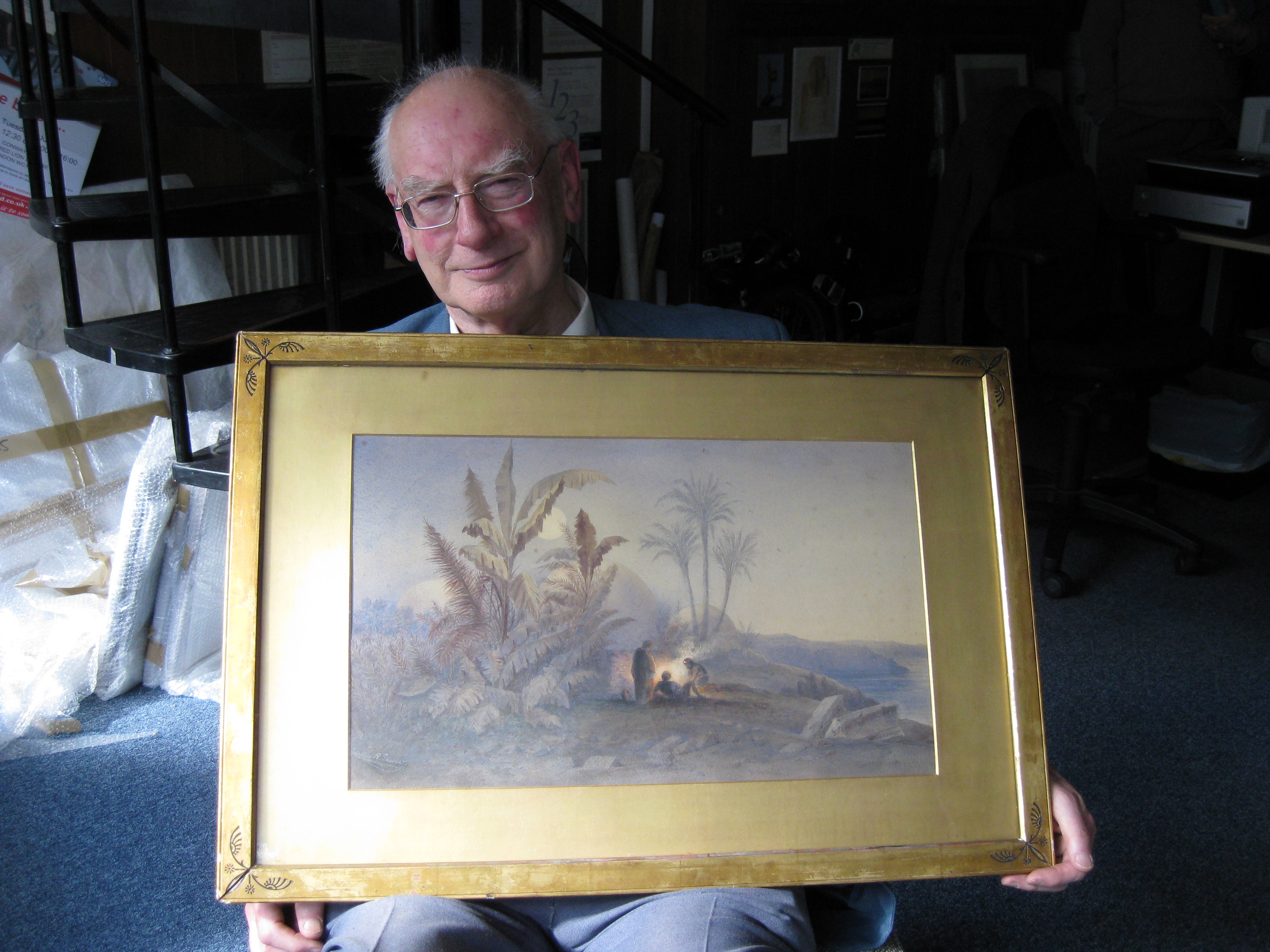
Ken with the painting by Amelia Edwards which he generously donated to the EES (see here).

He was a generous supporter of the EES and donated a painting made by Amelia Edwards to the Society for its collection in 2009. If I remember rightly it had been given to him by Rosalind Moss of the legendary ‘Porter and Moss’. He came to London on several other occasions during my time at the Society to give lectures and seminars and, on one very memorable occasion, travelled down to meet a group of our ‘scholars’ from Egypt. They were quite bowled over to meet the great man. A creature of habit, he always stayed at the PEN Club near Russell Square, and I remember from a few occasions in restaurants that he ate very quickly, his knife and fork rushing busily around the plate, and always asked for apple juice.


Prof Kitchen and I with four of the six EES scholars in 2015, L-R: Yasser Abdelrazek, Ahmed Neqshara, Mohamed Abuelyazid, me, Ken, Hesham Hussein.

Anyway, to the main reason why I wanted to write about Prof Kitchen.

I went through a pretty tough time around 2009-2011. I’d had a bad experience doing my PhD: politics at the EES had meant that I’d had to go somewhere other than Birmingham for my doctorate; my new university had changed my supervisor several times, and none of those I’d been given had provided the support I was hoping for (or any at all really). Although I’d finally submitted my thesis in summer 2009, a few months later I’d had a bad viva and was asked to go away and do some more work on it (‘major corrections’). A few days before the exam my mum had, out of the blue, been diagnosed with a very serious form of leukaemia and I was really looking forward to passing my PhD, getting it out of the way and giving the family some good news. I didn’t have the emotional bandwidth to deal with not passing, and having to go back and do more work on it. Mum was in hospital for the next ten months and eventually died in September 2010. I felt so let down by the university, my supervisors and by the examiners (well, the internal examiner) that I was very tempted not to re-submit. My great fear was that I would fail at the second attempt (you only get two gos) and I didn’t think I could take the humiliation and sense of having failed at my chosen subject.

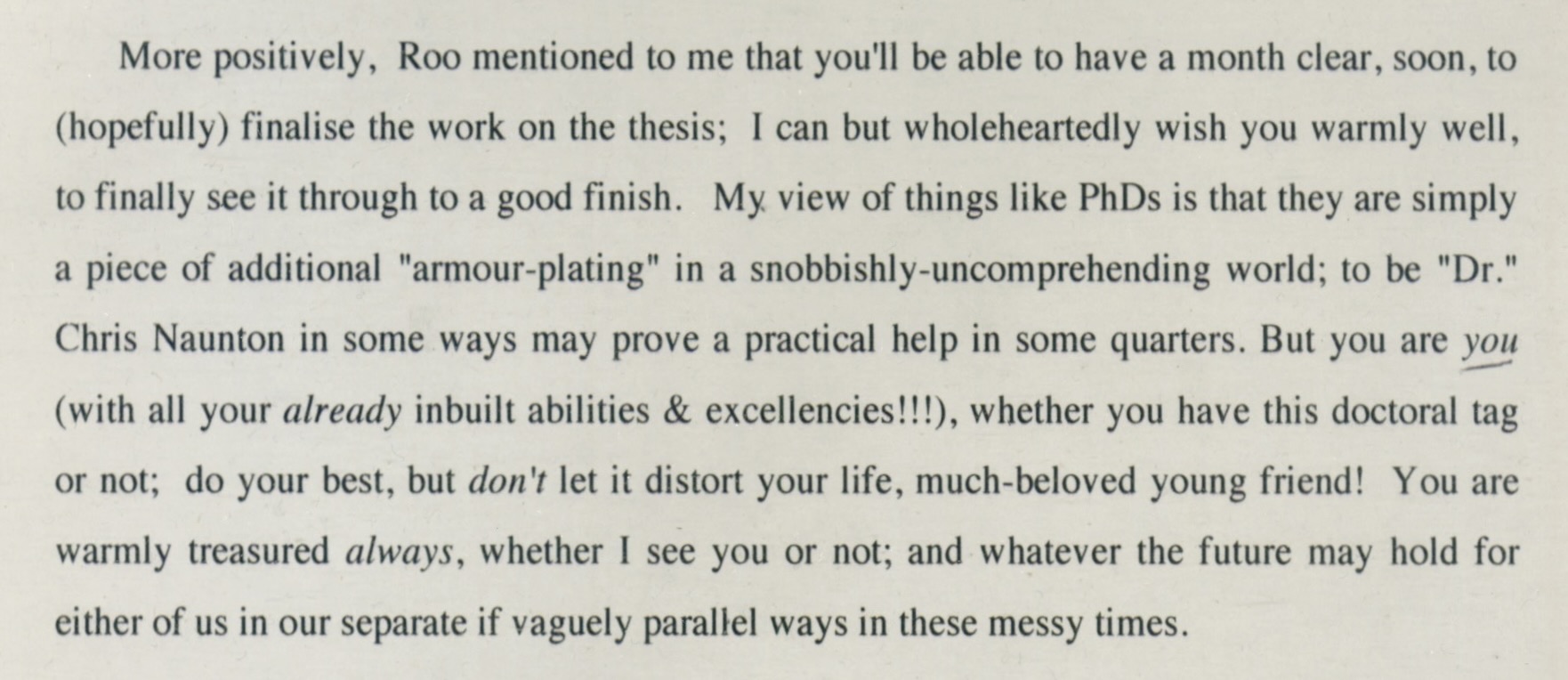
I don’t remember talking to him about this but Ken must have known I was thinking of giving up. In summer 2011 I was finally working on my thesis again. Ken called the office to talk to me about something but was told that I was taking some time away to get the writing finished. He wrote me a letter. A perfect letter.


A part of Ken’s letter (now in a frame): “My view of things like PhDs is that they are simply a piece of additional “armour-plating” in a snobbishly uncomprehending world; to be “Dr.” Chris Naunton in some ways may prove a practical help in some quarters. But you are you (with all your already inbuilt abilities and excellencies!!!), whether you have this doctoral tag or not; do your best, but don’t let it distort your life…” 

It strikes me that rarely in any circumstances has anyone ever shown so clearly that they know exactly what I’m feeling, and said exactly the right thing to make me feel better. As a giant of our field, what he said about me and my work carried a lot of weight. I was already very fond of him but I’m still awed, even now, by the perceptiveness of his understanding of what I was going through, and ability to say just the right thing. I got nothing like this from my university supervisors. It’s a rare gift to have that understanding, and a rare soul who takes the trouble to help another person like that, and I will be forever grateful that I was the beneficiary of it.

Ken’s great legacy will be his enormous contribution to scholarship in so many fields. He really was a giant and he will rightly be remembered for that. For me he started out – before I met him – as a nasty little man, but became a twinkle-eyed, charming, effusive, warm and funny friend – as soon as I came across him in person. I’m sure I won’t be the only person with stories like this but I wanted to share this one because to me, more than anything else, he was just a wonderful person.


“Do the best as you can for yourself and help the other.” Thanks to Hesham Hussein (seen here at Doughty Mews with Ken) for the reminder of this phrase of Prof Kitchen’s.

Thank you Ken.

Tomb of Thutmose II FOUND!

Well, this is exciting…

In a press release posted by the Luxor Times to social media on Tuesday earlier this week, the Egyptian Ministry of Tourism and Antiquities (MoTA) has announced the discovery of the tomb of pharaoh Thutmose II, by an Egyptian-British mission led by Dr Piers Litherland.

Screenshots from the Luxor Times post on Facebook: https://www.facebook.com/luxortimesmagazine

When things like this get announced I’m often asked for comment by the media. The discovery of new material – which is happening all the time, incidentally – there are dozens, maybe hundreds, of projects working the field in Egypt every year and they’re not all finding nothing! – is always interesting, but if I’m really honest I’m often not that excited and sometimes don’t have much to say. Press releases are often full of hyperbole but light on really good information; what can one say about the latest discovery of a cache of brightly coloured coffins without knowing much more about the circumstances of the find, the details of the material? ‘They are very pretty, yes…’

This week’s announcement is a bit different. The tomb of a king does not come up very often (although more on this below), and having written a book about the Lost Tombs… of various pharaohs it’s of particular interest to me. And as I’ve been asked to give several interviews about it this week I thought it was about time I got my thoughts together. Here goes…

What do we know?*

Most of the information that follows here comes from Litherland, P, ‘Has the Tomb of Thutmose Il been found?’ in Egyptian Archaeology 63 (2023), 28-31 – note the publication date – more on this below!


The Western Wadis. The map is taken from my talk on the subject and the possibility that Herihor might have been buried in the area, which is online here.

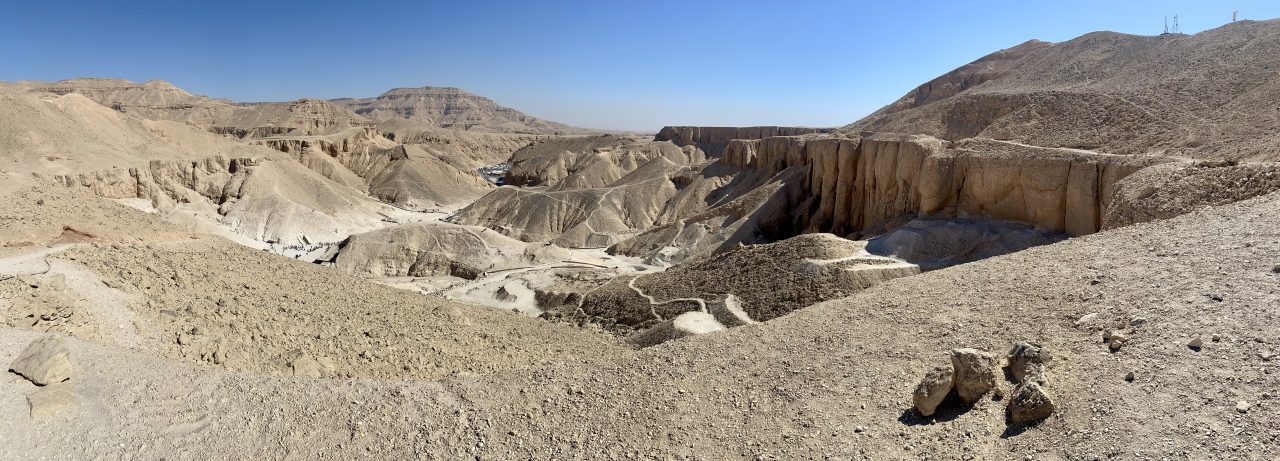
The tomb has been designated C4 by the discoverers, and is located in a wadi, long known as ‘C’ which is part of the remote ‘Western Wadis’ region, approximately 2.45 km from the Valley of Kings (my Google map showing the area is here). The tomb is rock-cut, and comprises two corridors and four roughly rectangular chambers of varying sizes. It has suffered badly from repeated flooding and is now in a very poor state of preservation. The floor of the corridor was coated in white plaster, and although little decoration survives, a small section of a starry ceiling – a distinctive feature of pharaonic tombs – has survived, along with traces of a khekher frieze. Fragments of the Amduat (‘what is in the netherworld’) – the main feature of the decoration of kings’ tombs at this time – have also been found.


KV 35, tomb of Amenhotep II. The twelfth hour of the Amduat with a khekher frieze and the very edge of a starry ceiling visible above.

Of the burial equipment, fragments of alabaster vessels belonging to Thutmose (deceased) and mentioning his Great Royal Wife (and half sister), Hatshepsut have been recovered, but little else: no sarcophagus, canopic equipment or shabtis. It seems the the king’s body was interred here as the presence of “large quantities of typically early 18th Dynasty ceramic plates, bowls, lids, amphorae and white-washed storage jars” (Litherland (2023), 31) would suggest, but also that the tomb was badly damaged by flooding only a few years after the king’s death and that his burial was therefore moved, leading to the suggestion that there may be another, as-yet undiscovered tomb nearby.

One of the team’s archaeologists, the very experienced Mohsen Kamel, was quoted in The Guardian (‘Archaeologists discover first pharaoh’s tomb in Egypt in more than a century’) as saying: “The possible existence of a second, and most likely intact, tomb of Thutmose II is an astonishing possibility.”

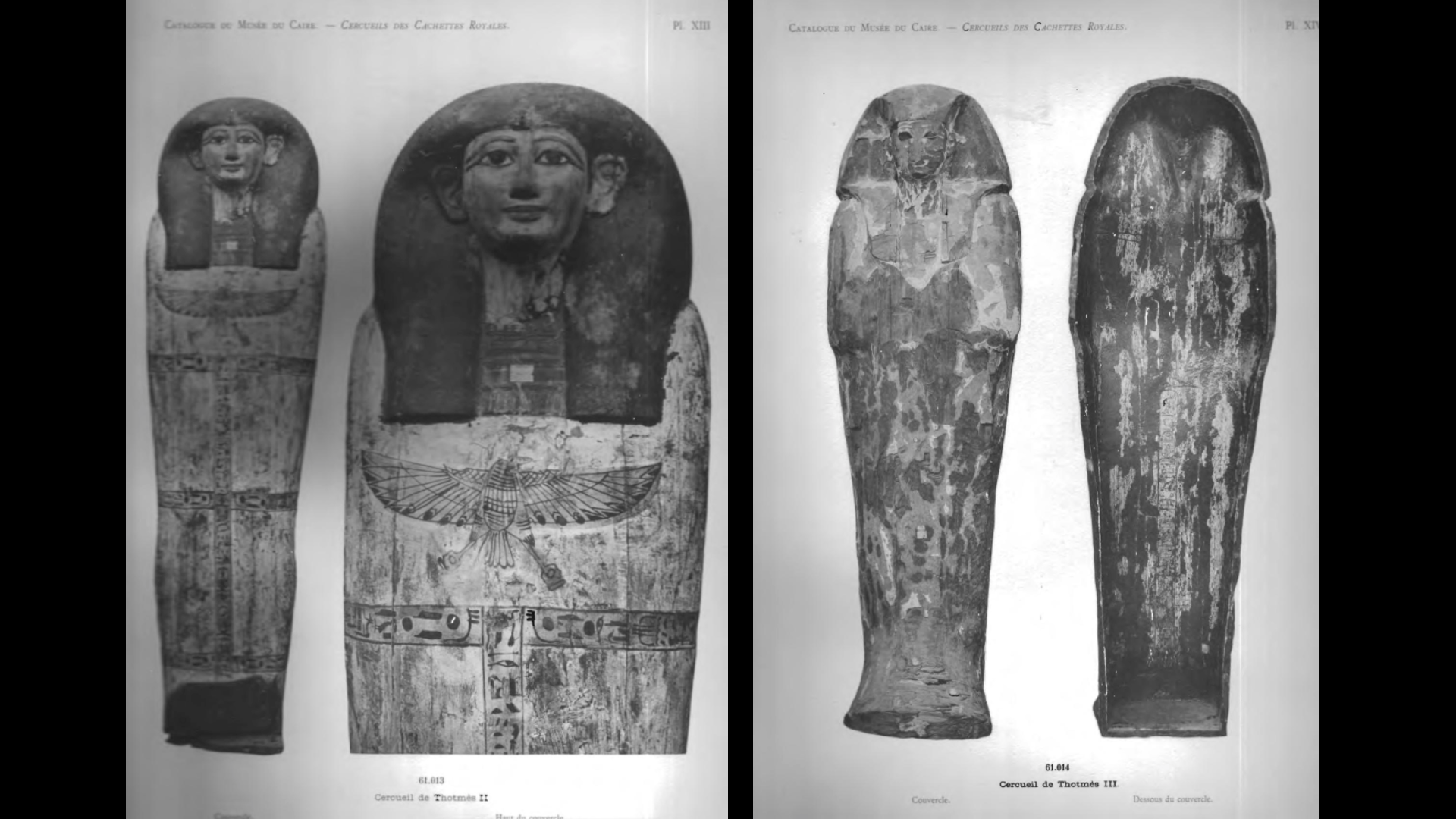
It seems very unlikely that any second tomb would be found intact however, as we know that the mummy of Thutmose II was removed from wherever it had been laid to rest when, towards the end of the New Kingdom, the mummies of almost all pharaohs of the period were removed from their tombs and re-buried in two secret caches. Thutmose’s mummy was found in tomb TT 320 (‘The Royal Cache’) in the late 19th century and is now on display in the National Museum of Egyptian Civilisation in Cairo. As part of the caching process the burial equipment of the kings was stripped of any precious materials, probably as Egypt’s rulers needed to reclaim the wealth that was tied up in the precious metals and inlays of the coffins, jewellery and other items the kings were buried with. (More on this in my talk here).


L: the coffin of Thutmose II discovered in the ‘Royal Cache’ tomb TT 320. R: the coffin of Thutmose III showing clear signs of an adze having been used to scrape off any gilding and with inlaid eyes removed. Both images from Daressy, G, Catalogue général des antiquités égyptiennes du Musée du Caire N° 61001-61044. Cercueils des cachettes royales (1909) which is freely accessible online via archive.org

So, even if there another tomb of Thutmose II to be found somewhere, it’s very unlikely that it will be any more intact than any of the other royal tombs found in the Valley of Kings and elsewhere. Nonetheless, it could yet yield some very exciting stuff including the sarcophagus, canopic equipment and shabtis mentioned above.

UPDATE (22 Feb 2025): an article headed ‘‘You dream about such things’: Brit who discovered missing pharaoh’s tomb may have unearthed another’ has been published in The Observer online today (here) in which Dr Litherland claims that the mummy thought up to now to be that of Thutmose II cannot in fact be his as it’s the body of a man of around 30 years old which is too old for Thutmose II. This is the basis for the argument that a second, intact, tomb of Thutmose II may yet be found. There is a certain amount of evidence that suggests that Thutmose II may not have reached the age of 30 but it’s not entirely conclusive. It’s also true that there was some mixing of the material found in the Royal Cache; but the coffin certainly bears Thutmose II’s name, as did the mummy itself which was labelled with identifying ‘dockets’. Perhaps those responsible for the caching got completely the wrong body… It still seems unlikely to me but if an intact tomb with Thutmose II’s mummy does turn up in the Western Wadis then I’ll be proven wrong!


The mummy identified as being that of Thutmose II – image from Smith, The Royal Mummies (available online here).

Significance?

Well, the discovery of the tomb of a pharaoh is exciting, full-stop. In this case, it’s the tomb of a king who lived and reigned during a celebrated period in Egypt’s history, the Eighteenth Dynasty, which, along with the 19th and 20th constitutes the New Kingdom. Egypt was the great power in the region at this time, its kings conquering other people and places all around through military force, bringing in great wealth in the form of annual ‘tribute’ (we’re in charge now so give us all your stuff). It was a time of great building, and famous pharaohs including several by the name of Thutmose, several Amenhoteps, Akhenaten, Tutankhamun and Ramesses the Great. It was also the time of the Valley of Kings, and most of the tombs of pharaohs of this period of five centuries or so are well known. Thutmose II’s was conspicuously missing, one of the great ‘Lost Tombs’ – until now.

The king himself remains fairly obscure however: we know of few monuments constructed in his name, and few inscriptions, and it seems likely that he reigned only for a very short time, perhaps as few as three or four years. He is, however, an important part of a very interesting period in Egypt’s history.

First, he was son of Thutmose I who is much better-known and one of the pharaohs who helped establish Egypt’s dominance in the early New Kingdom. His son and successor, Thutmose (III), would rule for 54 years and became perhaps the greatest warrior pharaoh of them all. In between the great campaigns of Thutmose I and Thutmose III we get one of the most fascinating stories in Egyptian history: that of Thutmose II’s half sister, Hatshepsut, who he took as his Great Royal Wife. Thutmose III succeeded his father when he was very young leaving Hatshepsut in charge of the country initially as regent, but at some point during the early years of Thutmose III’s reign she assumed the role of pharaoh.


Hatshepsut, her skin of the red colour usually used to depict men and wearing a divine beard. From her temple at Deir el-Bahri and now in the Egyptian Museum, Cairo.

Evidence from early on during this time shows Hatshepsut adopting more and more of the trappings of kingship but only gradually, as if easing herself into the role while navigating the challenges of doing so as a woman in what, by convention, was a role played by a man. Initially she was shown as a woman but with the full titulary of pharaoh, but eventually she would even adopt male features such as the divine beard. After her death her image and names were deliberately erased, and she was omitted from later king lists, her reign deliberately forgotten.


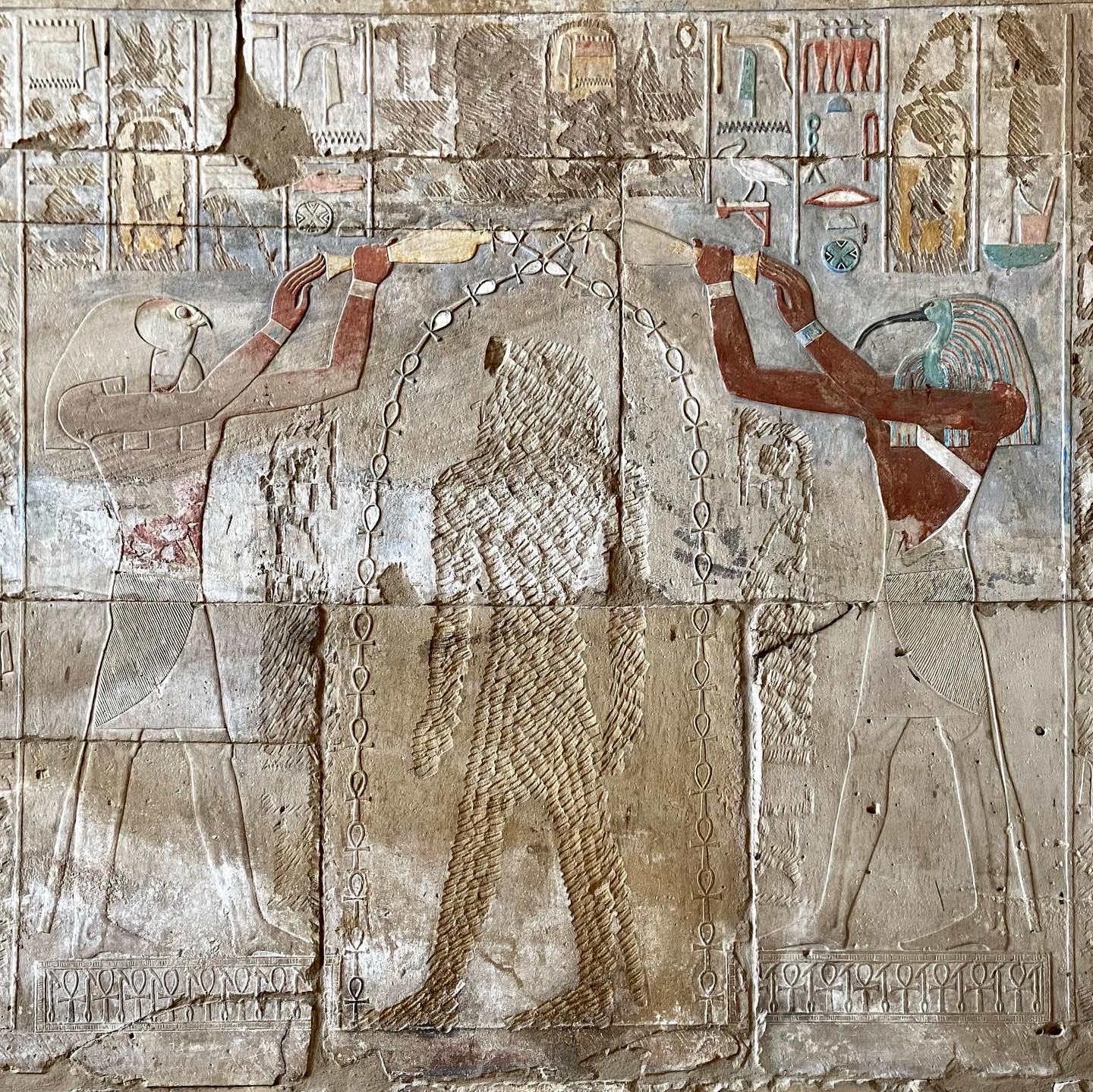
Hatshepsut being purified by Horus and Thoth, her image and names erased so carefully that the hieroglyphs can still be read(!). Room XII close to the granite sanctuary of Philip Arrhidaeus at Karnak.

As scholars began to piece the story back together in modern times they originally concluded that she was a megalomaniac who seized the opportunity to take the throne while her step-son was too young to stop her, but this has now been challenged. The erasure of her memory seems not to have started until some twenty years after her death, and was perhaps related to a struggle to decide who would succeed Thutmose III as he grew old. He was eventually succeeded by Amenhotep (II) who was not directly related to Hatshepsut – was there a rival from her side of the family whose claim would be weakened by the removal of any trace of her reign? In any case, Hatshepsut’s elevation to pharaoh may simply have made most sense as she was ruling the country anyway while her step-son was incapable. Peter Dorman’s article ‘Hatshepsut: Wicked Stepmother or Joan of Arc?’ (here) explains all this in more detail and more eloquently. He concludes that “Both Ineni’s biography and Senenmut’s graffito indicate that Hatshepsut was the effective ruler of Egypt from the death of her husband. The question was not the wielding of power but how to represent it in a public context.”


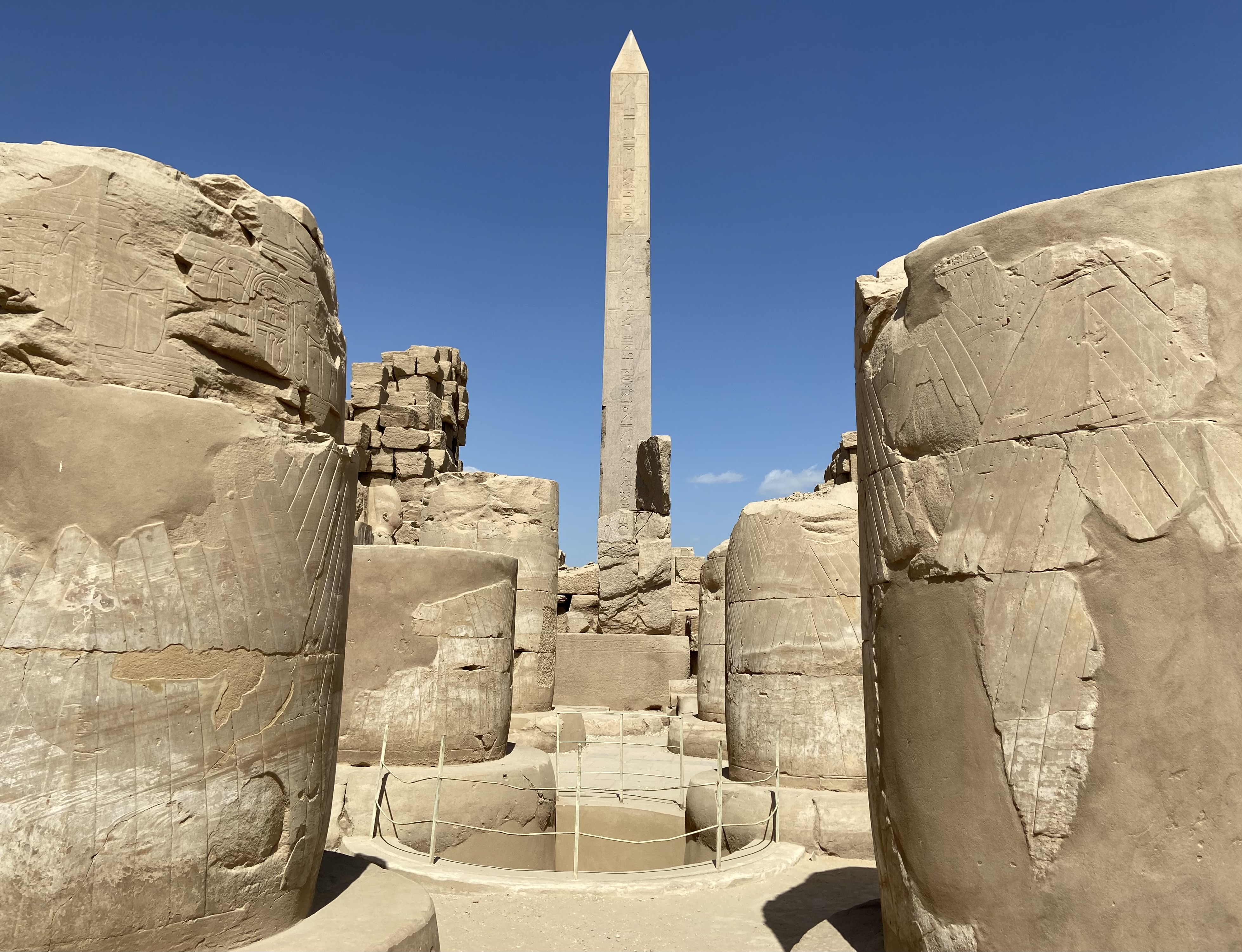
The northern obelisk of Hatshepsut at Karnak, the largest ever erected in its day, still standing more than 3,000 years later.

Hatshepsut’s reign was a great success, notably in her building achievements – the largest obelisks ever erected in Egypt up to her time, an exquisite bark shrine at the centre of the Egyptians’ most important temple at Karnak, and her mortuary temple which architecturally is perhaps the finest Egypt ever produced, a superbly harmonious marriage of man-made design and the natural landscape.


Hatshepsut’s spectacular mortuary temple at Deir el-Bahri.

In seeking a narrative that would legitimise her she emphasised her connection to her father Thutmose I in the temple decoration, but also created the story of her mother’s union with the god Amun-Ra, the divine conception and birth of pharaoh which would become one of the enduring myths of Egyptian kingship.

Hatshepsut was a great pharaoh and her husband Thutmose II’s main claim to fame is probably that he was married to her!

Development of the royal tomb in the early New Kingdom

For me, the most interesting aspect of the new discovery is that it adds to what we know about the development of the royal tomb in the early New Kingdom. This was a time of transition. The Valley of Kings is one of the defining features of the New Kingdom, it was the burial place of almost all the pharaohs of the Eighteenth Dynasty, and all those of the Nineteenth and Twentieth with the exception of that of Ramesses VIII whose tomb hasn’t yet been identified, and Ramesses XI for whom a tomb was cut in the Valley but which was never used as the king had decisively lost control of Thebes to the Chief Priest of Amun by the end of his reign, which itself marks the end of the New Kingdom. The Valley didn’t come into use until a few reigns into the Eighteenth Dynasty however. During the preceding Seventeenth Dynasty, the kings were buried somewhere in the Theban foothills in the area we now call Dra Abu el-Naga. Their tombs were excavated in the mid-19th century and several coffins and other equipment removed, but the precise location of the tombs themselves has subsequently been lost – as they were undecorated and are now stripped of any identifying material – thanks to the archaeologists – we’d have no way of knowing, even if they did turn up (perhaps they already have). The location of the tombs of the first two kings of the period, Ahmose I and Amenhotep I, remains unknown (on the latter see my Lost Tombs book and this lecture). The first tomb to be cut in the Valley of Kings was probably the one we now refer to as KV (Kings’ Valley) 20. This appears originally to have been the tomb of the third king of the period, Thutmose I, which was subsequently also used by his daughter Hatshepsut after she became pharaoh. The burial chamber was found to contain a sarcophagus for each of them.


KV 20. Plan created by the Theban Mapping Project, via https://thebanmappingproject.com.

Searching for the perfect location for the royal tomb

This was not Hatshepsut’s first tomb. For members of the elite, construction of a tomb would be well underway during your lifetime and before she ever became pharaoh a tomb for Hatshepsut was cut in Wadi A, not far from Wadi C where the new tomb has been found. Her ‘cliff tomb’ was identified in 1916 by Howard Carter in proper Indiana Jones circumstances: Carter was dispatched by night into the desert to investigate a discovery by two rival groups of looters who were fighting over the spoils. Access required abseiling down a cliff on a rope – Carter cut the looters’ rope preventing them from escaping and then lowered himself down to see what was going on… (More on this in my talk on Herihor and the Western Wadis here).

This prompted Carter to look into the possibility that there might be other tombs in the area and this led him to the map the western wadis and thereby to lay the groundwork for future investigations although he made no further major discoveries there himself (might he have returned had he not been somewhat diverted by the discovery of the tomb of a certain Tutankhamun a few years later?). It was already known that the ‘tomb of three foreign wives of Thutmose III’ – which was found to contain a lavish haul of treasure – was in the area, and Carter found hints that Hatshepsut’s prominent daughter Neferure was also buried nearby. Many years later John Romer had proposed that the tomb of the Twenty-first Dynasty priest-king Herihor might be found in the area and testing that hypothesis appears to have been part of the original reason for the current project. They found no tomb of Herihor (and did find evidence to dismiss the idea) but they have made a string of very interesting discoveries, demonstrating that the Western Wadis were far more important as the burial place of members of the 18th Dynasty royal family than had previously been suspected.

The discovery of the tomb of Thutmose II raises the stakes even higher of course.


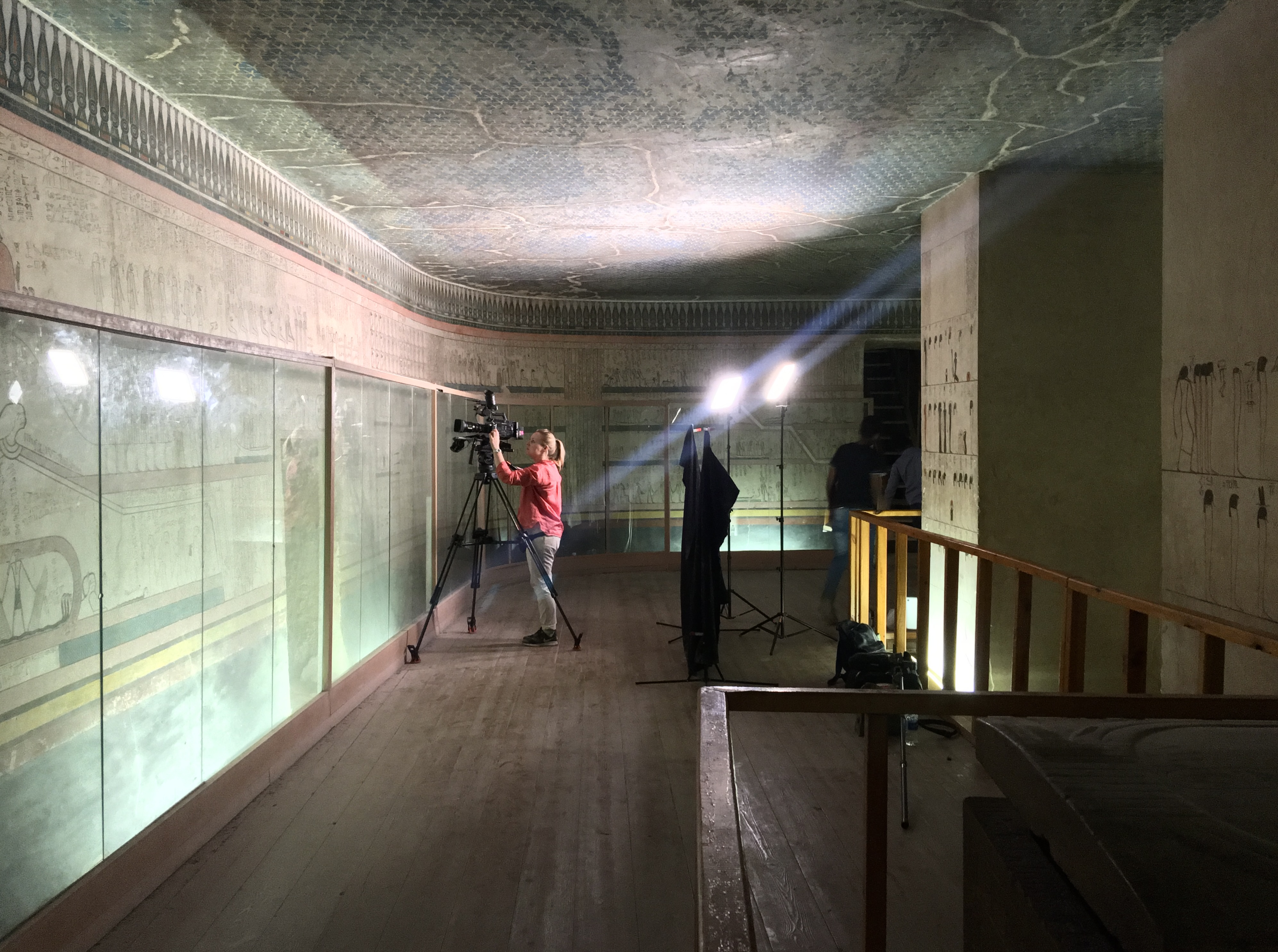
Filming inside KV 34, tomb of Thutmose II’ son and successor Thutmose III, in 2019. Note the Amduat, khekher frieze and starry ceiling, all present also in the newly discovered tomb C4.

So, Thutmose I was buried in the Valley of Kings. We also known that Thutmose III was buried there in KV 34. Another tomb KV 38 is very similar in design to KV 34 and appears to have been cut for Thutmose I. For many years it was believed that this was his original tomb but it is now thought that he was first buried in KV 20, and that his grandson Thutmose III subsequently cut a tomb very similar to his own and reburied his grandfather in it, perhaps to reclaim Thutmose I and separate him from Hatshepsut.

Now, with this new discovery, it seems that while Thutmose I sought to break new ground by having himself buried further away from the Nile Valley than his Seventeenth Dynasty predecessors in the high desert wadi that would become the Valley of Kings, Thutmose II decided to go elsewhere, he and his wife Hatshepsut building tombs for themselves even further away from civilisation in the Western Wadis. It’s not difficult to imagine the king’s surveyors and architects searching for the perfect place, well away from would-be robbers perhaps. As the autobiography of Thutmose I’s architect Ineni says: “I inspected the excavation of the cliff-tomb of his majesty, alone, no one seeing, no one hearing.”

The archaeologists’ discovery that tomb C4 was so badly affected by flooding perhaps suggests this taught the ancients that this wasn’t quite the right place. Perhaps this and Hatshepsut’s desire to associate herself closely with her father prompted her to move back to the Valley of Kings, a decision that was then followed by Thutmose III and almost every pharaoh for the next few centuries.

Not New

A few points of clarification… The suggestion that C4 is the tomb of Thutmose II is not new – it was published by Dr Litherland in the EES’ magazine Egyptian Archaeology in autumn 2023, and this is, as far as I know, by far and away the best source of info on the new discovery. Indeed it’s not clear to me what exactly is new since the time that article was published. The Luxor Times post says:

“…as excavations progressed this season, new archaeological evidence confirmed that the tomb belonged to King Thutmose II. Further analysis revealed that it was Queen Hatshepsut, both his wife and half-sister, who oversaw his burial.”

But the 2023 articles concludes with: “a tomb of Thutmose Il does indeed seem to have been found”.

The 2023 article contains photos and plans of the tomb, and of the main identifying features including the starry ceiling, Amduat fragments, and alabaster vessels. If you want to read more about the tomb I highly recommend getting a copy of EA 63 (via the EES, here)!

False Claims

More importantly, there are a number of claims made in the Luxor Times post which are simply not true:

The idea seems to have taken hold that this is ‘the first royal tomb to be found since the discovery of King Tutankhamun’s tomb in 1922’ (as per the Luxor Times post), but there have been several others, most notably the royal tombs of Tanis (1939 onwards) in which the burials of several kings of the Twenty-first and Twenty-second Dynasties were found (more on this in my talk on the ‘Silver Pharaohs’ here), but also including the tomb of pharaoh Senebkay at Abydos in 2014 (see here), and the pyramid of princess Hat______ at Dahshur in 2017 (see here, and another talk, ‘Egypt’s Lost Pyramid’, here).


The tomb of pharaoh Senebkay which was discovered in 2014.

Elsewhere in the same post the Luxor Times says tomb C4 is the ‘First Royal Tomb Found in Theban Necropolis Since the Discovery of Tutankhamun’s Tomb in 1922’ (my emphasis). This would exclude the discoveries mentioned above, but not the family burials of two wives and a son of Amenhotep III that Dr Litherland’s team discovered in previous seasons.

It’s also claimed that C4 is ‘the last missing royal tomb of Egypt’s 18th Dynasty’. But even if one takes ‘royal tomb’ to mean the tomb of a pharaoh here and not simply that of any old member of the royal family, then what of the tombs of Ahmose I, Amenhotep I, Ankhkheperure of the late Amarna Period (whether you believe there were two pharaohs who took this name or only one there’s at least one further missing tomb) the location of all of which remains unknown? Perhaps I’m being too pedantic…

In any case, it’s great news and Dr Litherland and his team, our colleagues at the MoTA and all concerned deserve our warmest congratulations!

Further reading / watching

As per the references above I wrote about a lot of what’s discussed above in my book Searching for the Lost Tombs of Egypt.

I’ve also given talks on several of the subjects discussed: I’ve just made my lectures on Herihor (and the western wadis) and the caching of the Royal Mummies freely available to all. Talks on some of the tombs of the Eighteenth Dynasty that remain ‘missing’ are available already including Amenhotep I, and Ankhkheperure / Smenkhkare / Nefertiti / Neferneferuaten (and how to make sense of this confusing mass of evidence and names!). My most recent talk was on Hatshepsut (the day the discovery of C4 was announced!) – this one is available to channel members only but all are very welcome to join of course!

UPDATE: The above previously stated in error that Hatshepsut ‘cliff tomb’ was found in Wadi C, when in fact it lies in Wadi A. This has now been corrected. My thanks to Ted Loukes (via Facebook) and @aigineus (Instagram) for pointing this out!

Pyramid Mythbusting: further thoughts…

*I first drafted this piece in February 2023 but I’ve only just got round to finishing it, as a complement to my recent talk on ‘Pyramid Mythbusting’.

Three phenomena I’ve been able to observe over the twenty odd years I’ve been working in the field:

1) Giza and the pyramids, specifically the Great Pyramid and how it was built, probably attract more attention and more theorising than any other aspect of Egyptology. This isn’t surprising: the great pyramid is one of the very best known achievements of the ancient world, it is self-evidently a staggering achievement, it’s very old and we still don’t entirely understand how it was built.

2) This last thing naturally encourages people try to solve the mystery by applying their own ideas and skills often drawing on specialisms beyond Egyptology such as engineering or geometry. This is also unsurprising, but much more curiously, I’ve also often found that the people with these ideas don’t want to commit to telling you what they are on the phone (which I used to have to pick up when I worked at the EES) or on email. Their ideas are secret and can only be imparted via a meeting in person. They assume that Egyptologists spend our lives scratching our heads, desperately trying to figure out how the Egyptians erected such vast and precisely constructed monuments when in fact most of us are more likely to be absorbed in our own particular research interests (for how much longer after his invasion of Egypt did Piye continue to reign? Did Ankhkheperure Neferneferuaten and Tutankhamun rule alongside one another?) or just as likely consumed but something much more mundane (what time do I need to get to the station? Do I need to buy that book or should I try and find it at the BL?). They think that we will be desperate to know what they say when, sorry folks, new – and secret – ideas about how the pyramids were built are ten-a-penny and generally aren’t any more persuasive than any other ideas, they often involve specialisms I have no expertise in and therefore cannot apply any expertise to, and they’re impossible to prove in any case due to an absence of any real evidence. 
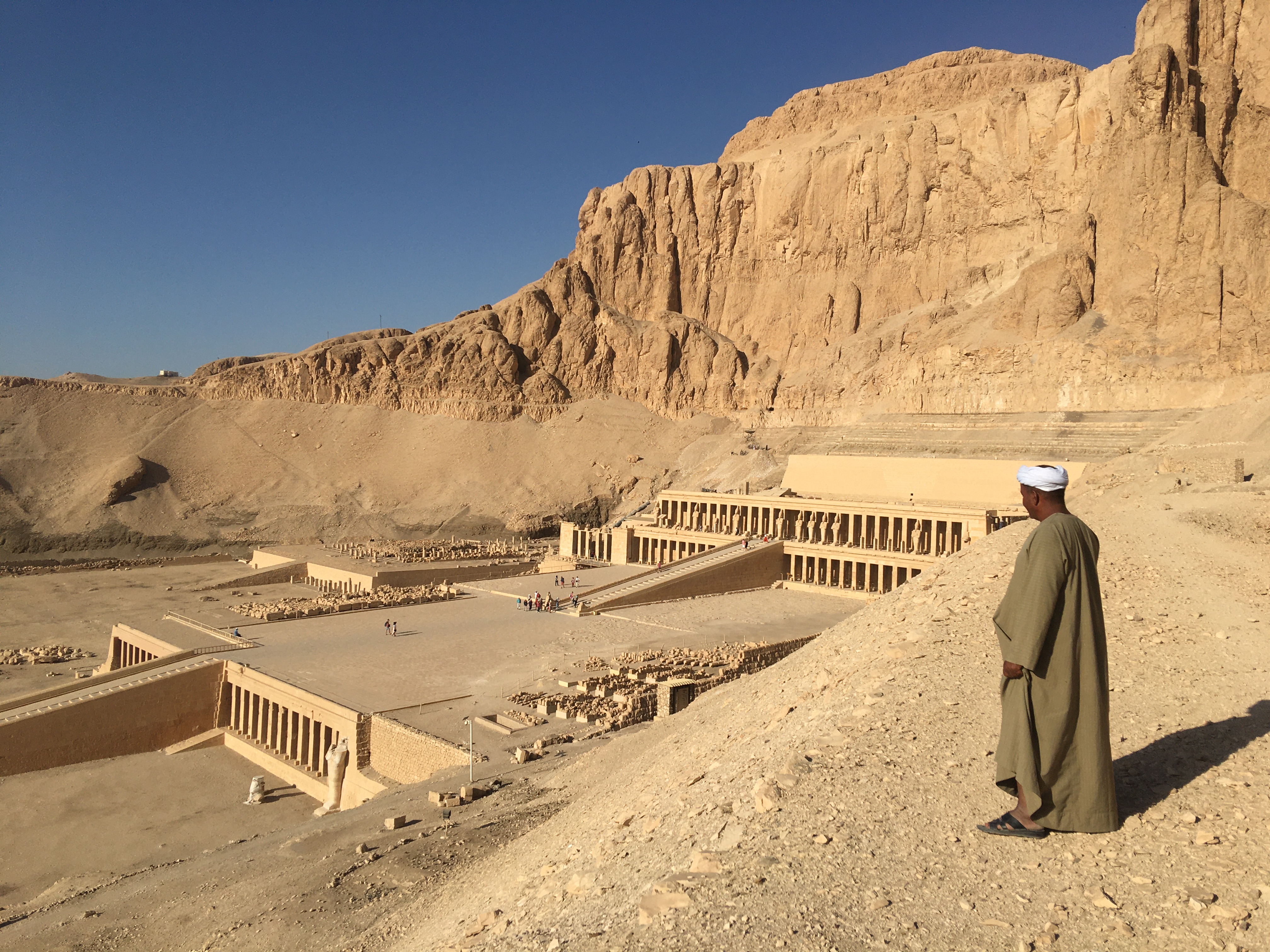
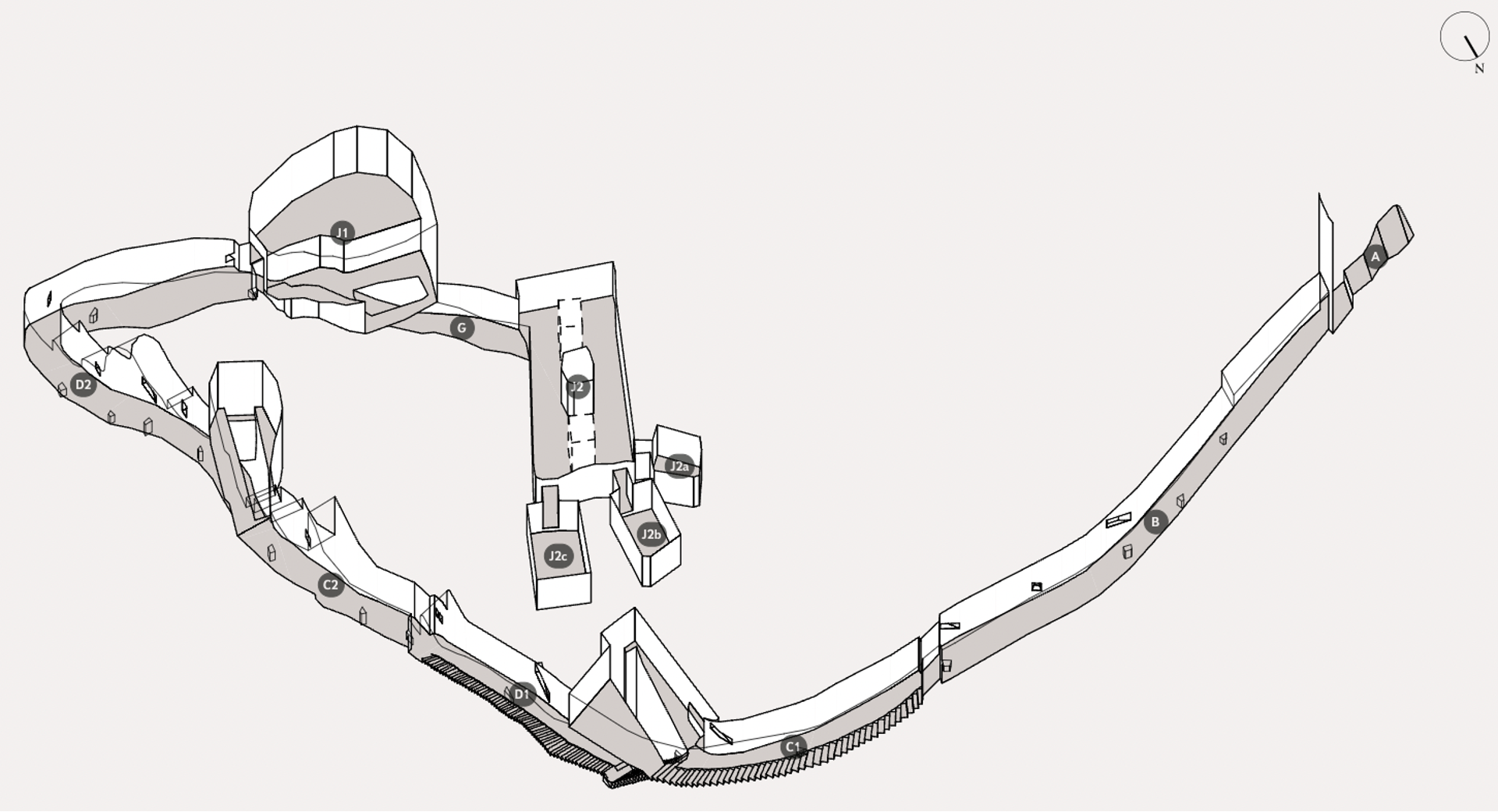
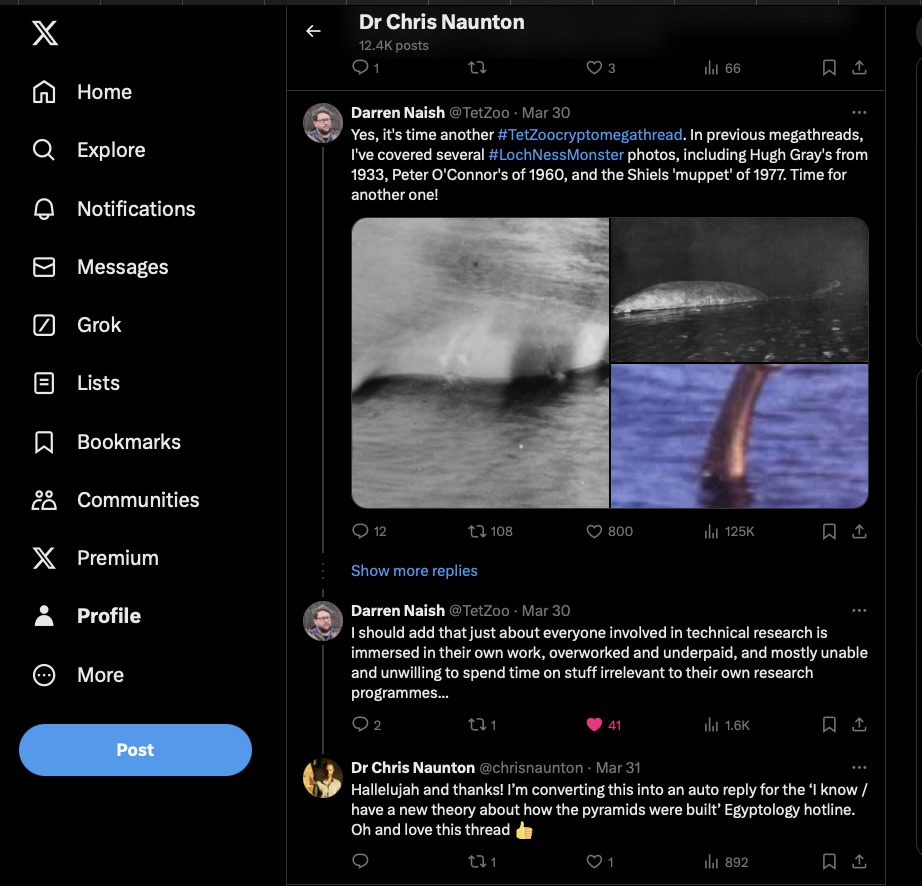
I was delighted to see similar thoughts posted to X/Twitter not long ago by Dr Darren Naish who works in another field that attracts a lot of pseudo-science and alternative ideas:

”I should add that just about everyone involved in technical research is immersed in their own work, overworked and underpaid, and mostly unable and unwilling to spend time on stuff irrelevant to their own research programmes…”

See here to read the original post on X/Twitter.

Unfortunately, when I’m unable to to engage with these ideas it probably only encourages the third of these phenomena:

3) The notion that Egyptologists are involved in a conspiracy, that we somehow know that the conventional wisdom about the date and nature of the Great Pyramid is wrong but that we don’t want to allow THE TRUTH to come out because… We stand to lose our reputations / credibility / cushy jobs etc.

I was moved to write this as a response to some comments made about some photos I posted of a part of Giza I hadn’t visited before – the Central Mastaba Field – which attracted a lot of attention from people with ‘alternative’ ideas about the things I had been looking at. I found myself rather frustrated about one or two of these comments (‘Why do you say it’s a tomb when there’s no evidence for it, you’re wrong.’ Me: ‘Well, actually…’) and wanted to try to explain why the conventional interpretation is actually very sound. I realised that doing so would take a while but could form the basis of a useful and, I hoped, interesting piece, and indeed this was the basis for my recent talk on ‘Pyramid Mythbusting’.

Calling monuments like this one in the Central Mastaba field ‘tombs’ attracted some frustrating comments at the time! The series of photos I posted starts here.

I think there is a wider significance to this because of the phenomena of ‘fake news’ and a general disregard for expertise in favour of ‘alternative ideas’, as if the conclusions drawn by experts on the basis of the accumulated empirical evidence, years of study, practical experience etc. are no better or more valid than anyone else’s.

Egyptology has had a very long association with alternative theories and I freely admit that some of them helped encourage my own interest in ancient Egypt. But conventional Egyptology is a serious scientific endeavour, led by empirical evidence. There are huge gaps in that evidence – that’s the nature of the study of people and civilisations far removed in time from our own – but any conclusions we draw about the ancient past are rooted in the evidence.

Experts are a good thing…

Egyptologists are experts. Part of the skill of being an Egyptologist is in knowing stuff. Ask me to name the kings of the 18th Dynasty and I will reel them off one by one from memory. There are loads of things I don’t know off the top of my head, but I know how to find what answers there are because I know the literature or at least how to find it. (For the pyramids see my recent guide to resources online and other reading, here). Where were the buildings of Amenhotep II at Karnak? I’m not exactly sure but I’d know to go to ‘Porter and Moss’ vol. II (‘Theban Temples’), and look up the index of royal names for the right king for the right pages in the Karnak section.

I don’t mind my expertise being questioned… But I’d want anyone reading my books, listening to me talk on TV or giving lectures, or reading captions to my photos from Egypt to know that, although I’m not infallible and I might make the odd mistake (ninth pylon, not tenth!), what I write and say is based on years of study and accumulated knowledge and an ability to justify my assertions with reference to the primary evidence.

From the 90s onwards, there has been a disturbing trend, particularly in pseudo-scientific television documentaries not only to advance such alternative ideas but at the same time to make baseless claims about ‘Egyptologists’ or ‘archaeologists’ being unwilling to examine new evidence or contemplate new theories. According to this narrative Egyptologists / archaeologists will always reject the new, exciting revelatory ideas proposed by the presenter because they (as above) don’t want to allow THE TRUTH to come out because… We stand to lose our reputations / credibility / cushy jobs etc. So when we say that no, we don’t think this new idea is credible i.e. because it doesn’t stand up to the evidence, this aspect of the programme’s case is proven: ‘ha, we told you, they don’t want THE TRUTH to come out!’

Egyptology could do better

Having said all this, I do think Egyptology bears some of the responsibility for alternative ideas gaining traction, as I explained on X/Twitter a little while ago:

X/Twitter user: Nobody knows if they were tombs though, I believe that is just guess work just like how they were constructed.

Egypttogists are pretty mainstream and finding any evidence that goes against history books could destroy someone’s life work.

Me: Hi, Egyptologist here. Had fun looking into all the alternative ideas w Dara [see here] for the TV but can confirm there’s a load of evidence -inc human remains- to show that pyramids were tombs (mainly 3rd-6th, & 12-13th Dynasty) & pretty much nothing to suggest anything else… (1/)

This isn’t my life’s work but the work of hundreds of specialists who have gathered the evidence from Giza, Saqqara, Dahshur, Abu Roash, Lisht, Meidum, Hawara, Lahun and many other cemetery sites (lots of burials of mummies and other bodies) elsewhere over the last century or so.

There is a vast body of info & literature on this & a large part of being an Egyptologist is about knowing the stuff to an extent but also knowing how to access refs to the evidence. This -w references to further literature- is an excellent starting point: https://www.amazon.co.uk/dp/0500051895/ref=cm_sw_r_as_gl_api_gl_i_6EKK7N6JM14K1Q629QM6?linkCode=ml1&tag=chrisnaunton-21

Thanks btw @HanYolo21 , your tweet perfectly shows how badly wrong things can go when we Egyptologists don’t do a good enough job of showing *why* we think what we do i.e. in this case pyramids = tombs because that’s by far the best interpretation of all the available evidence!

(Click here to see this exchange on X/Twitter)

I originally intended this post to address this issue by, as I said on X, showing *why* we think what we do. This has been overtaken by my talk now, but even if it means repeating myself a little my main points – formulated as alternative ideas, ‘myths’ – to be busted – were as follows:

Myth 1: The pyramids of Giza are much older than Egyptologists believe (4th Dynasty, c. 2550 – 2400 BCE)

No.

The arguments for an earlier date, including the ‘Orion Correlation’ and ‘Sphinx Weathering’ theories can be disregarded, as can the idea that it suspicious that there aren’t more inscriptions relating to Khufu in evidence inside the Great Pyramid – monumental tombs of the elite including those of kings, were usually not decorated at this time, contrary to the practice of later times, and the presence of graffiti naming Khufu is in keeping with the discovery of similar inscriptions naming other kings at other pyramids.

There is in fact no evidence for earlier activity relating to the pyramids and sphinx, while in support of the conventional view there are vast amounts of evidence to associate the construction of the three Giza pyramids with the reigns of Khufu, Khafra and Menkaura.

Slide from my talk showing one of the titles held by the official Qar and containing the name of the Great Pyramid, the ‘Horizon of Khufu’ which is written with a pyramid determinative sign.

Myth 2:
Construction of the pyramids is so incredible it can only have been achieved with technology now lost to us

No.

While what the Egyptians of the Fourth Dynasty achieved is almost incredible we have the evidence for almost every stage in the process – quarrying and cutting stone, transporting it, and lifting it into position. There are still gaps, but not enough for anything sensational to be required.

Scene from the tomb of Djehutyhotep at el-Bersha showing a colossal statue being hauled into position. Via Wikimedia Commons.

Myth 3: Pyramids were not tombs.

No, they were.

In their design, location, buildings associated with them, contents, and the decoration (of those that were inscribed) they conform absolutely to Egyptian tombs. They have been found to contain human remains, not intact mummies, but the proportion of tombs to have survived intact is vanishingly small.

Scene from the tomb of Ameneminet (TT 277, Luxor) showing two deceased individuals in upright coffins, attended by mourners, in front of the tomb entrance which is surmounted by a pyramid.

Myth 4: Egyptologists know ‘the truth’ but don’t want it to get out because… It will ruin their reputation / life’s work? Something more sinister?

There seems to be a belief among some of those with alternative ideas that Egyptologists are hiding something. On the contrary, the consensus view – the when, how and what of the Giza monuments – isn’t just a series of unsubstantiated claims and hypotheses but is, rather, built on masses of evidence, huge amounts of which are freely available for study online (see my guide to further reading for how to find it). Any alternative interpretations must show how this evidence can be interpreted differently, and cannot disregard it. It’s clear to me that at least some of those with alternative ideas, e.g. that the pyramids were not tombs, have not taken all the available evidence into consideration.

Central Mastaba Field, Giza with the top of the pyramid of Khafra in the background.

Thanks for reading, as always do let me know what you think in the comments!

Archaeology is sometimes best when it’s rubbish

*I wrote this several years ago, in 2016, and now can’t remember what my original intention for it was, but I never did anything with it. I came across it again recently and thought it was worth posting. Just a bit of archaeological whimsy but still…

I was listening to a very heated debate on the radio recently about the mingling – or not – of communities in certain parts of northern England. The central issue seemed to be that some groups leave their rubbish lying around outside their houses, while others are more rather more enthusiastic about keeping refuse out of sight. Those from the second group who were calling in to complain seemed to believe that there was a right or better way of doing things, and that ‘scruffy’ was unacceptable.

Modern activity – a goatherd and his flock – among modern and ancient detritus at an archaeological site in the Egyptian Delta.

This reminded me of a thought I often have in Egypt, whether pondering archaeological remains or wandering the modern streets. I dare say some of the callers on the radio might consider Egypt to be a bit scruffy. Household waste and other kinds of rubbish are generally more visible around the streets, but nobody seems to mind very much. Rubble from building works is often left uncleared, and indeed building projects are often apparently left unfinished. 

I visited a colleague’s excavations at the site of the ancient city of Bubastis recently. She had been saddened to find that the Egyptians of the New Kingdom had been very efficient in clearing away the remains of an earlier cemetery, as it meant we would never quite know what had been there during the earlier Middle Kingdom phase. I thought then of the build up of waste on Cairo’s streets, and how wonderful it will be for archaeologists in the future to dig this great city up and to find layer on layer of evidence of continuous human activity.  

I was also reminded that perhaps the greatest single discovery of ancient texts ever made came about thanks to the preservation of ancient rubbish heaps. The people of Ptolemaic, Roman and Byzantine Oxyrhynchus in the Faiyum region of Egypt had discarded their unwanted papyri in great heaps over a period of more than 1,000 years. When these were excavated in the late 19th and early 20th centuries the remaining scraps were found to preserve uncanonical gospels, tragic and comic plays, epic poetry, scientific treatises, and non-literary texts relating to everything from tax assessments to wills, letters and horoscopes.

When the dumps at Oxyrhynchus were excavated over a century ago they turned out to be full of thousands of fragments of ancient papyri which have provided a vast trove of information and are still being studied today. Image from Graeco-Roman Branch sub-archive (GR). GR.NEG.201. Available online the Society’s archive at flickr.com. Courtesy of the Egypt Exploration Society.

Of course recycling is an important part of modern refuse management, and this was also of relevance in ancient Egypt too. Essential parts of the funerary equipment such as mummy masks were made of a material called cartonnage, which was composed of layers of ancient linen or papyrus held together with plaster, and then painted. The papyri used were often recycled, having served their purpose as written surfaces and then been discarded. The texts they bear often survive although they are difficult to read. In the past this has led some to commit the heinous crime of destroying the cartonnage to get at the texts, but this in turn has now led to the development and application of new, multispectral imaging techniques that allow the texts to be read without the funerary equipment being damaged in any way.

Perhaps rubbish isn’t so bad after all.

New lectures on YouTube & channel memberships.

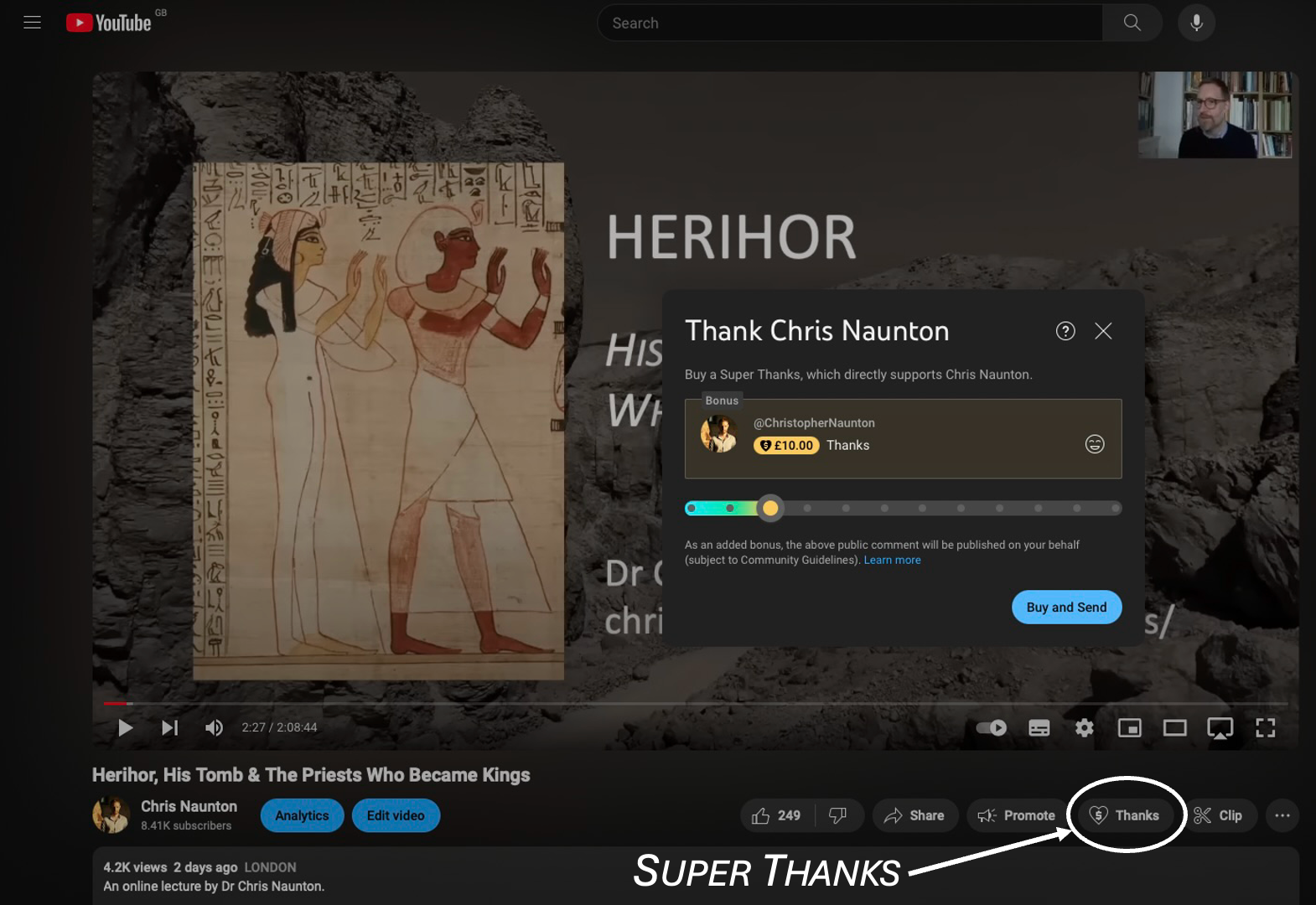
Hi folks, a little announcement: I’m going to be broadcasting my lectures via YouTube from now on. The first few of them will be freely available to all, and instead of paying the usual registration fee in these cases I’ll be encouraging you all to to make a small voluntary contribution via the ‘super thanks’ button (more on this below).

*UPDATE 28 August 2024: Lapis memberships are now available (see here).

Unfortunately I’ve had to increase the price of membership in this category: I hadn’t realised that I couldn’t just make up the prices – YouTube forces you to chose one of their options, and after much hand-wringing I’ve decided to go for a slightly higher amount than previously advertised, so Lapis membership will cost £12.99 per month. I am very sorry about this, I know that even the previous price (£10.99) would have been unaffordable for some of you. I would love all my lectures simply to be free to everyone, but I have to pay the bills(!) so either I charge what seems like a reasonable amount or I have to stop doing the lectures altogether. Thanks for your understanding!

I have also decided not to add a ‘gold category’ for now, as I cannot be certain that my schedule will allow me to offer the additional benefits. Again, I am sorry about this. YouTube encourages creators to add higher categories like this for anyone wishing to provide an extra level of support to creators and of course if you’d like to send an extra contribution you can still do via YouTube’s ‘thanks’ button or via ‘supers’ etc, and there’s also good old fashioned(!) PayPal as well.

I have adjusted the table below accordingly.

—–

From September 2024 I’ll be giving one new lecture each month and these will be available to channel members in the ‘Lapis’ and ‘Gold’ categories only. There will be three categories of membership altogether as follows:

Level 1 2 3
Name Alabaster Lapis Gold
Available from May 2024 September 2024 Tbc
Price £2.99 £12.99 £25.99
Benefits Badges Badges Badges
Emojis Emojis Emojis
Shout outs Shout outs Shout outs
Photos and updates Photos and updates Photos and updates
Exclusive access to new live lectures Exclusive access to new live lectures
Early access to recordings of the new lectures Early access to recordings of the new lectures
Exclusive access to the full lectures archive Exclusive access to the full lectures archive
Q&As / AMAs Q&As / AMAs
Private online chats
Meet-ups

Further details:

Level 1, Alabaster (£2.99 per month)

  • Badges and emojis: these are for members only and allow you to stand out in the chat during the live broadcasts.
  • This will allow me to identify members in the chat more easily and to give ‘shout outs‘ in reply to any posts
  • There will be a ‘members only’ area on the channel which I’ll be using to post exclusive updates – photos and videos etc from ‘behind-the-scenes’

Level 2, Lapis (£10.99 per month)

  • All the above perks.
  • Exclusive access to the live broadcasts of new lectures
  • Early access to recordings of the new lectures (members only for the first three months)
  • Exclusive access to the full lectures archive: I’ve made quite a few recordings of my past talks available online but I still have quite a few in reserve. Members will automatically get access to the complete back catalogue.
  • Q&As / AMAs: in addition to the lectures I plan to run a few discussion sessions, sometimes with colleagues, focussing on new discoveries, new books, or other topics that come across my radar or get suggested to me.

Level 3, Gold (£25.99 per month)

  • All the above perks.
  • Private online chats – small-group or one-to-one discussions online to discuss any particular topic you want to know more about.
  • Meet ups: to visit Egyptian objects or collections in the UK perhaps with a drink afterwards!

Schedule

In the next few months, I’ll be giving a first few lectures to test things out, as follows:

Alabaster membership will be available from May 2024 and members in this category will be able to enjoy the benefits of badges, emojis and shout-outs from that time onwards. Lapis and Gold memberships won’t be available until September 2024 when the first of the first of the members-only lectures – How to Read Hieroglyphs – comes around.

Background

Some of you might have seen the short video I posted recently, ‘A Postcard from Luxor’ which served as very preliminary announcement about the lectures I plan to give online from summer 2024 onwards.

Lecturing online became the biggest part of my work during the COVID lockdowns and has remained very important to me ever since. I wrote about this as the pandemic finally seemed to be coming to an end in early 2022, here.

Up to now, I have always used Zoom for this. It’s familiar to me and most of my audience, it’s easy to use, and allows me to set up an automated registration process and to charge a fee for each talk. However, since I began making recordings of some of my talks available via YouTube I’ve discovered there is another (bigger?) audience for what I do out there, and since Zoom now charges a much higher fee for its services while broadcasting via YouTube is free, I’ve begun to think about shifting over. I used a combination of Zoom and YouTube to broadcast my talk ‘Egyptology in an Hour’ last summer as an experiment to see how this might work and it seemed to go well, with a good number attending the live event, and more watching the recording – which was automatically and immediately available, afterwards and ever since.

The only snag for me was that YouTube offered no option to charge a registration fee, so in order that I can continue to earn something of a living from this kind of thing I’ve decided to experiment with a different way of doing things from this summer onwards.

Summer 2024 Onwards

Previously, in order to join one of my talks, you had to pay the mandatory registration fee of £6. In future you’ll now have a couple of options as regards how you access the talks, and how you support me if that’s something you’d like to do.

Some of my talks will be freely available, others will initially only be available to channel members.

The freely available talks will be just that, available to all for free, but for anyone who would like to make a contribution in return for access to the talk, as a way of supporting me, you can send a one-off contribution via the ‘super thanks’ button beneath the video. This gives you the option to select an amount to send (and I’ll be sure to let you know what amount I’d recommend!).

The other talks will be available only to members who pay a monthly subscription fee (which you can cancel at any time). Once the memberships are set up a a ‘Join’ button will appear next to the ‘Subscribe’ button on my channel.

Members will get access to the live broadcasts, which is when you’ll be able to send your hellos, questions, comments etc just as in the past with the Zoom events, and to the recordings for the first three months after that. In order to make sure members are getting good value for their money I plan to do one new lecture every month for at least six months, and longer if it seems this new way of doing things is working.

Scheduling

I will try to stick to a fairly regular schedule for the monthly talks but it’s likely that other commitments will get in the way from time to time. I’ll aim for something like the first Wednesday of every month at 6pm UK time (= 1pm EST) which I hope will suit as many of you as any one time possibly could. Of course the live broadcasts will be the time when I can interact with everyone, talk about the weather etc., but members will be able to watch the recordings at any time, and will still be able to leave comments, which I will reply to as soon as I can.

Currency

You’ll have noticed that I’ve given the (provisional) membership prices in pounds sterling. I think, depending on where you are in the world, the price will be converted to your local currency, and presumably rounded up or down, but I’m not sure about this yet. If anyone knows please get in touch!

Forthcoming Talks

In my little video announcement I committed to giving talks on the following subjects (I find making announcements like this is a great way of forcing myself to get things done!):


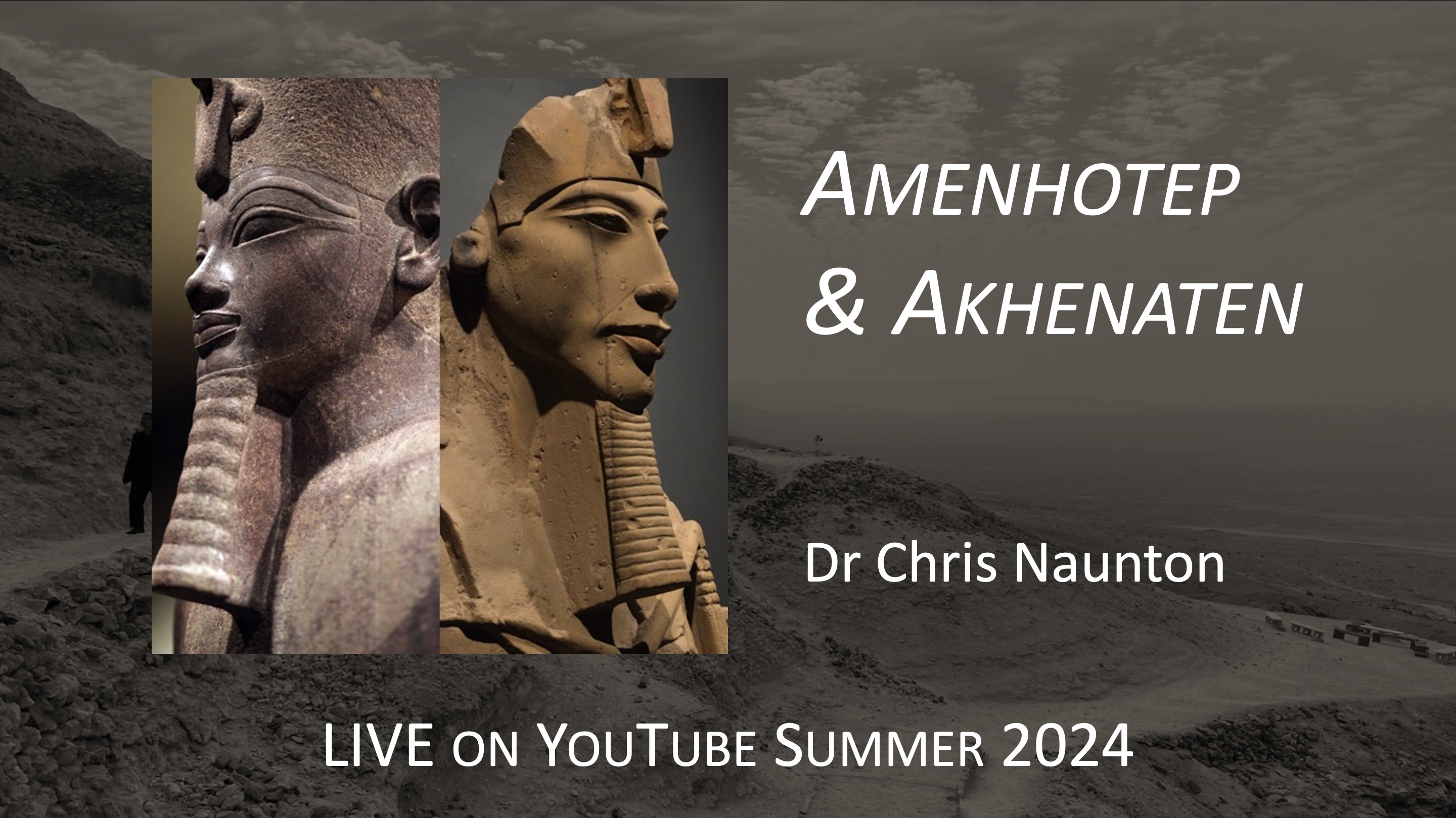
Amenhotep and Akhenaten10 July 2024, free to all.


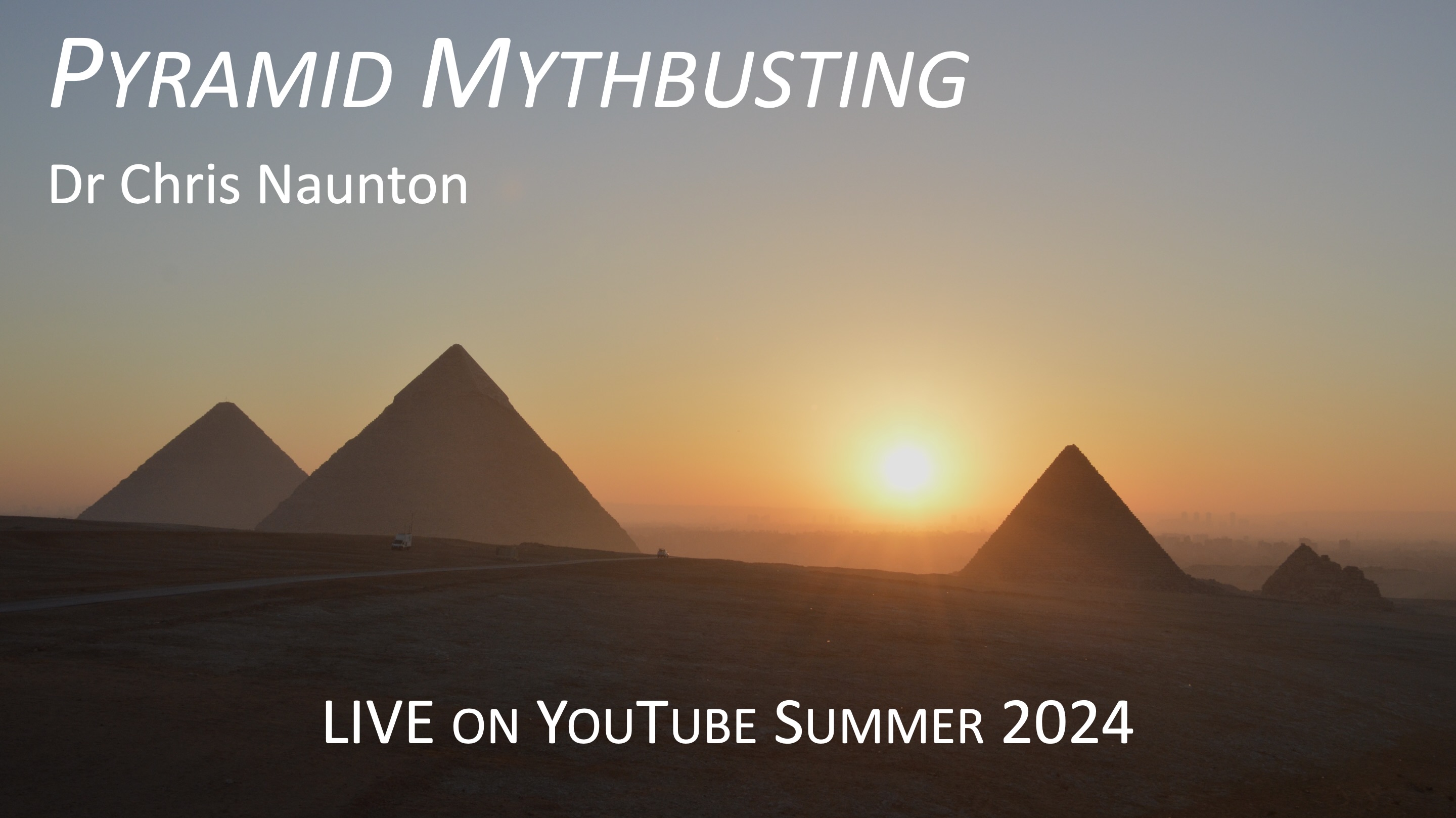
Pyramid Mythbusting7 August 2024, free to all.


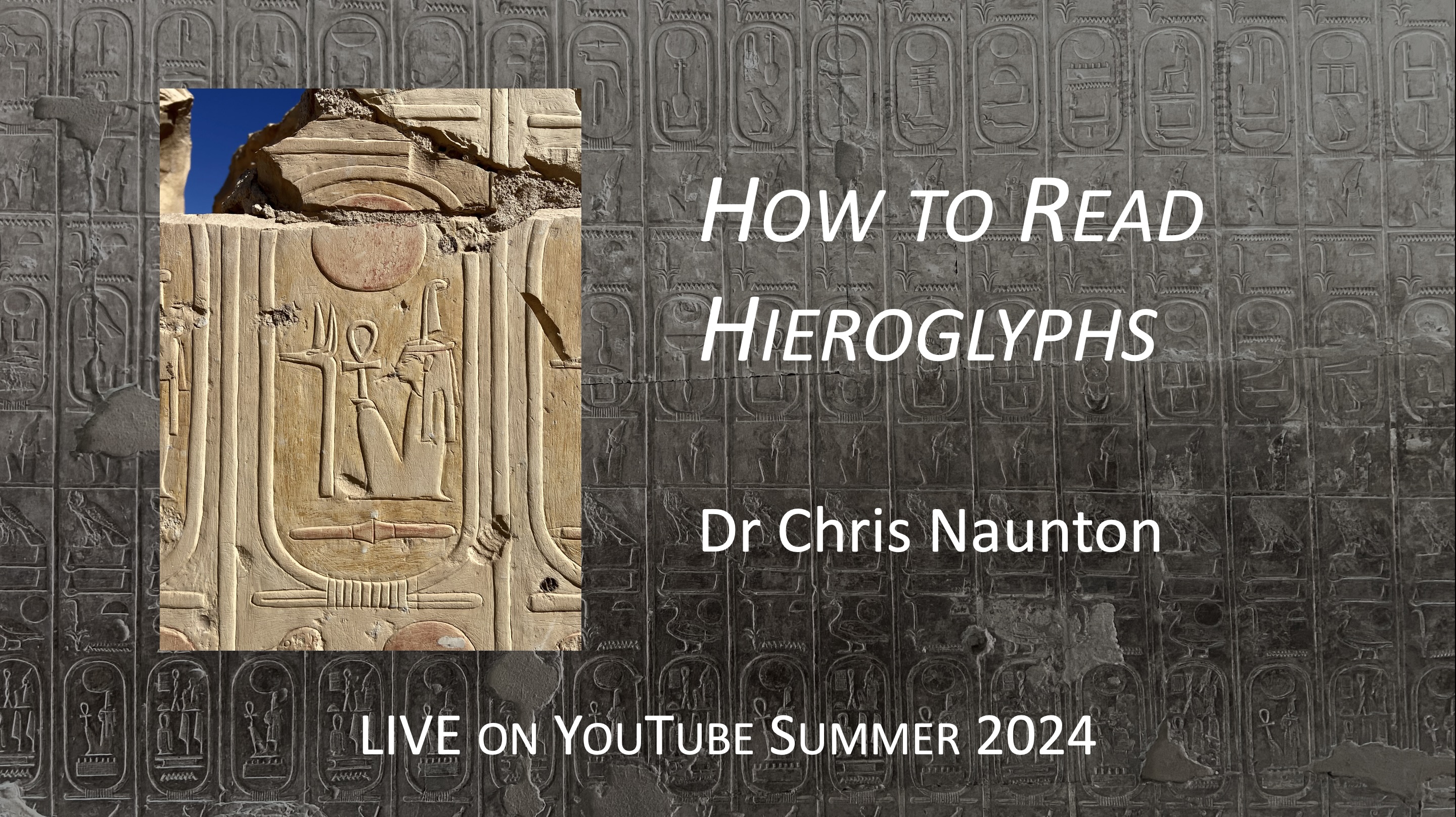
How to Read Hieroglyphs (and the Abydos kinglists)5 September 2024, members only.

I have a few more ideas for future talks as well. I’d like to cover a few parts of Egyptian history that I haven’t dealt with in any great detail before, as follows:

THE FIRST PHARAOH – Narmer and his famous palette
MISERABLE PHARAOHS – tough times in the Middle Kingdom
A GLORIOUS SCORE DRAW – Ramesses II and the world’s first peace treaty
TAUSRET and THE CHANCELLOR – the end of the 19th Dynasty
THE LAST PAGAN – Nesmeterakhem and the last ever hieroglyphic inscription

And I’d like to look in detail at a few monuments that particularly interest me including one or two non-royal tombs in Thebes, the evolution of the tombs in the Valley of Kings, and the enigmatic Osireion in Abydos.

I hope you’ll find there are a few things here that are of interest but of course I’d like to hear your suggestions too, and this is something we can discuss in future sessions online.

Getting Going

The first thing I want to do is to test the broadcast set up via YouTube, and to practice getting into the habit of mentioning all the things good YouTubers mention – the ‘like’ and ‘subscribe’ buttons, super thanks, and the forthcoming memberships.

I hope you’ll be able to join me as I’d really appreciate your feedback and encouragement! So here’s a date for your diaries:

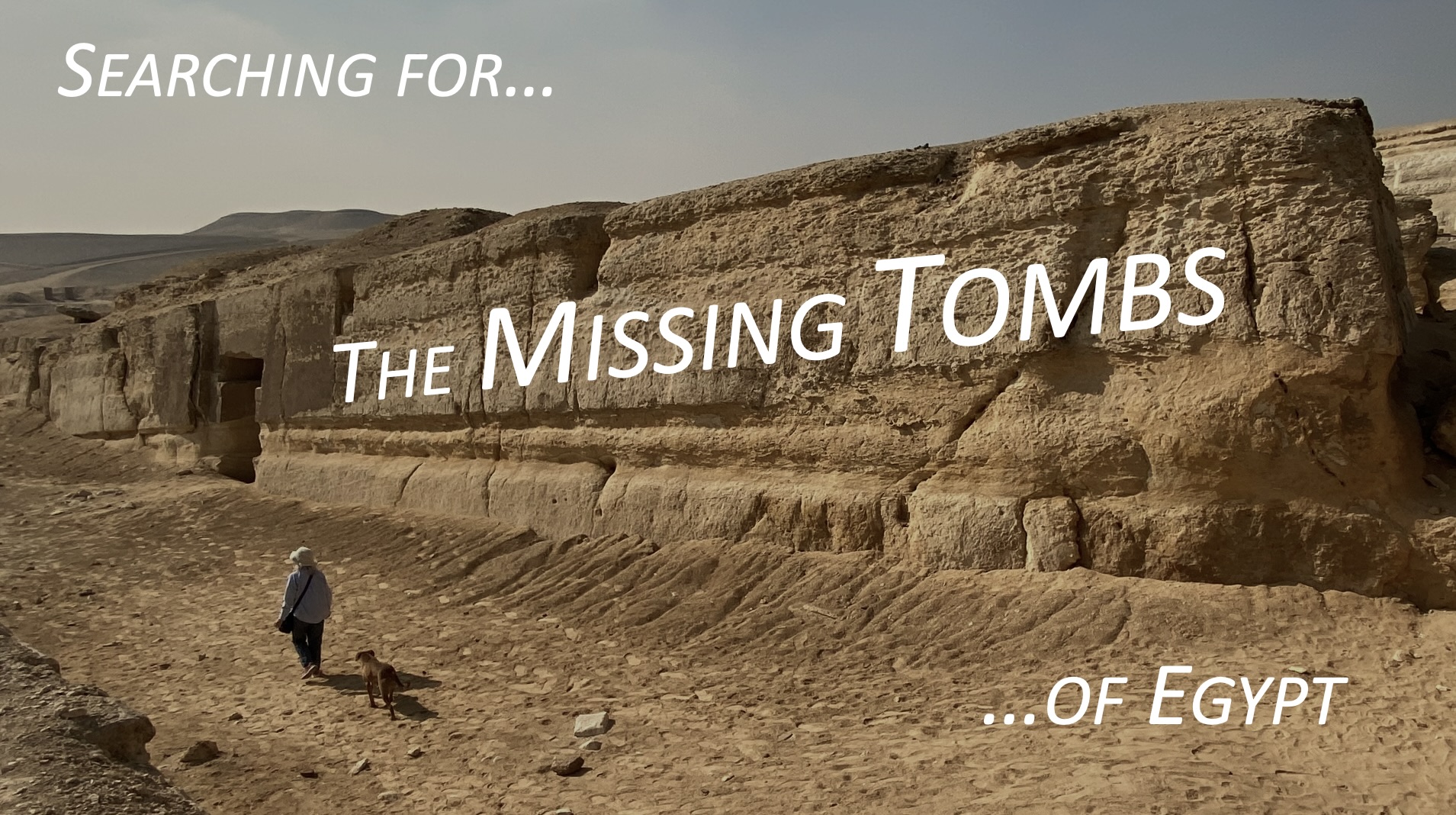
SEARCHING FOR THE MISSING TOMBS OF EGYPT
Wednesday 8 May 2024, 6.00 pm UK time (= 1.00 pm EST)
Live via YouTube – click here

It’s incredible to think that so many of the tombs of the pharaohs of Egypt – who altogether ruled for over three thousand years – have survived and been discovered by archaeologists. Most of those that haven’t survived belonged to kings about whom we know very little and who perhaps ruled only for a short time, or during periods of instability. But there are conspicuous absences – tombs that belonged to great and well-known historical figures that no longer exist, or perhaps just haven’t been found yet… This is the story of the ‘missing’ tombs of Imhotep, Amenhotep I, Akhenaten and Nefertiti, Herihor, the kings of the glorious Saite Period, and even Alexander the Great and Cleopatra. What would they have been like, what treasures would they have contained, where were they, and could they still await discovery?

See you soon! 😊

Golden Mummies of Egypt

I visited this exhibition at Manchester Museum last week and enjoyed it so much I thought I would set a few thoughts about it down here.

Many congratulations to Dr Campbell Price (full disclosure: he is a friend!), I thought it was brilliant. Firstly, the material is fantastic, of course, especially the splendid mummies themselves, and it’s all from the Manchester collection incidentally. The exhibits are not overwhelmed by the number of labels which are concise and punchy and printed in a readably large font(!), giving you the essential info but with a liberal sprinkling of what felt like – for a blockbuster exhibition – new, unusual and progressive ideas: Graeco-Roman Egypt; the collision in that era of the varying beliefs, practices and styles of an increasingly diverse population; the origin of the Manchester collection and removal of material from Egypt during the period of British colonial rule; Flinders Petrie (the main excavator), Amelia Edwards & others’ dubious ideas about what the mummies could tell us about the ancient people; no x-rays or facial reconstructions (done to death – no pun intended! – and of limited value); a focus not on what biology reveals about the ancient people’s earthly lives but rather on what the practice of mummification, mummy cases, iconography etc tell us about what the people hoped for in an eternal afterlife.


The book which accompanies the exhibition is also excellent.

It’ll be too progressive for some people, and not progressive enough for others but for me it’s absolutely spot on: ‘golden’ and ‘mummies’ enough to bring people in – it has been wildly popular already, and for anyone who just wants to see beautiful blingy things, there’s a lot to enjoy – but with plenty of challenging ideas that will get people thinking. There are some really important and very relevant issues here – the mixing of different groups of people and cultures, colonialism, racism – that all of us, not just academics, need to be thinking and talking about. For the debate to reach the mainstream it has to be accessible, and not just the preserve of clever and angry academics. The messages are gentler here, but they are there and they will already have reached thousands of people. The exhibition is a triumph, go and see it if you can! Tickets are free but must be booked in advance, here.

Rights, permissions

I saw this tweet from a colleague, Maarten Horn, yesterday. I began thinking of replying and then realised I had a lot more to say than I could fit into a few tweets.


Read the conversation on Twitter, here.

What follows refers specifically to the granting of rights to look at, describe, draw, photograph and reproduce images of ancient and archival material, drawing on my experiences in Egyptology. I realise much of what I have to say here would not apply to intellectual property of many other kinds.

Over the years I’ve come across lots of situations in which rights are asserted or assumed, and rules or even laws assumed and apparently broken. As an author I have requested and been granted permission to use material, and I have also acted on behalf of a publisher and institution granting permission for the reproduction of images of ancient and archival material in its possession (The EES).

In general, the situation – the rules and how they are applied (if they even exist) – is very unclear, and there’s rather a lot to consider, including:

• The difference between what is law, and what is simply a commonly accepted standard of practice or a rule particular to an individual or institution.
• The way such laws / standards / rules might differ from one context to the next or in different countries etc.
• The consequences. Breaking the law is very serious, obviously; falling short of standards or flaunting the rules of an organisation with which you may wish to collaborate again may be less serious but it is discourteous, and as such may harm your working relationships.
• The rationale behind rules. I have encountered situations in which rights have been asserted or rules imposed when there was no sound basis for it, preventing material from being used which in the end was in no-one’s interests, and by extension was detrimental to scholarship (it seemed to me).
• Who owns the rights? The author? The artist? The photographer? The publisher? The individual or institution that owns the thing being described, drawn or photographed? All of them??

Before going into this in any more detail, how should I reply to Maarten?

First of all it seems to me at best discourteous if nobody was asked for permission in this case (or perhaps just clumsy if the author is inexperienced and really has no idea how such things work, but in that case the publisher could have advised them). The author using the images that appeared in Maarten’s work (hereafter ‘author X’) could have tracked Maarten down online or contacted the publisher to ask. Despite this, it seems to me possible that no rules were broken, especially if author X had secured permission from whoever owns the objects as Dr Will Carruthers has already suggested:

In that case author X (or his publisher) might well have felt no further permissions were required. Still, whatever the rules, it’s just good manners to ask and such things do matter, particularly in a small field like Egyptology where everyone knows everyone else, and we all have to work together.

Another consideration would be what rights were asserted by the rights owner and how this was expressed in Maarten’s publication. Presumably it was something like ‘image courtesy of <<name of institution>>, all rights reserved’. In that case it would be unambiguous: permission would have to be sought. There are other kinds of rights however such as ‘creative commons’ which allow rights holders to “pick and choose which rights they want to control and which they want to grant to others.”¹ Author X may have known that the rights holder in this case universally grants permission for its material to be used in certain contexts.

When I worked for the EES I was, for a while, in charge of dealing with requests for permission to reproduce images in the Society’s copyright, generally either photographs from the archive or images of papyri in the Oxyrhynchus collection. I can’t remember ever refusing permission. Usually, the only question would be whether the image was to be used for a scholarly i.e. non-commercial venture – most commonly a scholarly article – or a commercial project such as a book or television programme. In the latter case there would be a fee to pay, but for scholarly use permission would be granted free of charge. The fees we did receive were a nice little source of pocket money but not really significant. It seemed to me that the bigger picture for the Society was that that we had a responsibility to make our material available for scholarly / educational purposes, not to discourage or prevent it from being used by charging fees scholars could not afford, and that we would benefit from the heightened awareness of the Society that we hoped circulation of our material would bring. Permission was, of course, only granted on condition that the Society be acknowledged (‘Courtesy of the Egypt Exploration Society’).

Had I ever come across an instance in which a scholar made use of one of our images in an article without having asked for permission I would probably have been a little bit annoyed, but provided they acknowledged the Society’s copyright I would probably have concluded that it wasn’t worth doing anything about it, and that in fact, the author had perhaps done the right thing in saving themselves, and me, the time as I would only have granted permission anyway.

In 2007 thousands of images in the Society’s archives were digitised thanks to a generous donation. This was a great boon for us – it made browsing and searching the collection, and providing high quality images to researchers, much easier. We were quite guarded about circulating them to begin with however: what if people started using them without our permission? Well, after a while we realised that people probably weren’t going to do that, that they would generally follow our rules and acknowledge the Society’s ownership of the images, or even pay a fee if required. In recent years the Society has made the majority of these images available for free online (here) – a fantastic initiative which no doubt has been a great boon for scholars, saved the Society’s staff a great deal of time in tracking images down and sending them off, and helped raise awareness of its history and work.

Time and effort

One of the advantages of creative commons licences is that they provide for exactly this kind of situation i.e. for material to be used in certain ways without the need for the time-consuming process of permission being requested and granted. The reality is that many institutions granting permissions are understaffed and cannot always deal with such requests as quickly as authors etc. might like. In a worst-case scenario this could prevent material from being included in published work which is in no-one’s interests. At the EES I always felt that the important thing was that the material be used. As I’ve already said, I can’t recall coming across a situation in which there was any reason not to grant permission, the only question was whether or not we should charge a fee, and I would never have wanted to deter anyone from using an EES image because it was too expensive – I would much rather have offered a discount or waived the fee entirely and had our image be the one chosen for the documentary or the front cover of the book, than stick doggedly to the rules and end up with no fees and someone else’s image used instead. In reality such situations hardly ever arose – commercial publishers and production companies were generally happy to pay our fees – but I appreciate that other institutions might take a different approach if reproduction fees are more significant to them than they were to the EES when I was there (2001-16 incidentally).

In practical terms…

If anyone had really wanted to use one of our images in such a way that we would have refused permission, or without paying a fee when we would have requested one, then there would have been very little we could have done to stop it.

In practice, in situations such as the ones discussed here, if someone had wanted to break the EES’ rules, there wouldn’t have been much we could have done about it. It might be impolite, and might spoil what would otherwise be a good working relationship, but otherwise there’s little that can really be done.

I learned this in my first couple of years there in fact, albeit in a slightly different circumstances. The Society was – and still is – a publisher of books and periodicals (a journal and a magazine). As far as the Society was concerned its excavation and other scientific reports were in its copyright, and always had been. On one or two occasions we found that old site reports had been reproduced without our permission for sale at a profit. We would have wanted to assert the sole right to reproduce these volumes, to help raise awareness of the Society and its work and to generate revenue. On one occasion I contacted a publisher in America to draw their attention to our claim and was simply told that according to US law the copyright had expired a certain number of years after the death of the author, and that we therefore had no rights. I knew of laws like this of course but hadn’t thought that different ones might apply in the US, and in any case felt he was missing the point that rights lay not with the author but the EES. I had to admit, however, that I was no lawyer and, moreover, even if I had felt we had a case would the Society have wanted to pursue it? Of course not. We wouldn’t have had the resources, and there was nothing stopping us from republishing the volumes ourselves (except that we didn’t really have the resources!). Eventually I would have to concede that if anything these other publishers were providing a service that the Society itself could not in making long out-of-print volumes available again. These days I am a huge fan of initiatives such as Google Books and archive.org which have made thousands of volumes – including many older EES reports (e.g. this one) – freely available online.

When rights are wrong(ly asserted)

Considering that:

• In my experience at least there is rarely any reason not to grant permission;
• That frameworks exist to allow material to be reproduced without permission being actively sought / granted (e.g. creative commons licenses);
• That dealing with permissions requests can be very time consuming, sometimes to the extent that institutions are unable to handle the workload;
• That in many instances no-one really loses out if material is re-used without permission;
• That there is something to be lost if permission is not or cannot be granted i.e. because it’s in everyone’s interests that the material can be circulated – scholarship in Egyptology depends on knowledge – descriptions, drawings photos etc – being circulated as comprehensively and widely as possible. An article about an object or site suffers if it does not include a good image(s) of that object or site;

…I have often found myself wondering if rights have been asserted when it would be better all round if they were not.

A few case studies that raise similar issues:

Up until recently it was against the Ministry of Antiquities’ rules to take photographs in any ancient tomb or archaeological museum in Egypt. I suspect the reasoning, initially, was that the Ministry would be able to generate much-needed revenue though the purchase of postcards and books at its sites, and through reproduction fees, and this may have worked. However, it must also have meant that many tourists were left disappointed that they were unable to take photos of the amazing things they were seeing – or simply paid the guardian on duty a little tip and went ahead anyway. And it meant that scholars like me fell back, for their lectures etc., on very old photos of their own or better ones scanned from books, or simply didn’t have photos to show. In recent years the rules have been almost completely relaxed, presumably because the Ministry concluded that the benefits of allowing photographs to be taken and posted to social media outweighed the potential gift shop sales and photography fees. And perhaps because it had become clear that policing a no-photo policy in an age when everyone carries a camera with them and expects to be able to take photos at all times had become unworkable. In this case the assertion of rights and granting of permission only by request probably proved unworkable and counter-productive. I congratulate them on the new policy!

While requesting images to be included in a book of mine a few years ago the publisher and I contacted several colleagues to ask for permission to reproduce their images. Two cases stood out:

In the first, I asked a colleague for permission to use a photo of some fragments discovered during an excavation they had directed. The image had been published in a specialist magazine. I mentioned the fragments in my text and felt it was important that my readers could see what had been found. My colleague granted permission but only after hesitating, explaining that academics are sometimes a little ‘paranoid’ about such things. I was puzzled by this: the image had already been published, and my text was uncontentious. What could anyone stand to lose from the image being published again? If anything, I hoped that my colleague and their excavations would benefit from my helping to circulate information about the material found to a wider audience. I was of course pleased and relieved to receive permission, and also grateful for the explanation, not least as the notion of paranoia seemed an admission that the hesitation was not entirely rational, which helped explained why I found it so puzzling.

In the second instance, I asked the director of a project I had worked for myself for permission to reproduce a photo I had taken of a tomb wall. As far as the publisher was concerned, as the photo was mine there should be no need to ask for permission but I felt it would be courteous to ask, and that not doing so would risk spoiling relations with a good friend and colleague. In this case the answer was (paraphrasing) ‘yes, but please don’t use your photo because it’s not very good. Here’s a better one taken by the team photographer.’ Moreover, my colleague asked to read my text to make sure I wasn’t saying anything inappropriate. Again, I felt this was not something I ought to feel obliged to do but, not wanting to spoil a good relationship, I agreed. Fortunately, my colleague agreed that there was no problem and that we could go ahead. The explanation was that in the past, other members of the same project had claimed to have discovered the tomb themselves. I was somewhat alarmed that anyone would do this – this particular tomb wasn’t really discovered by anyone having been visible since antiquity and appeared frequently in literature from the time of the earliest European travellers onwards, so any such claims would, transparently, have been ludicrous – and even more so that my colleague would think I would make such a claim…

In both cases it seemed to me that my colleagues were not being entirely reasonable. In these cases permission was granted eventually, but it makes me wonder how often that’s not the case.

And indeed, there have been other occasions when I have failed to secure permission. In one case, a museum holding an object I wanted to illustrate simply failed to reply to my messages. In this instance I assume the museum in question simply didn’t have the resources to reply deal with such enquiries. Fortunately in this case I was able to find an alternative image and secure permission via other means.

On another occasion I was prevented from even mentioning the existence of a particular monument on the basis that it hadn’t yet been fully published. I had thought there would be no issue with this as I had been careful not to include any information that hadn’t already been published but this briefly got me into a little bit of trouble. In this case, no laws were broken and the denial of permission was, to my mind, unreasonable and in fact counter-productive, and I felt the book, its readers and even the institution denying permission(!) were worse off as a result. But the maintenance of good working relations with my colleagues took precedence and were, thankfully, restored in short order.

Conclusion

Over the years I’ve accumulated quite a bit of experience of permissions requests in various different situations. It seems to me that there’s a lack of clarity and consistency in what the rules should be, and how they should be applied. It also seems to me that there is a tendency on the part of some individuals and institutions to assert rights or require permissions when perhaps there is no need, or even to deny permissions when there is no good reason to do so. I’m no lawyer but it seems to me that the principles of intellectual property law are there to protect creatives and other individuals / institutions who invest in works created – their property – to afford them a degree of control over how it is used and to allow them to generate the income they need to carry on their work. I have encountered situations in which creative work has been used without permission or acknowledgement, denying the creator the opportunity to control how their work is used, and the credit they deserve. Clearly this is wrong. But I have also encountered situations in which permissions processes have been imposed unnecessarily and counter-productively, and, worse, others in which permissions has not been granted without good reason, to the detriment of all concerned. It’s just a personal view but I think it would be very helpful if there were greater clarity as to what standards or practice or rules we should all aim to uphold, and probably greater understanding and application of creative commons licensing.

Thoughts?


Notes

1. See https://en.wikipedia.org/wiki/Creative_Commons. Accessed 10 January  2023.

Playing in the Past

I’m as relieved as anyone that we seem now to have left the period of COVID lockdowns behind us, but, as hard as 2020 and 2021 were, there were a few silver linings. For me, one of the most fun – and unexpected – things to have happened during those gloomy and uncertain times was that I found myself spending hours and hours playing video games for more or less the first time in my adult life. In fact, it was mainly just one game: the ancient Egypt-themed Assassin’s Creed Origins. Not only did I buy the game and a console to play it on, after a while I found myself a part of a university-funded public engagement project exploring the use of such games as a way of sharing expertise in, in fact teaching, Egyptology.


The Step Pyramid enclosure at Saqqara as depicted in Assassin’s Creed Origins.

The project was called Playing in the Past (PITP). It’s two years now since I first got interested in the game, and around a year since our final public session. Since then, the game has frequently been mentioned to me by people who knew about the project and my involvement, and by others who didn’t. ‘Have you ever heard of Assassin’s Creed Origins? I think you’d love it…’. Well now I can say, ‘Yes, I have and in fact, since you ask…’

It occurred to me that it would be good to be able to gather together some of the resources we produced and other stuff that arose from the project so that anyone interested can find them easily enough, and as a way of capturing something I thoroughly enjoyed working on, and am proud to have been associated with.

So how did this come about?

In summer 2020 I was finalising the text for a book about Cleopatra for children (which was published earlier this year in fact – Cleopatra Tells All!) and was looking for visualizations of the Ptolemaic city for the illustrator, Guilherme Karsten.


One of Jean-Claude Golvin’s superb reconstruction drawings of ancient Alexandria. Taken from https://jeanclaudegolvin.com/en/project/egypt/ JEAN-CLAUDE GOLVIN COPYRIGHT © 2018

I was familiar with the brilliant reconstructions drawn by Jean-Claude Golvin (many examples are available via his superb website, and in his books, including Voyage en Égypte ancienne), but otherwise what kept coming up when I searched for images online were screen shots from Assassin’s Creed. Initially, I was inclined to ignore them – because I’m not a gamer, I don’t have access to the game and it’s just not for me. But then I kept seeing them, and they seemed to be quite good… And in fact I do like my gadgets and as I started reading about the game I became aware that it incorporated a ‘Discovery Tour’ in which you could just walk around the virtual ancient landscapes without having to play the game. I was always terrible at video games when I was young, which perhaps explains why I had then avoided them in my adult life, but if I could just walk around without having to worry about being virtually shot or killed, then well, I would certainly be interested in walking around a virtual Ptolemaic Alexandria, especially if it was done well.

So I posted this tweet:

One of the people who saw my tweet was Egyptologist and gamer, Gemma Renshaw and to cut a long story short Gemma offered to show me round AC Origins’ virtual Alexandria via a livestream – she would play the game and share her screen via a video call so she could also talk me through what she was doing and I could ask questions or yelp with excitement when a recognisable ancient monument came into view (The lighthouse!! The Heptastadion!!). We were also joined by my very good friend Dr Kate Sheppard of Missouri University of Science and Technology. In fact by the time of the virtual tour I had spent so much time eyeing up games consoles online that I had decide to buy my own – an Xbox One – so I could play the game myself, and had been stumbling my way through the game for a few days by the time Gemma, who is very good at these things, stepped in to show how it should be done.

Both Kate and I were completely blown away by the game: by how rich the virtual world was, and by the attention to detail: the virtual Alexandria had clearly been designed according to the textual and archaeological evidence, with all the gaps in the evidence filled in with what seemed like very reasonable conjecture.


Looking out across the harbour at Alexandria towards the famous lighthouse on the island of Pharos.

The textures were astoundingly realistic – the stone of the roadways and grander buildings, the mud brick of the ordinary houses, the fabric of the flags, carpets and drapes, the green of the grasses and scrub, the waters of the harbour and ocean beyond, the way the shadows play on the pavement as the palm leaves blow in the wind… I could go on – there is just so much to look at and enjoy in the game, just by walking around. Paving stones and walls didn’t look too perfect or brand new – an ideal the designers could have realised but avoided in favour of a city showing signs of wear and tear, a little crumbling stonework here and there, or tufts of grass emerging from cracks in the pavements – probably much closer to the reality of late Ptolemaic Alexandria, a city almost three centuries old by this point.


Exploring the streets of Alexandria in the AC Origins Discovery Tour.

Your avatar (a dastardly-looking Ptolemy XIII in the above two images, but there are lots of others to choose from) could walk, run or gallop around on horseback, apparently without ever finding the edge of this virtual world, and you could summon up an eagle to fly you around should you want a bird’s eye view. As time went by the daylight changed and night eventually fell – the cycle of night and day went round far quicker than it would in real life but still gradually enough to feel natural, and the changes gave the city a different feel with shadows coming and going, and torches lighting the streets after dark.


My friendly eagle, Senu, flying over the main east-west street in ancient Alexandria, the Canopic Way, after dark in AC Origins.

Both Kate and I found the whole thing utterly engrossing, and I loved exploring on my own with my new toy.

Jean Claude Golvin’s reconstructions were well-known to me partly through his books but also because they are so frequently used by Egyptologists in their books and lectures to show what ancient sites would have looked like (in fact a large-scale bird’s eye view of the centre of Alexandria by Golvin is on display in the National Museum of Antiquities in Alexandria). AC Origins seemed to take the idea of reconstructing an ancient place to the next level however, by presenting it on a far grander scale, and allowing you to move through the landscape, which you can hear as well as see, and which the designers of the game have populated with the ancient inhabitants for you to interact with (or bump into as I do – they’re not shy in telling you what they think of that).

The Project

By this point, I’d got all the visual material I could ever have wanted for the book I was working on, and I was enjoying my experience of playing video games in almost 30 years. This was more than I could ever have hoped for but Gemma already had bigger plans. She suggested that we host a live tour of the game for an audience online which we did in September 2020 (which was very much the year for hosting events online of course). Gemma took us around Alexandria, but also Giza and Saqqara both of which look incredible in the game. Kate and I chipped in here and there with non-gamer comments about how Egypt was presented, and quite a few ‘oohs’ and ‘wows’ along the way too. The session was recorded so rather than describe it at length I’ll just let you watch:

Spurred on by the success of this first event, and having long been interested in the use of history-based video games as a way helping people to learn about the past, Gemma proposed that we do something on a grander scale. In the weeks that followed, she devised a project to be called ‘Playing in the Past’, and applied for funding made available by Southampton University (where she’s doing a PhD on the archive of the pioneer early 19th century Egyptologist, Robert Hay) for public engagement in archaeology. And much to our excitement, she succeeded.


An advert for the first official PITP session.

During the first half of 2021, Gemma organised six ‘Playing in the Past’ sessions, based on the model established by our first event. Each took the form of a virtual tour, of a particular part of the landscape in the game that would allow a specially invited expert to discuss a particular aspect of Egypt in the ancient past and the way the game represents it.

By this point Gemma had also brought very considerable technical expertise to the project: the sessions were broadcast online via her channel on the Twitch platform, and viewers would be able to see the game being played, and a little thumbnail image of Gemma, me and/or Kate as co-hosts, and our expert. Our experts also began the sessions with a short presentation before the gameplay began.

Although Gemma, as the expert gamer, was usually the one to take the controls of the game, she allowed me to take the reins during the first session – ‘A Visit to Ptolemaic Thebes’ – which was very kind and trusting of her, and if nothing else probably added an element of humour to the proceedings as I bashed into the people and temples of the ancient city… A recording of this session is here:

And in case it’s of any interest, the slides – which include a few images of sites as they appear in real life today, and as they appear in the game for comparison – from my presentation at the start are here.


Slide from my presentation showing the temples of Deir el-Bahri as they appear in real life in the 21st century…


…and the temples as they appear in AC Origins.

The other sessions in the series, which in all cases were hosted by Gemma, were as follows:

How to live forever. Death and the afterlife in ancient Egypt’ with Dr Carrie Arbuckle MacLeod
From Potter’s Wheel to Baker’s Oven’ with Dr Sarah K Doherty
Who Lived in Ptolemaic Egypt?’ with Heba Abd El Gawad
Visions of Ancient Egypt in the 19th Century: Boats and Travel on the Nile’ with Ziad Morsy. Kate also gave a presentation at the start of this one.
Visualising a Living and Immersive Ancient World’ with Professor Stephanie Moser (University of Southampton) and Maxime Durand (Ubisoft)

Publicity

It just so happened that during 2020 I had been introduced online to Kelly Evans, an Egyptophile who works in media relations. Kelly had offered to help with anything that I wanted to publicise so when I mentioned that ‘Playing in the Past’ was now a university-funded public engagement project Kelly set to work looking for interest from the press. And being great at what she does, she succeeded. The project was covered in Games Radar (‘New Twitch series will teach you about ancient Egypt by exploring Assassin’s Creed: Origins‘), Video Game Almanac, the Southern Daily Echo (‘Southampton student exploring ancient Egypt using video game‘) and, most excitingly of all, by Ubisoft, the French company that designed the game. The three of us were interviewed by Youssef Maguid, who by happy coincidence is Egyptian himself, for a piece entitled ‘Why Three Egyptologists Are Teaching History Through Assassin’s Creed Origins’ which was published on Ubisoft’s website in March 2021.

By this point we were of course convinced ourselves of the value of the game as a means of engaging with an audience and sharing our Egyptological expertise, in ‘teaching’ in other words. We were huge fans of the game and utterly inspired by the obvious lengths to which Ubisoft had gone to ensure the world inside the game was as accurate as it could be, and wherever possible based on good solid evidence and expertise, calling on a number of expert colleagues of ours. (For more on the development of the game see https://en.wikipedia.org/wiki/Assassin’s_Creed_Origins). The game’s ‘discovery tour’ was a clear attempt to use the game for educational purposes, so it was obvious that Ubisoft had hoped the game might be used for such purposes. Still it was a great thrill that they would want to share our project with their (massive) audience; I certainly felt that their interest helped to validate what we were doing, and perhaps they felt that we had provided a little extra validation for that aspect of what they were trying to achieve too.

Gemma cannily capitalised on the relationship by inviting Maxime Durand, World-Design Director at Ubisoft, who worked on AC Origins to join the panel for the final session in the PITP series. Gemma, Kate, Maxime and I were also joined by Professor Stephanie Moser of the University of Southampton, one of the world’s leading scholars in the reception of ancient Egypt. It was the perfect panel and the perfect way to end the series, and you can watch it back here:

Thank yous

As I said at the start my aim in posting this piece is mainly just to capture what was a really fun project and a very memorable part of the strange period of the lockdowns of 2020 and 2021, and to gather together all the related material that now exists online, especially the recorded versions of the PITP sessions and the interview we did with Ubisoft. And very importantly, this also gives me an opportunity to say a few thank yous:

To Gemma, for offering to run the first virtual tour, which led to me buying my first games console since Christmas 1992(!) and spending hours and hours in the incredible world of AC Origins, and most importantly, for having the idea for the much grander project and the determination and expertise to make it happen. Thank you Gemma and very well done!
To Kate, for a tonne of expertise, for joining in, thereby making me not the only non-gamer on the team, and just generally for helping to make the whole thing so much fun.
It’s not really my place to do the thank yous for the project but I can’t help but mention all the expert contributors, Carrie, Sarah, Heba, Ziad, Maxime and Stephanie for giving up their time and sharing such a wide variety of insights into various aspects of ancient Egypt, and the way it is portrayed in modern times, especially in the game.
And to everyone who came along to the sessions and contributed questions, comments and encouraging noises. We wouldn’t have got anywhere if we hadn’t known there was interest out there online in what we were doing. Thank you!

I should also acknowledge that while it’s true that PITP attracted a bit of attention for using a video game as an educational tool we were by no means the first or only ones to have done anything like this, and indeed there is a growing body of academic discourse and literature about the intersection between archaeology and ancient history and gaming. I am by no means the expert but to learn more you could do worse than to search for the hashtags #archaeogaming and, of course, #playinginthepast on Twitter.

Now back to real life! (Or perhaps to the game…).

UPDATE October 2024: At a certain point after this post was originally published YouTube removed the recordings of the PITP sessions but they have now been restored to a new location, thanks to the generosity of the Missouri chapter of the American Research Center in Egypt (ARCE) – thank you ARCE-MO! The links above have all now been changed accordingly.

The freelancer and the pandemic – two years on

It seems a very long time now since I first wrote something about how the pandemic had affected my situation as a freelancer (see below). We’re still not out of the woods but as I write this I have just finished my first visit to Egypt with a group of tourists since the pandemic began and life seems to be returning to something like normal. So, the piece I wrote in April 2020 certainly needs updating, and now that I have finally been able to resume this aspect of my work, along with most others, now seems a good moment to reflect.


Me – with mask on! – inside the tomb of Ramose (TT 55) in Luxor last week (Feb 2022). Thanks to Marie Best for the photo!

It’s almost two years since it became clear that COVID was going to be a blight on our lives. By the time of my first piece, I had had one trip to Egypt postponed and it seemed fairly clear that any others that were on the cards weren’t going to happen (they didn’t). Any lectures I was due to give in various places around the UK and beyond were also postponed indefinitely.


Opening slide from my very first talk online – seems a long time ago now!

However, lecturing online suddenly became something which I, and lots of others like me, could do to keep ourselves occupied when so many other things weren’t possible, and for which there was suddenly a substantial and enthusiastic audience. It quickly took over my life in fact, and it was very exciting. The audiences I could reach online were generally much bigger than any I would normally speak to in person. My second talk – ‘After Akhenaten’ – sold out three sessions and was attended by around 700 in total. Attendees included regulars on the Egyptology circuit, many of them friends I have known for years, but also many I was ‘meeting’ for the first time. And they came from far and wide including places where Egyptology lectures were simply never available in person – it was really great to hear from all those who were able to listen in to talks like this for the first time as no such thing would be available for them locally.


‘After Akhenaten’ in progress

In some ways though it was harder to see and to know my audience. Not being able to see anyone I couldn’t recognise any faces that might have been familiar, and I knew that, potentially, anyone could be watching including colleagues who might well know more about that day’s subject than I did… The pressure not to make any crashing mistakes and to give a good account of myself really motivated me to raise my game: I made sure I was on top of my material and paid more attention to my presentations, making sure I included captions and image credits where necessary. Although the talks were always based on subjects I knew to some extent, putting together the material for the presentations almost always gave me the excuse to look at certain things in more detail, allowing me to learn a lot as I went along. I also created guides to ‘further reading’ after each talk, partly so that the entertainment didn’t have to stop at the end of the lecture but also partly as a way of covering any themes or details I had to leave out, and to provide my audience with all the information on which my interpretations were based and alternative explanations so that they could make up their own minds.

It gave me a huge lift to have so many people joining the talks and to feel the huge wave of enthusiasm for all this Egyptology that was suddenly available at a time when we all sorely needed distractions.


Opening slide from my talk on Imhotep, the first for which I charged a small fee

The next step for me – which seemed like a big risk at the time – was to see if the lectures would still be of interest if I were to charge a small fee. It was enormously rewarding to find that the numbers held up and that many people even said that I should be charging more! Since I first charged for one of my talks in June 2020 this has become my main source of income, and I really feel as though it saved me both financially and psychologically thanks to the good feelings that came with it.

There is another advantage to this which I hope will endure, pandemic or not: hosting my own lectures has not only allowed me to generate a little income but to my schedule too. One of the hardest things about the kind of freelance work I do it is that it’s mostly intermittent and unpredictable. I have periods when there’s loads of work and others when there is very little. But now, if I have the time and am a bit short of funds I can put a lecture in the diary and know I’ll have something to work on and a with any luck a bit of money to show for it.

Two years on I now have a mass of material in much better shape than my presentations were ever in before and have made recordings of several my talks available on YouTube – more content which I hope will be of value in its own right while also perhaps introducing more people to my work.


Recorded lectures waiting to be watched on YouTube!

Other Adventures

In addition to my own lectures I’ve been very fortunate to have been invited to give talks online for various other groups in the UK and overseas. I’m very grateful that all involved were able to make the transition to online events helping those of us for whom public speaking is an important part of our work to carry on, albeit in a new way.

I also feel very lucky that when the pandemic began I had just finished working on a book – Egyptologists’ Notebooks – and despite COVID it was published on schedule in October 2020. So I had a new book to promote and lots of new material to use as the focus for new lectures. I also published a book for children – King Tutankhamun Tells All –  in June 2021. Those also have helped to keep me busy.

The postponement of a Nile Cruise that was due to set sail in April 2020 gave me the idea for a ‘Virtual Nile Cruise’ – a daily photo series on social media taking in sites and monuments as one might encounter them on a journey up the Nile, which eventually took in 80 sites / days in the Nile Valley, Delta, Western Desert and Sudan. Aside from providing a bit more content and an excellent opportunity to keep in touch with my audience it gave me a great excuse to go back over all the thousands of photos I have taken in Egypt in over 40 visits since 1998, and having pulled out the best ones I now have a definitive and well-organised set. I can find things quickly at last!


A felucca on the Nile – the image Dr Kate Sheppard and I used to promote the Nile Cruise Then & Now podcast

Other projects have come my way too, including the ‘Nile Cruise Then & Now’ podcast with Dr Kate Sheppard, and the ‘Playing in the Past Project’ with Kate and Gemma Renshaw which explored the ways in which the video game Assassins Creed: Origins could be used as an educational tool.


Visiting a Theban temple of the late Ptolemaic Period in Assassin’s Creed: Origins

THANK YOU

Throughout the two years I have been incredibly fortunate to have the support an encouragement of so many people who have joined the talks, watched something I’ve been in on TV, read one of my books, or seen the photos I’ve posted online and responded with positive comments.

It’s been lovely to know that there is an audience out there for what I do. Getting offers of work enables me to earn a living but it also helps remind me that there is a point to what I do, that there’s value in what I have to offer. I’m really grateful for all the supportive messages I’ve received in the last couple of years, and extra specially thankful to all those of you who have gone above and beyond by sending contributions of money to support what I do, and also books. Putting together so many lectures in the last year or so has meant making more use of my own small library than I have ever needed to do before and being able to augment it with exactly the things I needed thanks to your generosity has been of great practical benefit but, again, just helped give me such a lift. Thank you!

What comes next?

False dawns and dashed hopes have been a feature of this pandemic but dare I say it 2022 is shaping up to be better year than the previous two. In fact I managed to get back to Egypt – for two days’ filming – in October 2021, and In January 2022 I spent a week in London making a documentary for HistoryHit.


DoP Milo after hours in the Egyptian sculpture gallery at the British Museum while filming for HistoryHit

Following two weeks of visits to sites in the Luxor area with groups from Ancient World Tours (details here) I will be back at home now for another week or so before flying out again to join another group. Altogether I have three more tours coming up in the next few weeks and have work on three more films lined up as well. And I have another book for children coming out in May (watch this space!). I also have a number of talks in the diary, both in person and online. The summer is likely to be quieter and at that point I plan to give a couple new talks of my own, and perhaps to make a few more recordings available too.

Thanks for sticking with me, it’s really nice to think that I still have a freelance career despite the last two years and I’m not sure I could have done it without your help. Again, THANK YOU!

—–

ORIGINAL ‘Support My Work’ text:

UPDATE 20 May 2020: I’ve been incredibly touched by the response to this page since I first posted it at the end of April. You’ve sent donations of money and books, and messages of support, advice and encouragement. It’s helped keep my spirits up, and off-set the loss of earnings; I have now heard from the government that I will be eligible for a grant from the Self-Employment Income Support Scheme so that will help further still. It has all been enormously helpful and moreover, encouraging. Thank you to all of you  who responded however you’ve been able to, it’s all been very much appreciated.

At the start of the lockdown I was thinking that these online activities – lectures#virtualnilecruise etc – would help keep us all going for a few weeks until things got back to normal, but it now seems likely ‘normal’ is still a long way away, and may never return completely, and that ‘lockdown lectures’ like these might be a part of a ‘new normal’. It’s for this reason that I’m beginning to experiment with charging for online talks; I will need to bring money in if I’m going to continue – as I’d really like to – and it’s your thoughtful and generous responses that have persuaded me that it might be possible. Thank you!

I’ve written a little more about my plans and how I got to this point here.

ORIGINAL POST:

Lockdown, lost earnings

I’ve been self-employed for 3 and a half years now and I earn my living from writing, TV, lecturing and leading tours to Egypt and elsewhere. I also earn an honorarium from my work for the Robert Anderson Trust. The lockdown has changed things for me as it has for everyone. I’ve lost some paid work – a tour to Egypt, a few lectures and a TV project. This has meant I’ve had a bit of extra time to work on making the best of the situation, and I’m glad to have had the opportunity to give a few lectures online, to lead a ‘virtual Nile cruise’, and in general to share more via social media than I would have done otherwise, knowing that there are probably more people out there with the time and inclination to indulge their interests in Egyptology than there would be normally. This has been great fun, but so far I haven’t taken any steps towards trying to recover any of my lost income, and I couldn’t carry on working like this without earning any money for very long.

Screenshot 2020-04-20 at 16.30.12
Online lectures – details here

Being very English I don’t like to ask, but it’s been suggested to me that anyone who appreciates the lectures etc might like to support their friendly neighbourhood Egyptologist…

I’m by no means the worst affected by the current crisis: I’m healthy, safe, I’m with my loved ones, and certainly have plenty to occupy me. There are plenty of people who need support much more than I do, those in the NHS (to support NHS Charities Together go here), those who are homeless (go here) or struggling to feed themselves or their families (here) , and those working at historic sites and monuments for whom a lack of income from visitors threatens their ability to protect these vital parts of our shared heritage (see the campaign here) – to name but four that have been in my mind.

But in case you were wondering if or how you could help a freelance Egyptologist, here are a few suggestions.

Books

My first book, Searching for the Lost Tombs of Egypt is available now in print and e-book form (via Amazon, or your local bookshop), and my next one Egyptologists’ Notebooks will be out in September 2020 and is available now for pre-order (Amazon.co.uk and Blackwells in the UK, Amazon.com in the US). Buying copies for yourself or your friends and family really helps, as does pre-ordering – this encourages sellers to buy in more stock from the publisher, and to do more to promote the book to readers. Leaving a review – on AmazonGoodReads and elsewhere – can really help encourage people to buy books as well (unless you really didn’t enjoy what you read I which case I imagine you probably wouldn’t be here…).

Lost Tombs & Notebooks COMPOSITE 200dpi

A small contribution

If you’d like to show your support by making a small financial contribution you can do so via PayPal.Me. So far I have avoided charging any fee for online lectures but putting together and giving talks takes time, and I now pay for a Zoom subscription for hosting webinars; ordinarily I would be paid a small lecturer’s fee, and I often take the opportunity to sell books afterwards – neither of these things are available to me at the moment. I’d rather keep the lectures free for now, but if you’d like to show your support by making a small contribution, I‘d be really grateful. If the lectures weren’t free I’d probably charge somewhere between £2 and £5 (I think?).

Egyptological Library

In order to do my work, I need books! I’m very lucky that in 20 years of studying and working in Egyptology I’ve amassed a decent collection of my own, and I also have access to the collection of the late Dr Robert Anderson, former honorary Secretary of the EES. But I don’t have everything I need and ordinarily I would need to supplement what I have at home with visits to the British Library, EES and elsewhere. If you’d like to help add to the collection a list of titles on my ‘wish list’ is here.

UPDATE JULY 2021: Thank you so much to all of you who have sent books for my library in the last few months – it’s been so helpful with my work prepping lectures, writing and answering questions. I have tried to thank everyone concerned but parcels occasionally arrive without any information about the sender so if you haven’t had a reply please accept my apologies and feel free to drop me a line to let me know what you sent! I have been updating my wish list on Amazon.co.uk – it’s a great way to make a note of books that I think will be useful! – and I have also now added a list of Amazon.fr (here) as I’ve been coming across quite a few titles lately that are only listed on the French version of the site. You should find this works in the same way as the UK – version you can log-in with your usual account etc and pay using the same methods. Thank you again for your support!

IMG_1192

Thank you!

Thanks for reading this. As I said above, I don’t like asking, and I’m not expecting to get anything from this. Any and every response to the above will be very, very welcome. If you have any questions or thoughts, please let me know via this page. Thank you!