I began giving lectures online (via Zoom) when the world went into lockdown in 2020, and it’s since become one of the most important parts of my work. From summer 2024 all my own talks have been hosted via YouTube, mostly for ‘Lapis’ level channel members only. For more on memberships please see here.
PLEASE NOTE I will be taking a temporary break from my YouTube lecture series from May 2026 onwards – more on this here.
A complete list of all my previous talks is available here. Recordings of a selection of these are freely accessible to all, others to Lapis channel members only. In most cases I have also posted my slides and guides to further reading – see here.
I also give lectures in person of course – for more information please see here, and do come along and say hello if I’m nearby!
—–
FORTHCOMING EVENTS:
Life, Death and the Afterlife in Egyptian Belief
Thursday 26 March, 2026, 8.00 pm (UK time)
Hosted by The Last Tuesday Society, Viktor Wynd Museum
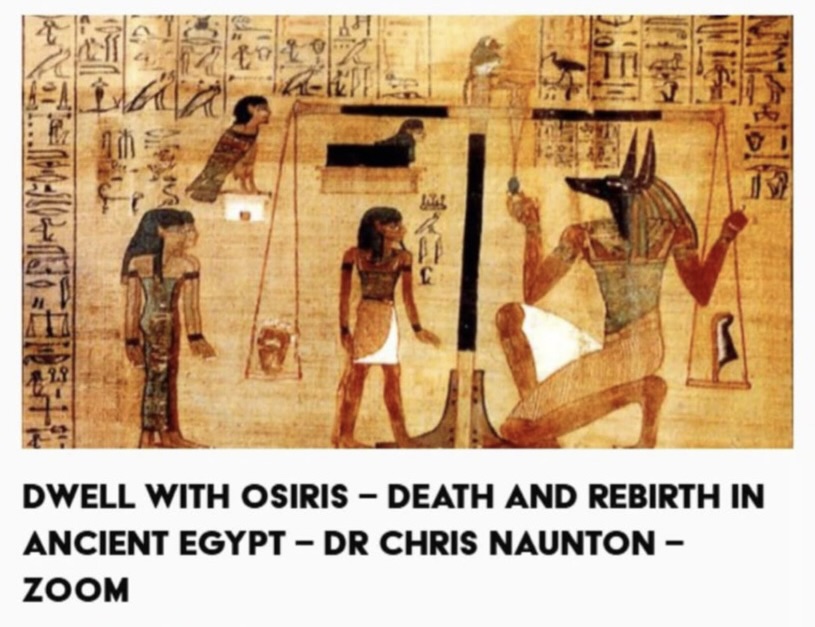
Siptah, Tausret and the Chancellor, Bay: the end of the 19th Dynasty
Tuesday 31 March 2026, 6.00 pm UK time
Live via YouTube – click here
PLEASE NOTE: This talk will be available to YouTube Channel members in the ‘Lapis’ category only. To become a member – or to upgrade from alabaster to lapis – please see here.
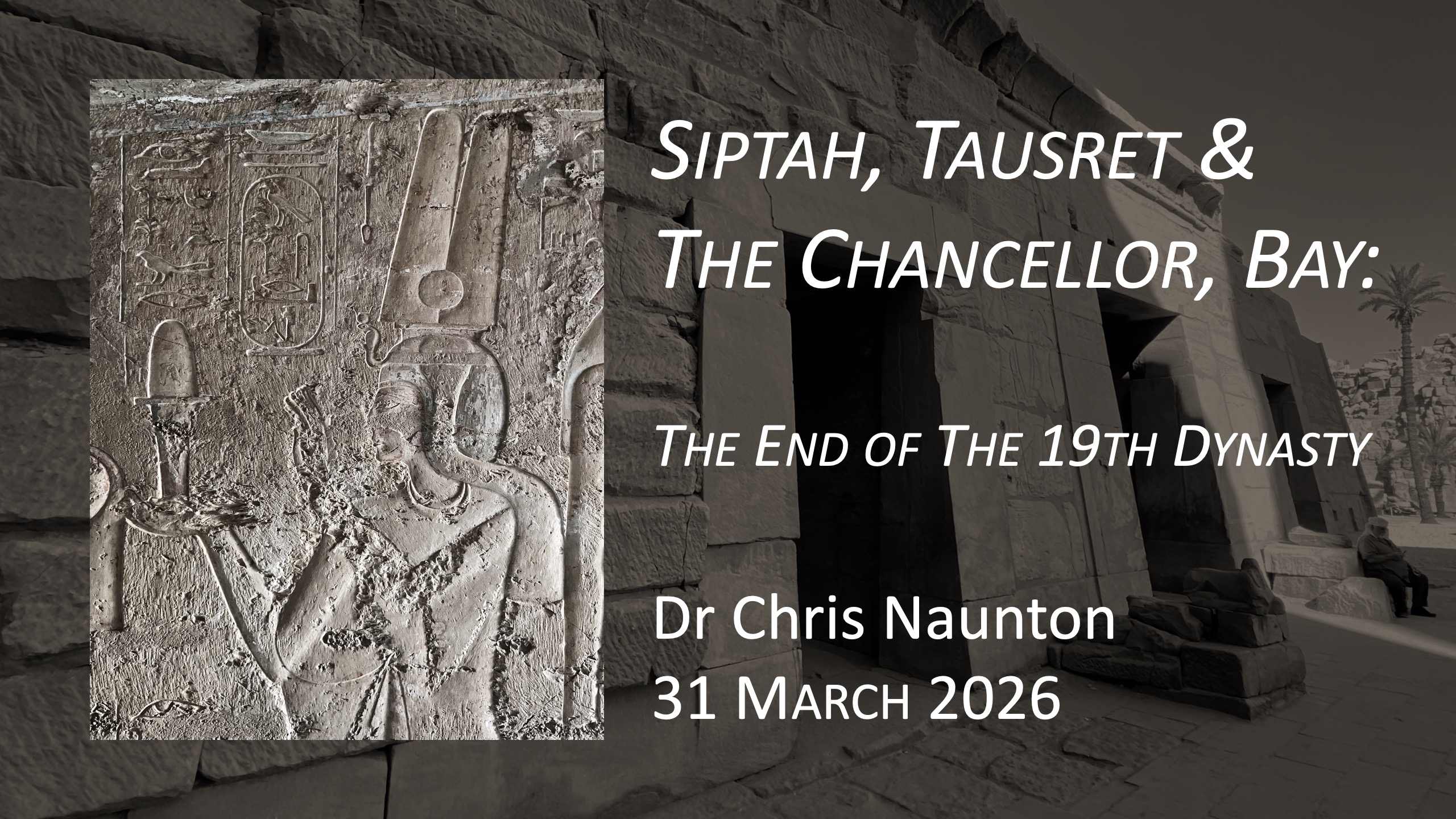
Within two generations of the long and glorious reign of Ramesses II, the Nineteenth Dynasty seems to have been in crisis. Ramesses passed the throne to his thirteenth son, Merenptah (the previous twelve having predeceased their father), but then Merenptah’s son Sety II and Amenmesse – Sety’s uncle? Or half brother? – fought over the kingship; they were then succeeded by Siptah who was probably a son of one or the other of his two immediate predecessors, who came to the throne as a child and ruled only for a short time. Sety II’s wife, Tausret, and the Chancellor Bay – an Asiatic – pulled the strings as regents to Siptah, before the queen had Bay, and eventually reigned for a year or two on her own. This chaotic situation was only brought to an end by Sethnakht a man who was probably unconnected to the royal family, and inaugurated a new line of kings: the Twentieth Dynasty. This talk will review the evidence for these individuals, their relationships and the intrigues that eventually brought the Nineteenth Dynasty to an end.
Statues, Mummies and Embalmers: caches in ancient Egypt
Friday 24 April 2026, 6.00 pm UK time
Live via YouTube – click here
PLEASE NOTE: This talk will be available to YouTube Channel members in the ‘Lapis’ category only. To become a member – or to upgrade from alabaster to lapis – please see here.
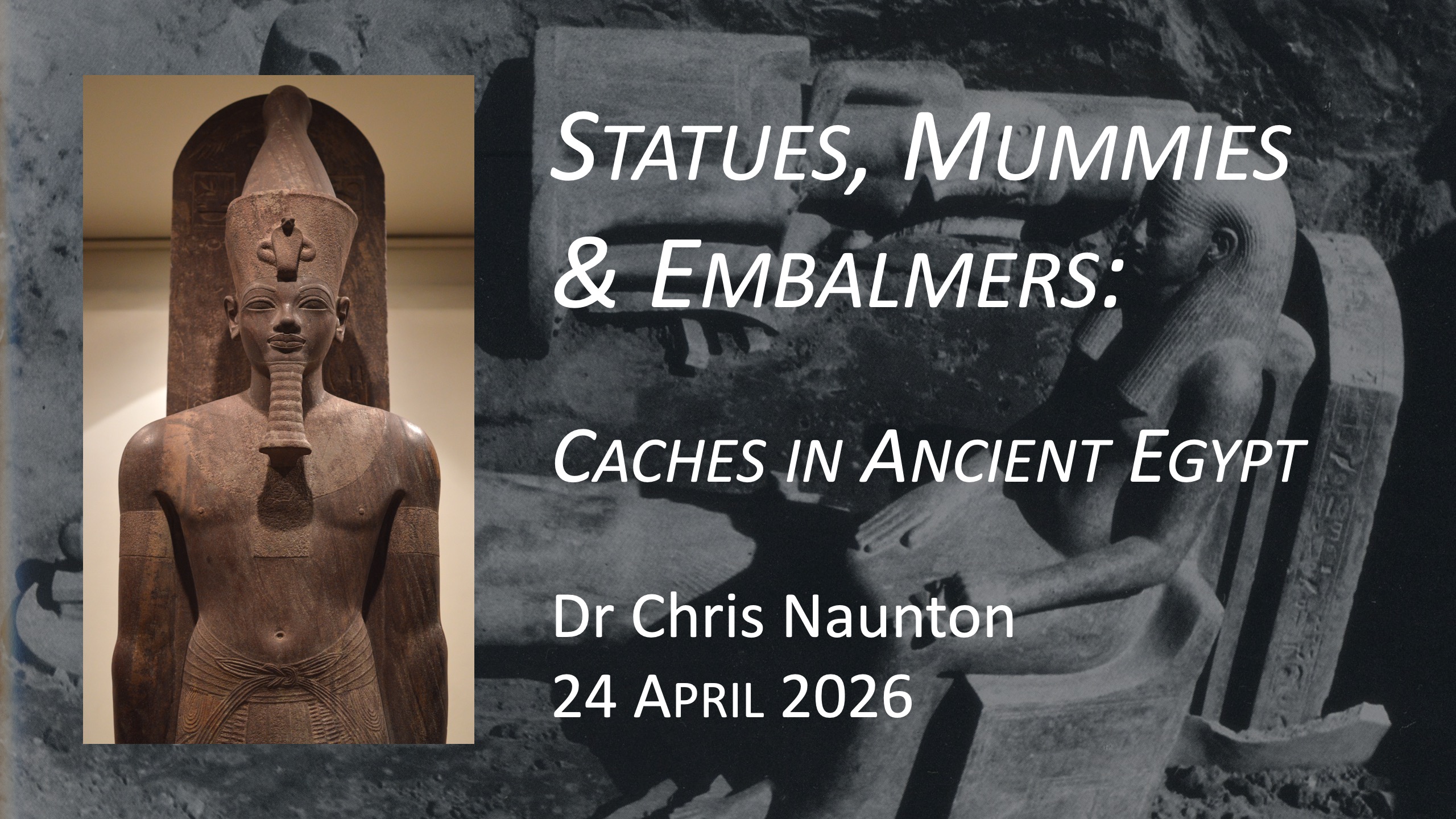
For archaeologists, ancient objects are the material embodiment of information – they tell us things about the ancient past. They’re often also very beautiful and convey a powerful sense of connection to the ancient people who made them, owned them or used them. For the ancients, certain kinds of object were so sacred that even when they were no longer required, they could not simply be thrown away, but instead were deliberately and carefully buried. Caches of statues have been found at Karnak, Luxor, Dokki Gel and elsewhere, and caused a sensation when they were rediscovered in modern times. Caches of mummies, of kings, queens and others made for equally spectacular and important discoveries. Less well known, but arguably as important, are the caches of other material – embalming equipment, temple furniture, and precious metals. This talk will look at some of the best examples of this fascinating ancient practice.
—–
PREVIOUS ONLINE TALKS (with links to recorded versions!):
PEOPLE AT AMARNA. From Akhenaten and Nefertiti to John Pendlebury and Mary Chubb
Tuesday 14 April 2020, 12.00 pm (UK time)
Thursday 16 April 2020, 5.00 pm (UK time)
Tuesday 21 April 2020, 11.00 am (UK time)
Hosted by The Egypt Exploration Society.
A recorded version of this talk is now available via the Egypt Exploration Society’s YouTube channel and here (see below):
Tell el-Amarna is the name we give to the site of Akhetaten, the city founded by the heretic pharaoh Akhenaten as the capital of his new Egypt. His story has proven to be one of the most captivating from anywhere in the ancient world and yet it was almost completely unknown until less than two hundred years ago. Various travellers, expeditions and archaeologists have helped reveal the evidence for what happened in the relatively brief period of the city’s existence, and the contribution of the various EES expeditions in this is immense. In this talk we’ll look at the site, some of its history and the work of those who have revealed Amarna to be one of the most important ancient sites in the world.
For those who have joined / will be joining any of the ‘People at Amarna’ talks, a guide to further reading and other resources online is available here.
AFTER AKHENATEN. Nefertiti, Smenkhkare, and where were they all buried?
Monday 27 April 2020, 12.00 pm (UK time) FULLY BOOKED
Wednesday 29 April, 5.00 pm (UK time) FULLY BOOKED
*NEW DATE: Monday 4 May 2020, 5.00 pm (UK time).
A recorded version of this talk from April 2021 is now available here.
What happened after Akhenaten’s death? Where was he buried? Who succeeded him? Could it have been Nefertiti? And who was Smenkhkare? Tantalising clues have been found at Amarna and in the Valley of Kings. But how to make sense of them?
For those who have joined / will be joining any of the ‘After Akhenaten’ talks, a guide to further reading and other resources online is available here.
EGYPT’S LOST PYRAMID
Wednesday 13 May 2020, 5.00 pm (UK time). FULLY BOOKED
Monday 18 May 2020, 12.00 pm (UK time). FULLY BOOKED
Wednesday 20 May 2020, 5.00 pm (UK time).
A recorded version of this talk is now available here:
In 2017 an Egyptian Mission discovered a previously unknown pyramid at the site of Dahshur & it seemed the burial chamber was intact… I was lucky enough to visit to make a film when the tomb was opened. This is the story.
The film was broadcast in the UK on Channel 4 in October 2019 and is available via All4 here. It subsequently appeared on the Smithsonian Channel in North America, see here. Do take a look a look, there will be a chance for you to ask any questions you might have at the end of the talks!
As with previous talks a guide to online resources and further reading is here.
THE KINGDOM OF KUSH
Wednesday 24 June 2020, 5.00 pm (UK time).
Friday 26 June 2020, 11.00 am (UK time).
PLEASE NOTE: There is no mandatory charge for this event but registration is on a ‘pay what you like’ basis. If you would like to make a small contribution I would be very grateful; you can do so via PayPal or Monzo (no sign up required in either case).
Thank you and see you at the talk!
A recorded version of this talk is now available here.
The Kingdom of Kush: Egypt’s mighty rival in the south. Egypt expanded into the territory to its south at various times in history, built monuments there and influenced the beliefs and practices of the people they encountered. But the influence went both ways; at times the tables turned and the Kingdom of Kush, centring on the cities of Kerma and later Napata and Meroe, became more powerful than Egypt. Kings of Kush even came to rule Egypt as the Twenty-fifth Dynasty. They retreated after a century of rule but continued to thrive in the middle Nile Valley for centuries more, burying their rules under distinctively tall pyramids. This is their story.
The usual guide to further reading and online resources is available here.
SEARCHING FOR IMHOTEP
Wednesday 3 June 2020, 12.00 pm (UK time).
Monday 8 June 2020, 5.00 pm (UK time).
*EXTRA DATE: Sunday 5 July, 6.00 – 8.00 (UK time).
This event will be hosted by The Explorers Club. A big thank you to Sarah Janes for the invitation!
A recorded version of this talk from November 2020 is now available here.
Imhotep. The name has been made famous by Hollywood mummy movies but the real-life man of this name was perhaps even more extraordinary. He is credited with designing the Step Pyramid, the very first of these iconic monuments, and long after his death he became a folk hero, and eventually a god. Despite his status, his tomb has never been found. Two thousand years after he lived, the ancients made thousands of offerings to him around a group of tombs of Imhotep’s time. Could one of them have been the final resting place of the man himself?
For anyone wanting to follow up any of the specific issues discussed, a guide to online resources and further reading is here.
CAUSING HIS NAME TO LIVE: the ancient Egyptian quest for immortality
Sunday 19 July, 7.00 pm (UK time)
Hosted by New Day Culture. REGISTER HERE.
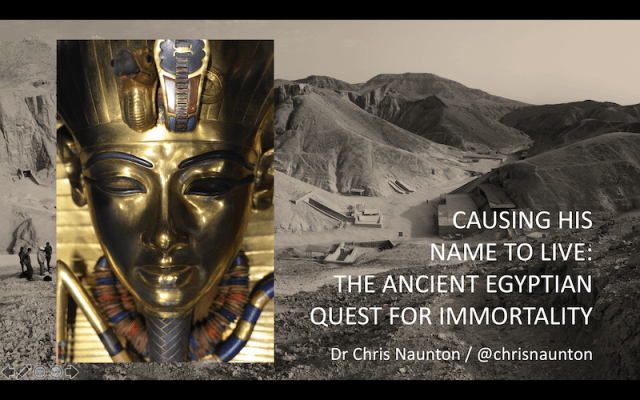
The discovery of the intact tomb of pharaoh Tutankhamun by Howard Carter in 1922 was the greatest moment in the history of archaeology. It brought to light more than 5,000 of the most exquisite objects to have survived from the ancient world, masterpieces which speak to the vision and imagination of the Egyptian artists and craftsmen, and their ability to work with a wide range of materials – wood, stone, ceramic and precious metals especially, of course, gold. Such beautiful objects need no more explanation – they can simply be enjoyed as exquisite works of art – but in fact every item was present in the tomb for a reason: they were the equipment the king would need for his journey to an eternal afterlife. This is the story of how he got there.
ALEXANDER THE GREAT. Buried three times in Egypt… But where are those tombs?
Friday 31 July, 11.00 am (UK time). Fee £4.
Wednesday 5 August, 5.00 pm (UK time). Fee £4. REGISTER HERE
A recorded version of this talk is now available here.
Alexander the Great conquered vast amounts of territory and came to rule a greater empire than had ever existed up that time. Along the way he chased the reviled Persians out of Egypt and was welcomed as pharaoh. He stayed in the country for just a few months and never returned, dying a few years later in Babylon. But his body was brought to Egypt for burial by his eventual successor, the general Ptolemy, no doubt in a suitably grand monument. Classical authors tell of visits by Julius Caesar, Augustus Caesar, Hadrian and others, but the tomb (or tombs…) has never been located. Where was it, and could it yet be found?
The slides from the talk and a guide to further reading are available here.
TUTANKHAMUN’S TURBULENT REIGN
Saturday 15 August, 9.00 pm (UK time)
Hosted by New Day Culture.
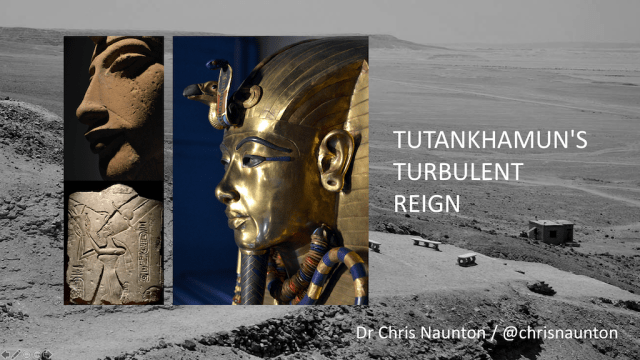
It’s often thought that Tutankhamun was a pharaoh of minimal significance: he was just a boy when he came to the throne, he died only a few years later as a young adult, and almost nothing was known about him until his tomb was found to be, by chance, intact. But in fact his reign represents a pivotal moment in Egyptian history. He was born in the midst of the revolution of his predecessor, Akhenaten, whose image – along with that of his queen Nefertiti – is a grotesque parody of the serene beauty of traditional Egyptian art, who asked his people to forget almost all their gods, and moved thousands to a brand new capital city in the desert. It didn’t last, and it was during Tutankhamun’s reign that Egypt emerged from its punk rock phase and normal service was resumed.
BOOK LAUNCH
Weds 30 September at 7.00 pm. This will be a very informal affair which takes the place of a real-life launch event. I’ll be giving a short presentation, and I’ll also be joined by SALLY NICHOLLS, the picture researcher I worked with in putting the images together. We’ll both be explaining how the book came about and what creating it involved, and trying to keep tearful thank yous to a minimum 🙂 I’m hoping to rope in a couple of others who worked on the book as well – more details as I get them. Bring a drink, and help us to celebrate publication!
This is a FREE event, ALL WELCOME. To register please go here.
EGYPTOLOGISTS’ NOTEBOOKS PART I: An Untouched Antique Land
Wednesday 14 Oct 2020, 6pm (UK time). Fee £4.
Friday 16 Oct 2020, 11am (UK time). Fee £4.
A recorded version of this talk is now available here.
Imagine a time before Egyptology, when Egypt was known to Europeans for its great ancient civilisation but only through the accounts of classical authors and the Bible. The earliest western visitors went to Egypt in the hope of seeing the pyramids, great cities, and perhaps the evidence of the presence of Joseph and Moses. Their expectations were sometimes exceeded, sometimes confounded: the pyramids were the great wonder of ancient repute, but Alexandria lay in ruins, and Memphis seemed lost. Nonetheless what they and their successors saw filled them with awe and some saw things Europeans were entirely unaware existed: imagine being among the first to see the ‘hundred gated Thebes’ of Homer, or the first to set eyes on Abu Simbel or Meroe…
STARRING: George Sandys, Frederik Ludwig Norden, Richard Pococke, Dominique Vivant Denon, Frédéric Cailliaud, John Gardner Wilkinson.
Egyptology in an Hour
Tuesday 20 October, 6.30 – 7.30 pm
(Victoria, Australia time = 8.30 – 9.30 am UK time)
Hosted by Glen Eira Libraries. For more info or to register go here.
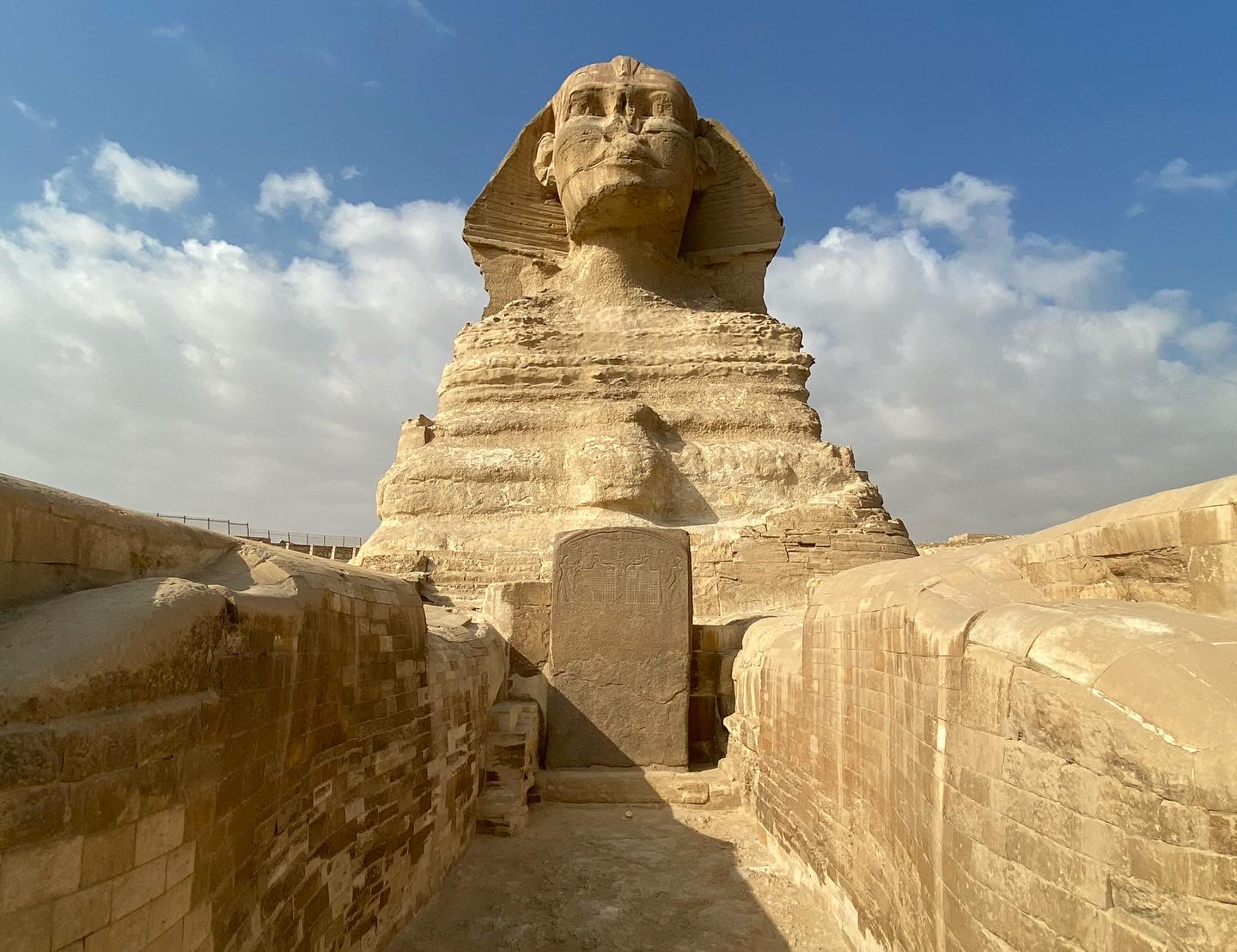
Ancient Egypt: where and when was it, and what made it the most instantly recognisable of all ancient civilisations, and the one that gets us all so interested? This is an Egyptologist’s take on what you need to know. Pyramids, obelisks, mummies, hieroglyphs, people with animal-heads standing side-on and walking like, well, Egyptians. Old Kingdom, New Kingdom, thirty Dynasties, a Kings’ Valley, a Queens’ Valley, two of the seven wonders of the ancient world, and some of its most famous names: Akhenaten, Nefertiti, Tutankhamun, Ramesses, Alexander the Great and Cleopatra, all of them pharaoh of Egypt, one of them the inspiration for a play of Shakespeare’s, another for one of Hollywood’s most famous villains. Bring your bull-whip and don’t forget your hat…
Tutankhamun and the Ancient Egyptian Quest for Immortality
Tuesday 27 October, 6.30 – 7.30 pm
(Victoria, Australia time = 7.30 – 8.30 am UK time)
Hosted by Glen Eira Libraries. For more info or to register go here.

The discovery of the intact tomb of pharaoh Tutankhamun by Howard Carter in 1922 was the greatest moment in the history of archaeology. It brought to light more than 5,000 of the most exquisite objects to have survived from the ancient world, masterpieces which speak to the vision and imagination of the Egyptian artists and craftsmen, and their ability to work with a wide range of materials – wood, stone, ceramic and precious metals especially, of course, gold. Such beautiful objects need no more explanation – they can simply be enjoyed as exquisite works of art – but in fact every item was present in the tomb for a reason: they were the equipment the king would need for his journey to an eternal afterlife.
200 years of Egyptology: the good, the bad and the ugly
Friday 30 October 2020, 2.00 – 3.00 pm
Hosted by Thames and Hudson as part of the Council for British Archaeology Festival of Archaeology.
A recorded version of this talk is now available here.
Renowned Egyptologist Dr Chris Naunton explains what Egyptology has taught us about the ancient past, but also how its darker, colonialist side might help us to do things differently in the future.
EGYPTOLOGISTS’ NOTEBOOKS PART II: Artists, Expeditions and Nationalist Competition
Wednesday 4 November 2020, 6pm (UK time). Fee £4.
Friday 6 November 2020, 11am (UK time). Fee £4.
A recorded version of this talk is now available here.
In 1798 a French expedition under Napoleon Bonaparte invaded Egypt in order conquer and exploit the country and disrupt British access to India. The expedition was forced to withdraw the following year in the face of resistance from British and Ottoman troops but Napoleon had also brought with him a corps of artists and scientists – ‘savants’ – whose task was to create a grand ‘description’ of the natural environment of the country and its monuments. The record they created was the first comprehensive survey of the country’s archaeology. In the years that followed more and more Europeans settled in Egypt, and many sought to create their own accurate records of the country’s monuments, improving on the savants’ Description as more and more monuments were discovered and scholars able to read hieroglyphs demanded more inscriptions be copied with greater accuracy. These records were of enormous value in their time and all the more so since, as many of the monuments they saw have since been lost…
STARRING: William John Bankes, James Burton, Edward William Lane, Robert Hay, Jean-François Champollion, Nestor l’Hôte, Karl Richard Lepsius.
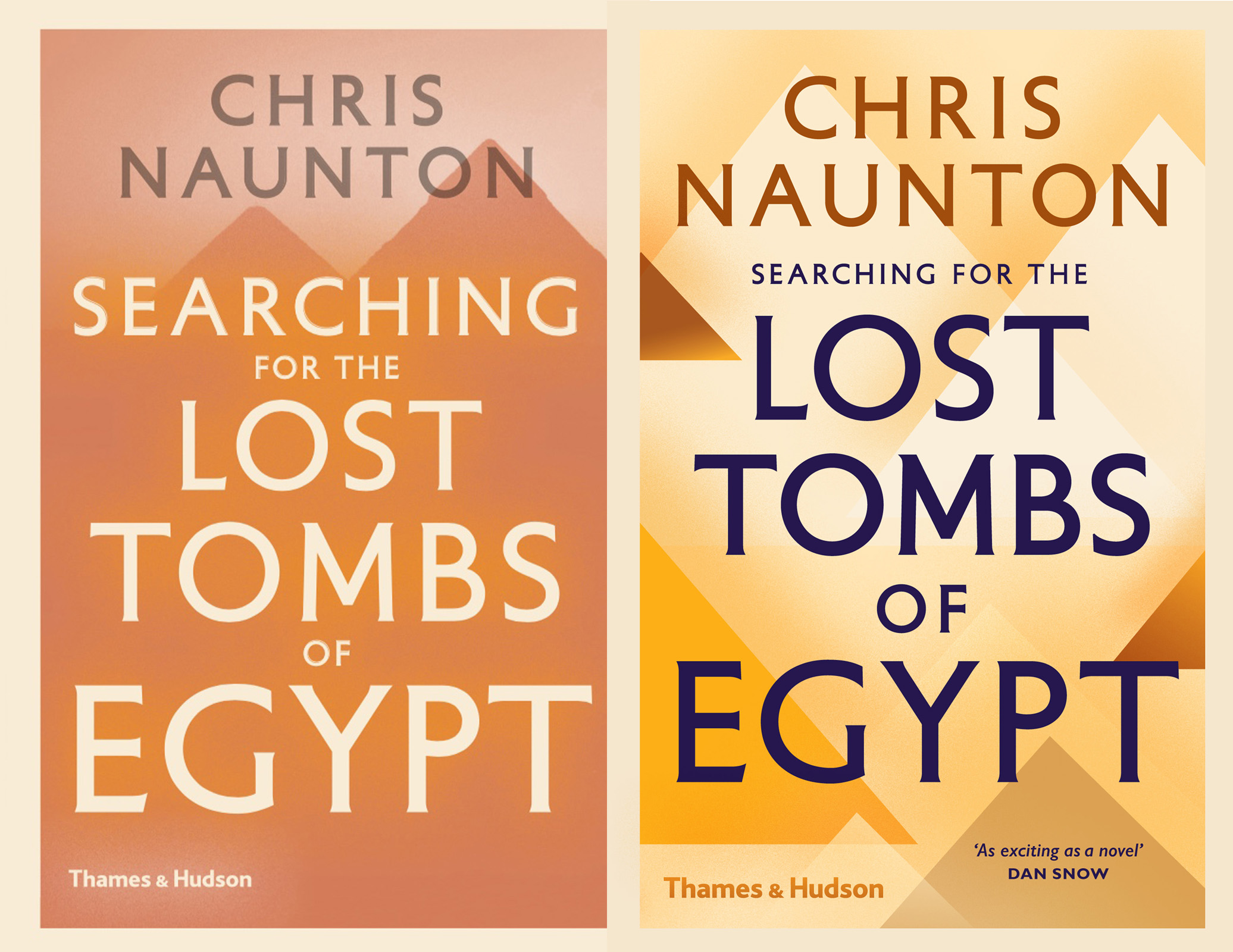
Searching for the Lost Tombs of Egypt
21 November 2020
Hosted by the North East Ancient Egypt Society – see here for further details.
EGYPTOLOGISTS’ NOTEBOOKS PART III: Archaeology Begins
This is the final installment of a three-part mini-lecture series on my new book Egyptologists’ Notebooks which was published out on 1 October. Each talk has been designed to work on its own so if you missed parts I and II don’t worry, this one should still be perfectly comprehensible (and perhaps even enjoyable!). As always there will be an opportunity to ask questions afterwards.
Wednesday 2 December 2020, 6pm (UK time). Fee £4.
Friday 4 December 2020, 11am (UK time). Fee £4.
A recorded version of this talk is now available here.
In the early nineteenth century the European powers considered the acquisition of ancient monuments for their respective national collections to be a fine way to bring glory upon themselves. And the bigger the collection, the bigger and finer or more exotic the pieces, the better. This led to intense competition, in particular between the British Consul, Henry Salt, and his French counterpart Bernardino Drovetti, both of whom were voracious collectors. Both employed a number of agents to uncover and remove antiquities, initiating the first archaeological excavations in the country. Salt and Drovetti both amassed multiple collections which were ultimately sold to the major museum in Europe, in particular in London, Paris and Turin. Two of their agents, Belzoni and Rifaud are responsible for the discovery of many of the great masterpieces of sculpture now in European museums. Their methods didn’t quite match up to the standards of today’s archaeologists but things were going to change…
STARRING: Giovanni Battista Belzoni, Jean-Jacques Rifaud, Joseph Hekekyan, Amelia Edwards, Flinders Petrie, Marianne Brocklehurst, Howard Carter, John Pendlebury, Bryan Emery.
CLEOPATRA: TOMB, BATHS and BIRTH-HOUSE (and other lost monuments)
Tuesday 15 December 2020, 6 pm (UK time). Fee £4. *SOLD OUT*
Wednesday 16 December 2020, 11 am (UK time). Fee £4.
*EXTRA DATE: Wednesday 27 January 2021, 6.00 – 8.00 (UK time).
This event will be hosted by The Explorers Club. For more info or to register please see here. A big thank you to Sarah Janes for the invitation!
A recorded version of this talk is now available here:
Cleopatra is perhaps one of most famous figures in the ancient world and yet little of what we know about her comes from archaeological evidence in Egypt. The story of her final days is well know and classical accounts tell us a little of her tomb and where it was, but it has never been found. She created a myth that she was Isis and her son, Horus – to help establish their legitimacy – and yet these crucially important scenes were lost over a century ago. Famously she bathed in milk and yet the ‘baths of Cleopatra’ which were a must-see for 19th Century travellers have now disappeared. What happened, and how can Egyptologists’ records help us to retrieve what has been lost?
The slides from the talk and a guide to further reading are available here.
EGYPTOLOGY CHRISTMAS QUIZ!
Tuesday 22 December 2020, 6 pm (UK time). Fee £4.
Wednesday 23 December 2020, 11 am (UK time). Fee £4.
WHAT a strange year it’s been… But being able to carry on doing Egyptology online has been quite the silver lining! I’ve given more lectures this year than ever before, to more people, in more places… Thank you so much to all those of you have joined the talks and posted your questions and comments at the events and elsewhere online. It’s been an enormous pleasure to be in regular contact with so many of you, and it has really helped keep me going this year. THANK YOU!
But now it’s time to see if you’ve learned anything… 🙂 Or, better, to celebrate this extraordinary year with one last, rather more laid back online event: my very first Egyptology-themed Christmas quiz. There will be questions on history, names, faces, places, mythology, Egypt in pop culture and a picture round. You’ll have the chance to WIN A SIGNED COPY of Egyptologists’ Notebooks, and I’ll be donating 50% of the proceeds to the The Trussell Trust (‘Stop UK Hunger’) and housing and homelessness charity, Shelter. Bring a drink, your pens and pencils, and your Santa Claus hats. Let’s celebrate the festive season, and all the good things that have come to us in the last 12 months, and say goodbye to all the bad. Hope to see you there!
EGYPTOLOGISTS’ NOTEBOOKS
Monday 11 January 2021
Hosted by The British Museum. Exclusive Members’ online event.
For further details or to register please see here.
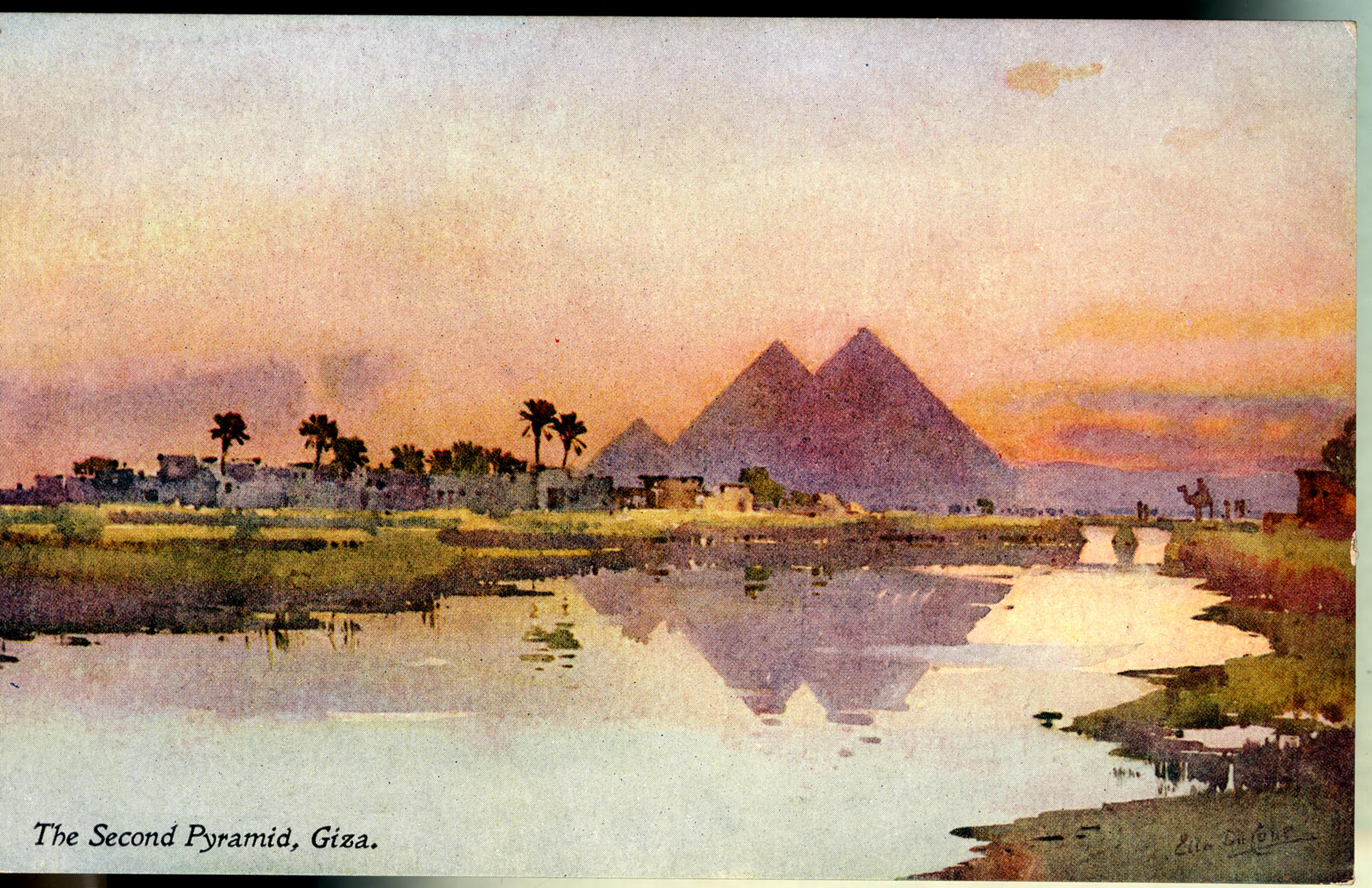
Postcard; printed paper; colour reproduction of a painting showing the Second Pyramid at Giza, designed as an illustration for John A. Todd’s book, ‘Banks of the Nile’, published by A & C Black in 1913. © The Trustees of the British Museum
For centuries the ancient ruins of Egypt have provided an endless source of fascination for explorers, antiquarians, treasure hunters and archaeologists. All, from the very earliest travellers, were entranced by the beauty and majesty of the landscape: the remains of tombs cut into the natural rock of hillsides and the temples and cities gently consumed by drift sand. These early adventurers were gripped by the urge to capture what they had seen in writings, sketches, paintings and photographs. While it was always the scholars – the Egyptologists, like Sir William Matthew Flinders Petrie – who were in charge, their work depended on the important roles played by architects, artists, engineers, photographers and local Egyptian workers digging on archaeological projects.
In this exclusive Members’ online event, discover the many people who contributed to our understanding of ancient Egypt. Dr Chris Naunton will evoke a rich sense of time and place, transporting us back to a great age of discovery and offering a glimpse into a very different history of Egyptology.
THE THIRD INTERMEDIATE PERIOD IN EGYPT
Two afternoons of lectures hosted by Kemet Klub (Bristol, UK)
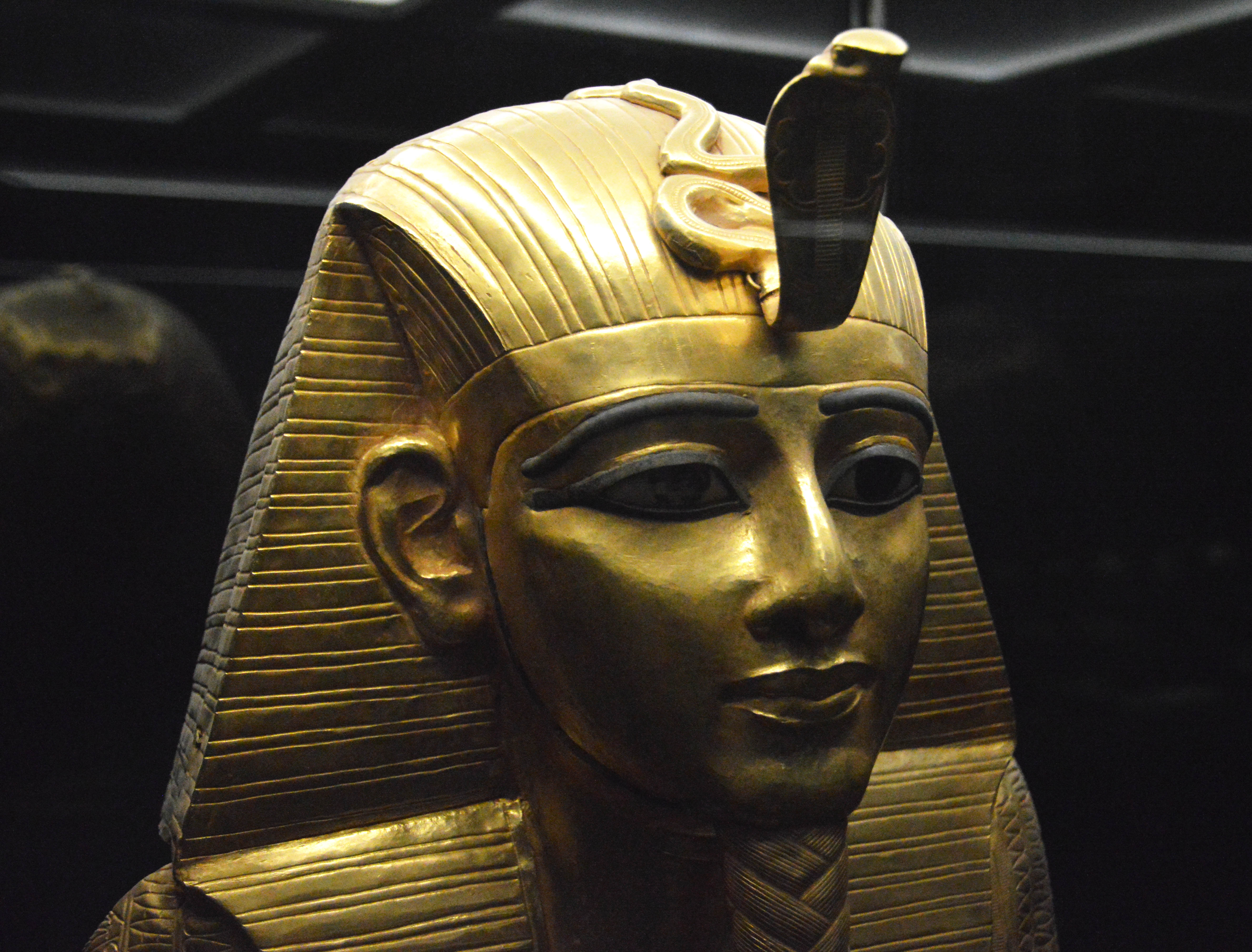
Death mask of Pharaoh Psusennes I (21st Dynasty) from his tomb at Tanis
Sunday 10 January 2021:
The Twenty-first Dynasty: pharaohs to the north, chief priests to the south
AND
The Libyans and a Reunified Egypt (but not for long) – Dynasties 22 and 23
Sunday 17 January 2021:
The Missing Third Intermediate Period Tombs – a case of looking in the wrong place
AND
The Coming of the Kushites: Egypt’s Twenty-fifth Dynasty
The Third Intermediate Period (TIP) has been much misunderstood. Spanning roughly four centuries it is a period characterised by cycles of division and reunification within the country, and also the influence of foreigners, particularly various groups of ‘Libyan’ settlers, and the emerging new power in the south, the kingdom of Kush. Individuals from both groups came to rule Egypt as pharaoh at various times. Archaeological and textual evidence for the period is fragmentary and has proven difficult to reconcile with other sources, particularly the king list provided by the historian Manetho. We now have a much improved understanding of how Egypt changed during the TIP, of what was distinctive about it, and in particular how Egypt was influenced by the foreign groups. Also vice versa, much more so perhaps, to the extent that even though we refer to parts of the period as the ‘Libyan’ or Kushite’ periods, Egypt was still very much Egypt.
Price. £27.50 To book your place: contact Ali on 01275 791562 or email ali.dave@blueyonder.co.uk.
My slides for all four talks and a guide to further reading are available here.
Playing in the Past: A visit to Ptolemaic Thebes
Thursday 4 February 2021, 3 pm (UK time)
Hosted by the Playing in the Past project (PITP)
A recorded version of this virtual tour is now available via Twitch, here.

Following an introductory tour of Ptolemaic Egypt as depicted in the video game Assassin’s Creed: Origins, this is the first in a new series of events exploring the game comprising (from the PITP website): a “20-30 minute talk on a specialist subject from an expert. Following this there will be a 10-20 minute in-game tour with the expert to showcase what was discussed in the talk and a 20 minute ‘free’ explore where viewers are encourage to ask questions to the experts and to direct us to explore the things you are most interested in.”
THE MISSING TOMB OF AMENHOTEP I
Wednesday 10 February 2021, 6.00 pm (UK time). Fee £5. REGISTER HERE
Thursday 11 February 2021, 11.00 am (UK time). Fee £5. REGISTER HERE
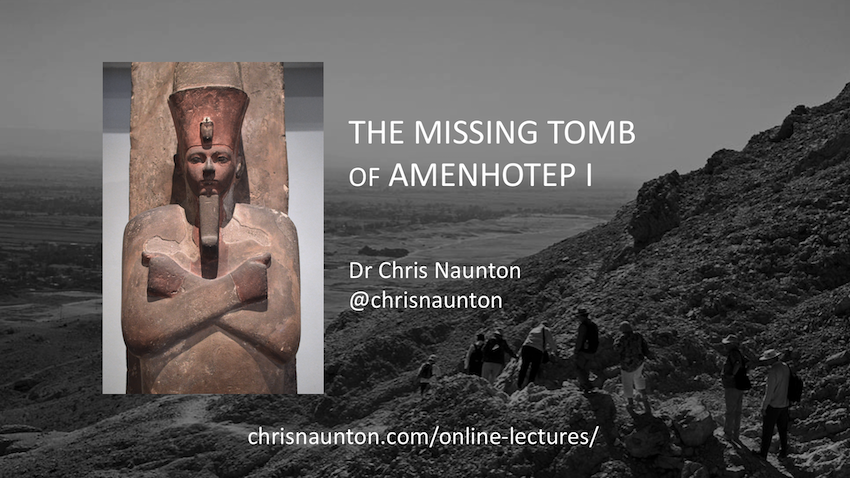
Amenhotep I was the second king of the Eighteenth Dynasty, and of the great period Egyptologists call the New Kingdom. Although all kings were semi-divine he seems to have enjoyed an unusually elevated status as a kind of ‘patron saint’ of the workmen of Deir el-Medina, who cut the royal tombs in the Valley of Kings. And yet his own tomb is one of few belonging to the kings of this period that has never been found. There are several candidate locations all of which are explored in this talk…
The slides from the talk and a guide to further reading are available here.
EGYPTOLOGISTS’ NOTEBOOKS: The Golden Age of Nile Exploration in Words, Pictures, Plans, and Letters – Live Author Q&A
Saturday 13 February 2021
Hosted by Save Ancient Studies America (SASA)
SASA Monthly Book Club w/ Live Author Q&A
A recorded version of the Q&A is now available here:
From the SASA website: Previous participation and previous knowledge not required.
This is your chance to pick the brains of some of your favorite ancient history authors! From fiction to nonfiction, fantasy to reality, we will explore the worlds of books which are set in ancient times, focus on ancient history, and help you learn more through amazing descriptive imagery of the ancient world.
A Popular Science: Communicating Egyptology beyond the Academe – Panel Discussion
Tuesday 9 March 2021
Hosted by Interdisciplinary Egyptology (IntEg) in partnership with The Egypt Centre, Swansea University.
For further details or to register please see here.
Ancient Egypt has long held the fascination of the world outside of the hallowed halls of universities and research institutes, but this can lead to the promulgation of misconceptions and ‘pseudo-science’. This panel explores how we can ensure that researchers can communicate to a wide audience with academic integrity, but in a way that maintains general interest and encourages a deeper appreciation and understanding of the ancient past.
Panellists for this session will be:
• Dr Yasmin el Shazly (Moderator), The American Research Centre in Egypt
• Prof. Salima Ikram, American University in Cairo
• Ms. Fatma Keshk, Freie Universität Berlin
• Dr. Chris Naunton, Independent scholar
• Prof. Kara Cooney, UCLA
TUTANKHAMUN: In Life, Death & Eternal Afterlife
Wednesday 24 March 2021, 6.00 pm (UK time). Fee £5. SOLD OUT
Thursday 25 March, 11.00 am (UK time). Fee £5. REGISTER HERE
A recorded version of this talk is now available here:
The discovery of the intact tomb of pharaoh Tutankhamun by Howard Carter in 1922 was the greatest moment in the history of archaeology. It brought to light more than 5,000 of the most exquisite objects to have survived from the ancient world, masterpieces which speak to the vision and imagination of the Egyptian artists and craftsmen, and their ability to work with a wide range of materials – wood, stone, ceramic and precious metals especially, of course, gold. Such beautiful objects need no more explanation – they can simply be enjoyed as exquisite works of art – but in fact every item was present in the tomb for a reason: they were the equipment the king would need for his journey to an eternal afterlife. This is the story of how he got there – of an eventful life, an early death, what came next, and how the treasures in his tomb have helped us to tell that story.
*This is a revised and expanded version of a talk entitled ‘Causing His Name to Live’ given in July 2020. My slides and a guide to further reading etc. are here.
SEARCHING FOR LOST TOMBS (in Egypt and in Archives)
Tuesday 30 March 2021
Hosted by Highgate Literary and Scientific Institution
Further details tbc.
AFTER AKHENATEN. Nefertiti, Smenkhkare, and where were they all buried?
Wednesday 14 April 2021, 6.00 pm (UK time). Fee £5. SOLD OUT
Thursday 15 April, 11.00 am (UK time). Fee £5. REGISTER HERE
A recorded version of this talk from April 2021 is now available here.
What happened after Akhenaten’s death? Where was he buried? Who succeeded him? We know that Tutankhamun’s reign saw the end of Akhenaten’s revolution and the restoration of the old ways, and the boy-king himself was the last of the family line. But it seems clear that there was at least one other pharaoh in between Akhenaten and Tutankhamun. Who were they? Could it have been Nefertiti? And who was Smenkhkare? Tantalising clues have been in tombs at Amarna and in the Valley of Kings. But how to make sense of them?
*This is a repeat of what has so far proven to be my most popular talk online with almost 700 registrations for three performances in April and May 2020. A guide to further reading and other resources online which I put together after the first performances of this talk in April and May 2020 is available here.
The Amarna Blessed Dead
Saturday 15 May, 2.00 – 4.00 pm (UK time). Fee £5
Hosted by The Chesterfield Egyptology Society. For more info or to register please go here.
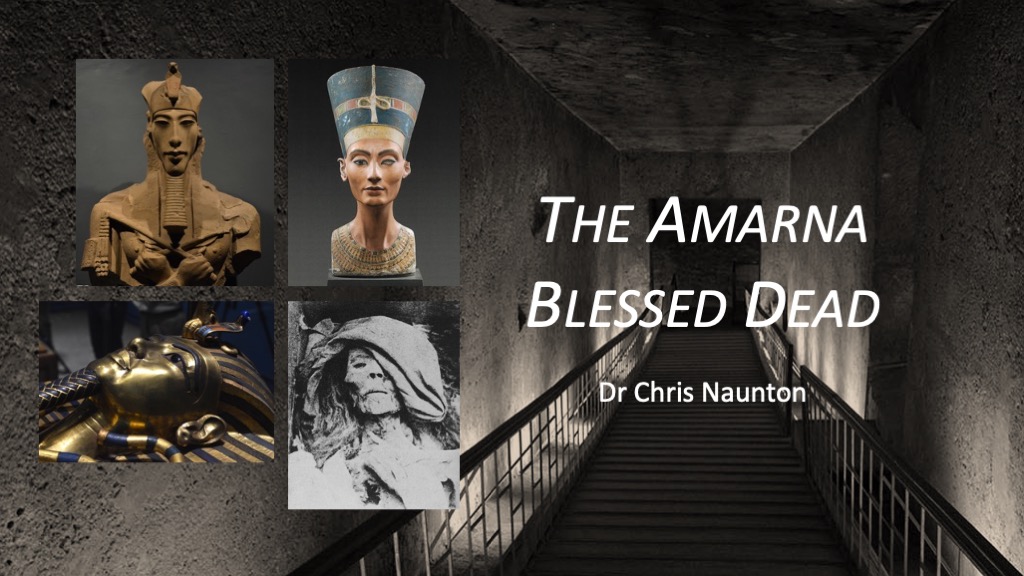
*Please note this is a repeat of a talk previously titled ‘After Akhenaten’ given in April and May 2020 and again in April 2021 (see above and here). It has proven to be my most popular talk online with almost 900 registrations over the five performances. A big thank you to friends at the Chesterfield Egyptology Society for the opportunity to give it again!
Egypt Lost & Found
Tuesday 18 May, 7.30 pm – 8.30 pm
(Victoria, Australia time = 10.30 -11.30 am UK time)
Hosted by Glen Eira Libraries. For more info or to register go here.

Image: the ruins of Karnak as seen by the expedition of Karl Richard Lepsius in the 1840s and published in his Denkmaeler aus Aegypten und Aethiopien.
The earliest European travellers to Egypt knew very little of what ancient sites and monuments they would encounter there. They took with them the descriptions left behind by writers such as Herodotus, Strabo and Pliny who described great cities and temples but they lived when there was still a pharaoh on the throne and their accounts were well over a thousand years old by the time our travellers were visiting. They were left trying to reconcile these ancient accounts with the jumbled ruins they saw on arrival in the formerly great city of Alexandria, and at various points on their journeys south up the Nile valley. This is the story of the modern rediscovery of ancient Egypt.
Akhenaten and Nefertiti: Egypt’s punk revolutionaries
Tuesday, 25 May 2021, 7.30 pm – 8.30 pm
(Victoria, Australia time = 10.30 – 11.30 am UK time)
Hosted by Glen Eira Libraries. For more info or to register go here.
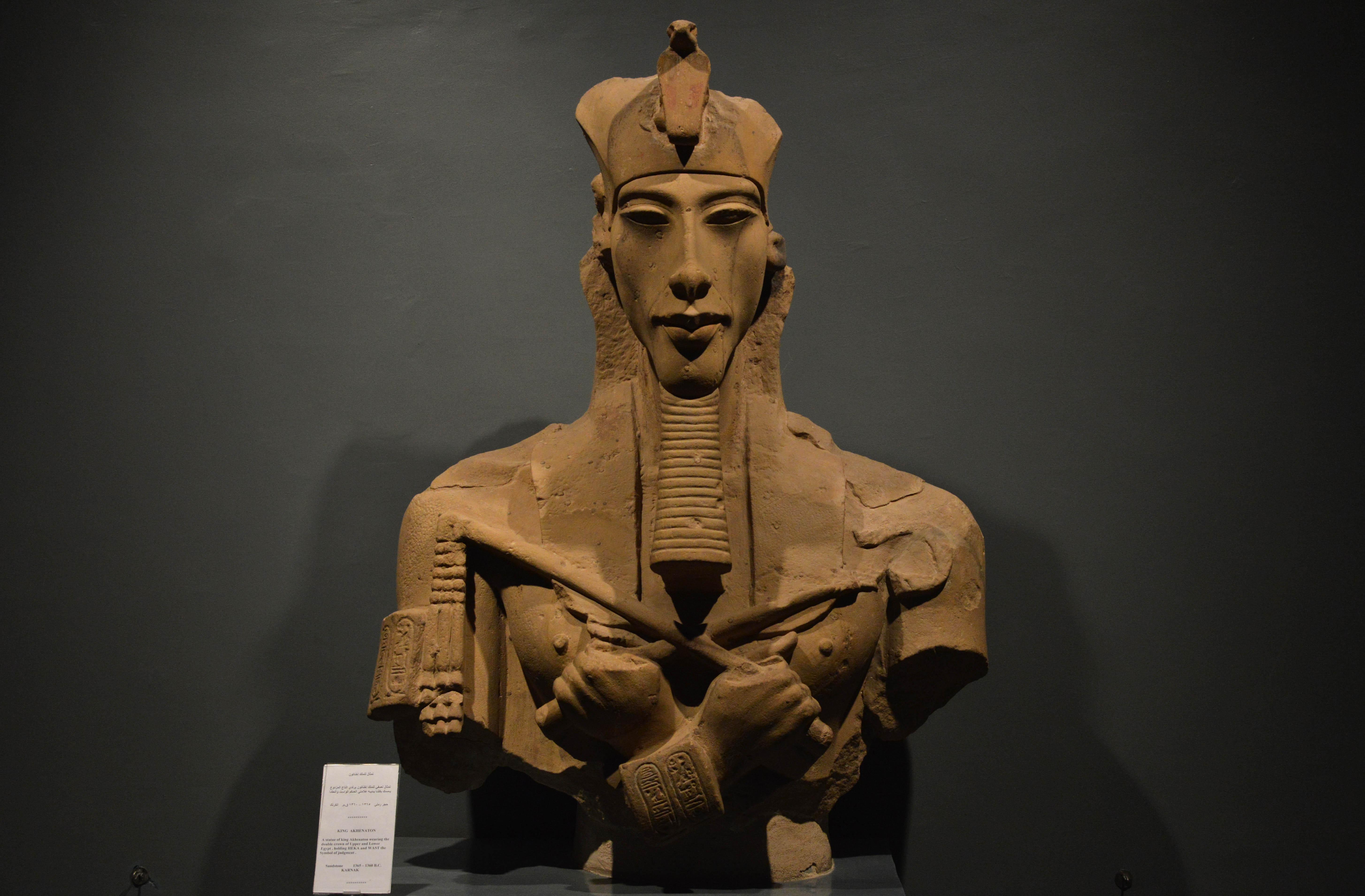
Egypt’s power and influence reached a peak during the 18th Dynasty. The military campaigns of Thutmose I and III had allowed Egypt to take control of the territories and the people to the north and south; vast wealth poured into the country in the form of tributes from the subjugated. At the top, pharaoh was as powerful as ever, and ever more divine. And then, in a few short years the tenth pharaoh of the line, Amenhotep IV, turned the country on its head. He built new temples on virgin soil at Karnak, in a new style with decoration showing himself and his wife, Nefertiti, elevated to much greater prominence than was conventional. Colossal statues of the king broke all artistic conventions, showing the king with exaggerated features, looking almost grotesque. After a few years he gave himself a new name – Akhenaten – ‘effective for the Aten’, and set about building an entirely new capital city – Akhetaten – the ‘Horizon of the Aten’ – on virgin soil at a place we now call ‘Amarna’. Just over a decade later, Akhenaten died and the old ways were soon restored, and Akhenaten deliberately forgotten. His aims remain unclear but in art and literature, things were never the same again. This was ancient Egypt’s punk rock moment, revealed by Egyptology to have been one of its greatest stories.
KING TUTANKHAMUN TELLS ALL! Virtual Storytelling Session
Friday 11 June, 4.00 pm (UK time). REGISTER HERE
Registration is free but the event is part of NSPCC’s Childhood Day and anyone attending is encouraged to make a donation via this page.
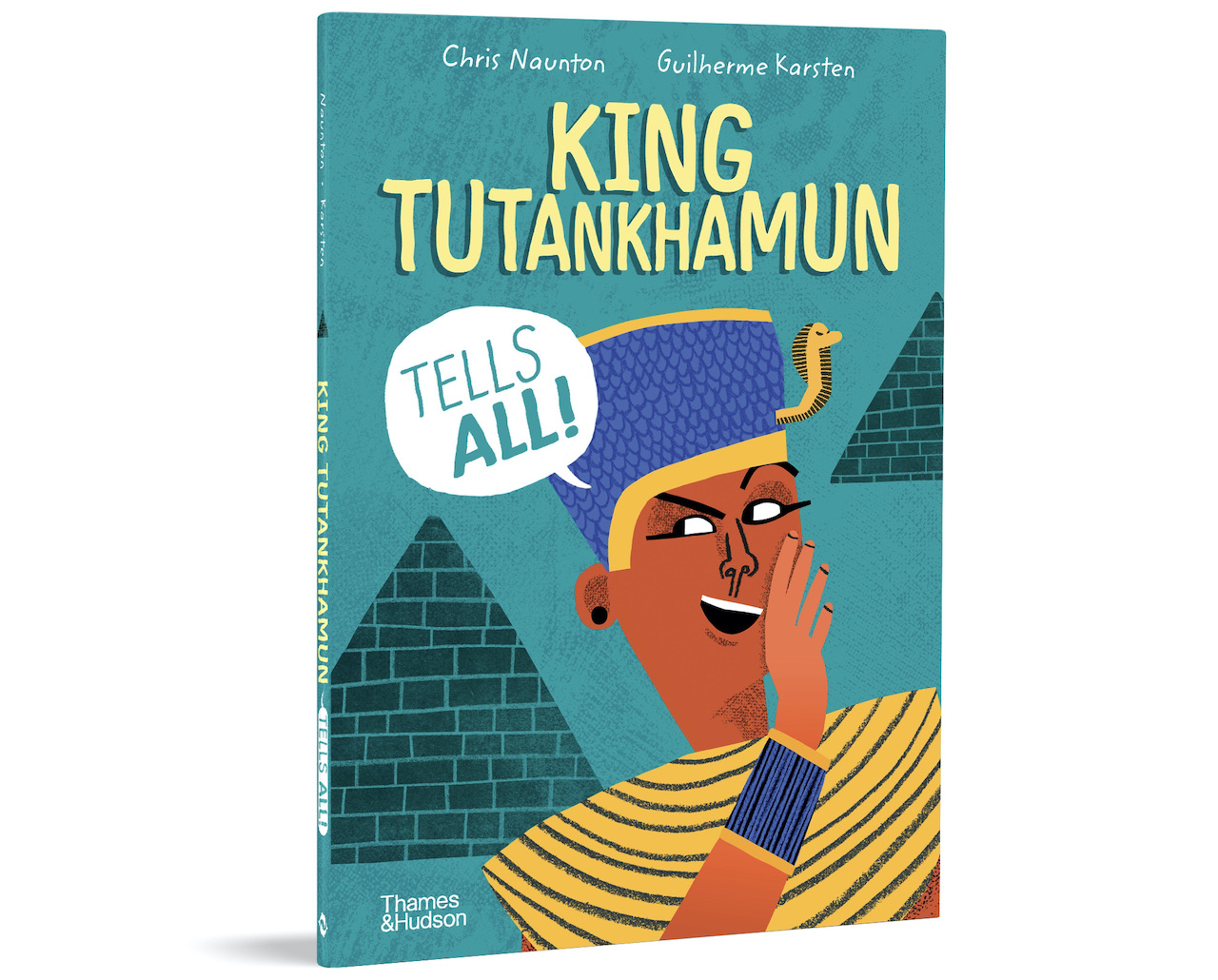
I’ve been studying Tutankhamun, his tomb and his life for years and have always wondered what the boy-king would say if he could tell his story for himself. He gets his chance in my new book: KING TUTANKHAMUN TELLS ALL! which will be published by Thames & Hudson on 3 June 2021 (more info here!). In this session for younger Egyptologists I’ll be explaining how the book came about, and reading some passages from it. And at the end there will be a chance for YOU to ask your questions!
Egyptologists’ Notebooks
Saturday 19 June, 1 – 2 pm (UK time). Free admission, booking required.
York Festival of Ideas. For more info or to register go here.
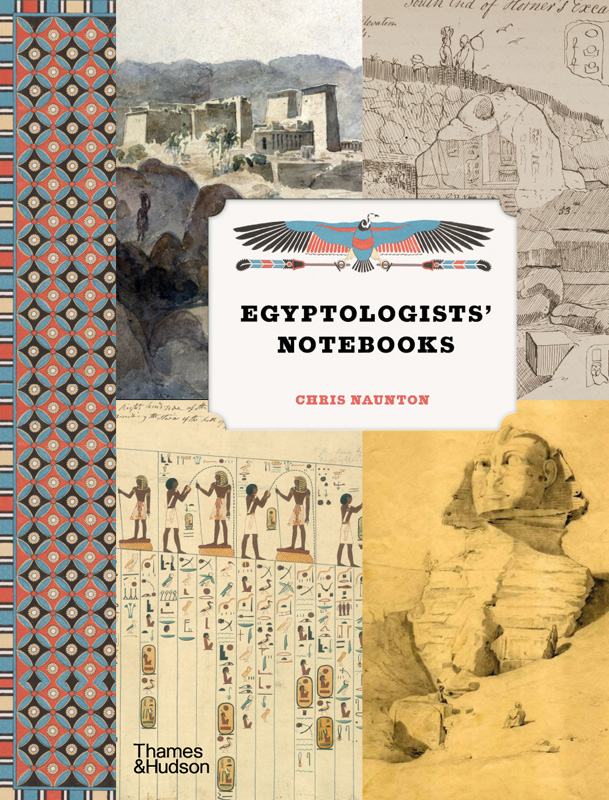
From the York Festival of Ideas website: “Join Egyptologist Chris Naunton for a gorgeous presentation of intimate diaries and journals that capture the excitement of the golden age of Nile exploration.
A visual celebration of Egypt’s ancient past, Chris’s richly illustrated talk will feature evocative sketches, paintings, and photographs from pioneering explorers’ and archaeologists’ journals, providing behind-the-scenes access to the archaeological discovery of Egypt.
Chris, author of Egyptologists’ Notebooks, will explore how for centuries the ancient ruins of Egypt have provided an endless source of fascination for explorers, antiquarians, archaeologists, and the public. Discover how early adventurers were gripped by the urge to capture what they saw in writings, sketches, paintings, and photographs.
This event is hosted live on Zoom Webinar. You’ll receive a link to join a couple of days before the event takes place and a reminder an hour before. During the event, you can ask questions via a Q&A function but audience cameras and microphones will remain muted throughout.
Book sales: You can buy copies of many of our speakers’ books from Fox Lane Books, a local independent bookseller and Festival partner. In some cases, author signed bookplates are available too.”
Egypt’s Silver Pharaohs
Wednesday 23 June, 7.30 pm – 8.30 pm
(Victoria, Australia time = 10.30 -11.30 am UK time)
Hosted by Glen Eira Libraries. For more info or to register go here.
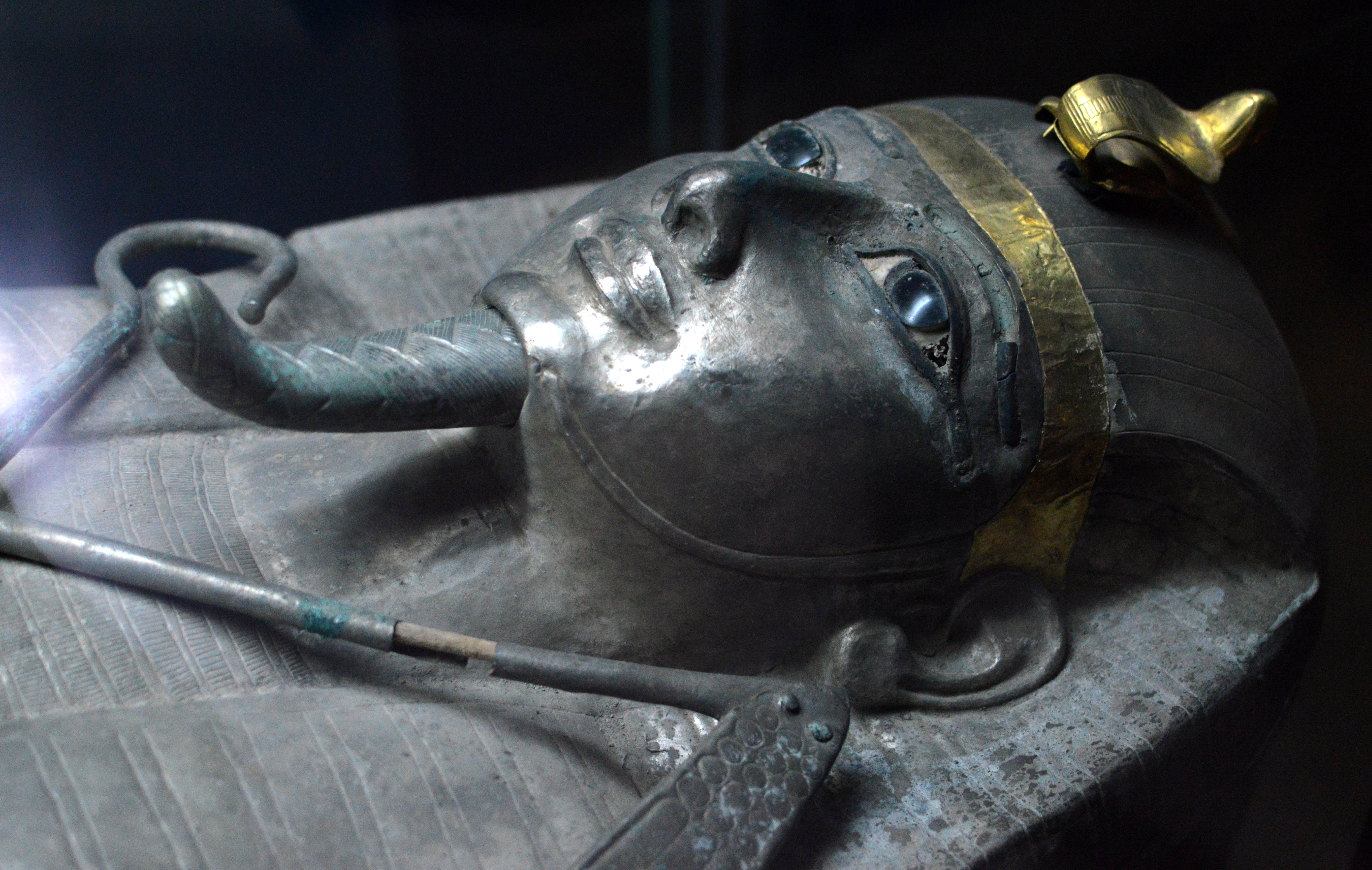
The end of the Twentieth Dynasty was also the end of the great era known as the New Kingdom. By this time Egypt had relinquished its empire, and pharaoh no longer even controlled all of his own country which was now split between the king in the north and an all-powerful Chief Priest in the south. This was the beginning of the ‘Third Intermediate Period’. Such phases are generally harder to understand – the evidence is thinner on the ground and confused, but they are generally held to be times of relative decline. But in 1939 a French archaeologist Pierre Montet discovered the royal tombs of the Twenty-first and Twenty-second Dynasty kings at Tanis in the Delta region, several of which turned out to be intact. What Montet had found might have caused a sensation to rival the discovery of Tutankhamun’s tomb – a solid gold death mask belonging to Psusennes I, several others like it and countless other treasures including several falcon headed coffins, one of solid silver, a material, that was much less common in Egypt than gold. But the world’s attention was elsewhere – WW2 had broken out… This is the story of his incredible discoveries.
Egypt’s Silver Pharaohs
Wednesday 7 July 2021, 6.00 pm (UK time). Fee £5. REGISTER HERE
Thursday 8 July 2021, 11.00 am (UK time). Fee £5. REGISTER HERE
A recorded version of this talk from July 2021 is now available here.
The end of the Twentieth Dynasty was also the end of the great era known as the New Kingdom. By this time Egypt had relinquished its empire, and pharaoh no longer even controlled all of his own country which was now split between the king in the north and an all-powerful Chief Priest in the south. This was the beginning of the ‘Third Intermediate Period’. Such phases are generally harder to understand – the evidence is thinner on the ground and confused, but they are generally held to be times of relative decline. But in 1939 a French archaeologist Pierre Montet discovered the royal tombs of the Twenty-first and Twenty-second Dynasty kings at Tanis in the Delta region, several of which turned out to be intact. What Montet had found might have caused a sensation to rival the discovery of Tutankhamun’s tomb – a solid gold death mask belonging to Psusennes I, several others like it and countless other treasures including several falcon headed coffins, one of solid silver, a material, that was much less common in Egypt than gold. But the world’s attention was elsewhere – WW2 had broken out… This is the story of his incredible discoveries but also of the tombs that are yet to be found…
The guide here was prepared following series of talks which dealt with similar themes and should, I hope, be of use for anyone looking to take their interest in the subjects covered.
2021 Amarna Fundraiser and Study Day
Saturday 17 July 2021, 3.00 – 5.00 pm (UK time)
Registration fee £10 (all proceeds to the Amarna Trust!)
Hosted by Dr Chris Naunton in partnership with the Amarna Trust.
Sponsored by Ancient World Tours
For further information or to register please visit this page.

I’m delighted to announce that I’ve been invited to host an afternoon of talks given by members of the Amarna Project which has been conducting archaeological research at the ‘city of Akhenaten and Nefertiti’ for more than forty years. Several team members will be giving brief updates on various aspects of their work, and these will be followed by a keynote presentation by the Project Director, Professor Barry Kemp: ‘City of gold, city of mud: Using one’s imagination at Amarna’.
I’ll be introducing the event and putting questions to the speakers including Professor Kemp, and there will be a chance for you to ask your own questions as well. For further information or to register please visit this page.
This is a fundraising event and the proceeds will go directly to the Project via the Amarna Trust. The fee has been kept deliberately low so as to exclude as few people as possible, but you are all are encouraged to make donations over and above the registration fee via this page. PLEASE GIVE GENEROUSLY. Despite the prestige and global significance of the site, the Amarna Project is reliant on contributions from the public for the continuation of the work. So much of what we know about Akhenaten and Nefertiti comes from Amarna, but there is still more to learn, and an urgent need for action to ensure that what remains of their city survives into the future. It should be a really brilliant event and I look forward to seeing many of you there!
Egyptians, Libyans and Kushites: The Third Intermediate Period UNTANGLED!
Tuesday 20 July 2021, 6.00 pm (UK time). Fee £5. REGISTER HERE
Wednesday 21 July 2021, 11.00 am (UK time). Fee £5. REGISTER HERE
A recorded version of this talk from July 2021 is now available here.
This talk is designed as a complement to my previous lecture on ‘Egypt’s Silver Pharaohs’ (7 and 8 July 2021). The era following the end of the New Kingdom is relatively little known and poorly understood. Scholars are still arguing, even now, about how the history of the period, and sequences of kings, should be reconstructed. Two things are clear: first, Egypt was split between two or more more rulers for much of the period, and attempts at unifying it were generally short-lived; second, this was a time when the country was subject to the influence of successive groups of foreigners hence the alternative names ‘Libyan Period’ for the 22nd and 23rd Dynasties, and ‘Kushite Period’ for the 25th. Reconciling the ‘dynasties’ of the ancient historian Manetho with the archaeological evidence remains a challenge, and provides a lesson in how scholars have used the evidence to understand what was happening at this confused and confusing period of history. The aim here is to explain what we know, and how we know it. Limber up, and come and join me!
The guide here was prepared following series of talks which dealt with similar themes and should, I hope, be of use for anyone looking to take their interest in the subjects covered.
A recorded version of this talk is now available here:
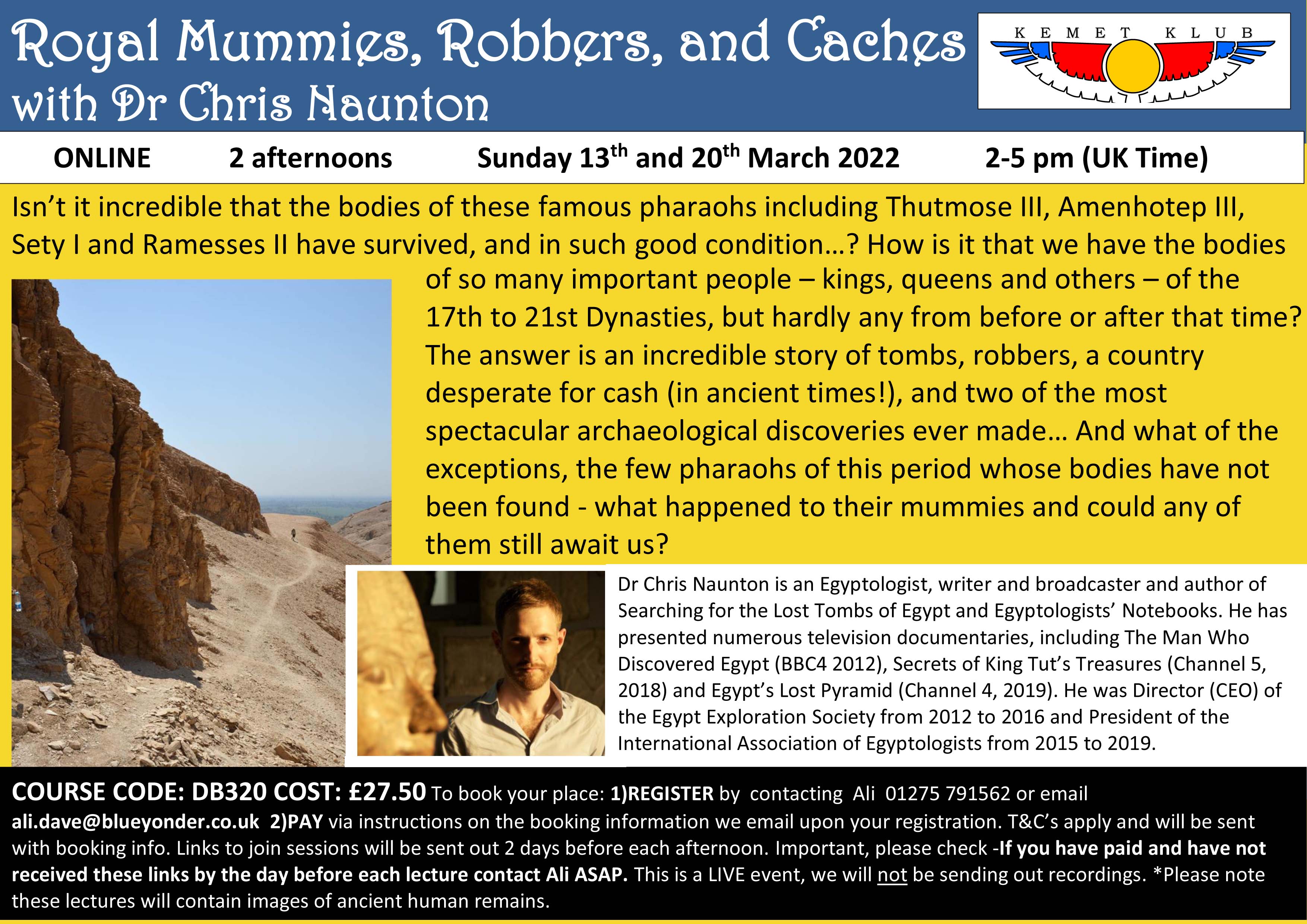
On 3 April 2021 the world watched the ‘Pharaohs’ Golden Parade’ in Cairo, Egypt. The bodies of the kings of the New Kingdom – the Royal Mummies – were being transferred from the Egyptian Museum on Tahrir Square in Cairo to their new home at the National Museum of Egyptian Civilisation (NMEC) where they will be the star attraction. Isn’t it incredible that the bodies of these famous pharaohs including Thutmose III, Amenhotep III, Sety I and Ramesses II have survived, and in such good condition…? How is it that we have the bodies of so many important people – kings, queens and others – of the 17th to 21st Dynasties, but hardly any from before or after that time? The answer is an incredible story of tombs, robbers, a country desperate for cash (in ancient times!), and two of the most spectacular archaeological discoveries ever made…
The usual guide to further reading and online resources is here.
Rediscovering Lost Egypt in Egyptologists’ Archives
Thursday 2 September 2021, 9.30 am (UK time) / 6.30 pm (Sydney, Australia)
Hosted by Chau Chak Wing Museum, University of Sydney, Sydney, Australia
REGISTER HERE
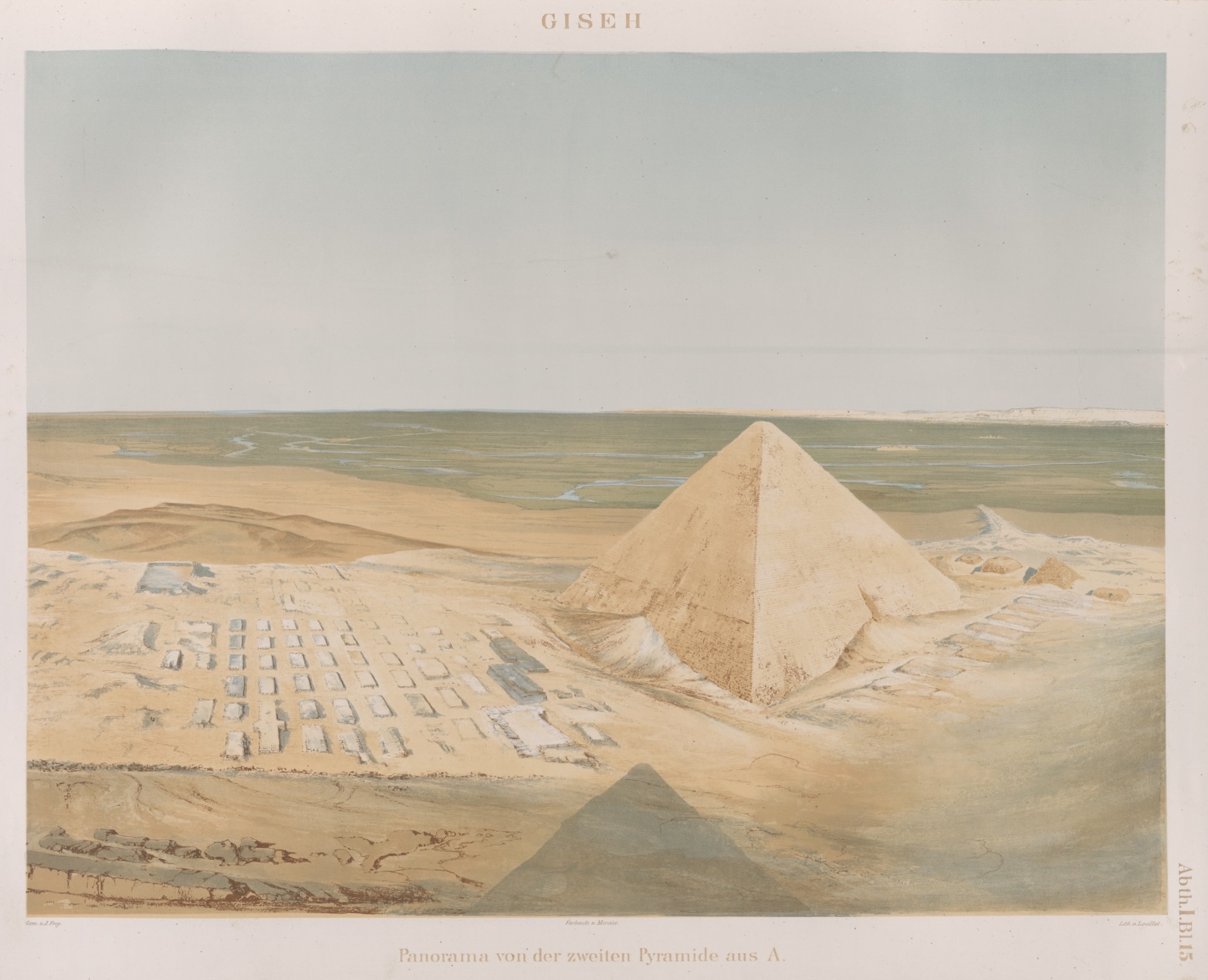
The sites and monuments of ancient Egypt are among the most spectacular to have survived from the ancient world. Most were unknown in the west until around two centuries ago when European travellers began visiting the country and making records of what they saw. Their archives are an invaluable record of the temples and tombs just as they were being revealed, of a relatively unspoilt landscape that was about to change dramatically, and in some cases of monuments that, paradoxically, have since been lost.
The Baths of Cleopatra
Wednesday 29 September, 10.00 am (UK time) / 7.00 pm (Melbourne, Australia)
Hosted by Glen Eira Libraries, Australia
REGISTER HERE
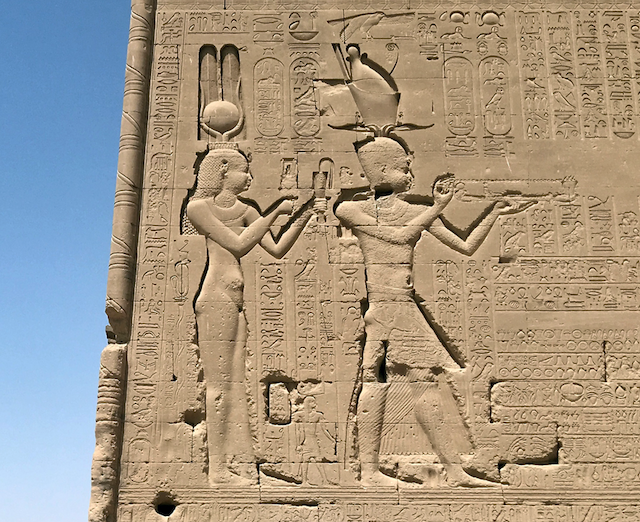
Cleopatra was Pharaoh of Egypt and yet few of her monuments remain. Is it possible that her tomb and even the ‘Baths of Cleopatra’ have survived?..
HERIHOR, his tomb, and the priests who became kings
Wednesday 29 September 2021, 6.00 pm (UK time). Fee £6.* REGISTER HERE
Thursday 30 September, 2021, 11.00 am (UK time). Fee £6.* REGISTER HERE

The Twenty-first Dynasty was characterised by a split between the pharaoh in the north, and the Chief Priest of Amun at Karnak who came to take control of Thebes and the south. Herihor was among the first of these newly powerful Chief Priests, and was in authority during the early stages of the ‘restoration’ and caching of the royal mummies of the Valley of Kings and elsewhere. His tomb has never been found, although tantalising clues have appeared in the remote ‘western wadis’ of Thebes. Herihor and the other Chief Priests of the era were also in command of the armies and the judiciary, and they adopted some of the trappings of kingship, but were they really ‘kings’ of Thebes? And what would that mean for the kind of tomb Herihor might have had…?
As usual, a guide to further reading and online resources is here.
Egypt Under Kushite Rule
Wednesday 13 October 2021, 09.00 am (UK time) / 7.00 pm (Melbourne time)
Hosted by The Monash Centre for Ancient Cultures, in partnership with the Egyptology Society of Victoria
For further information please go here

In the late eighth Century BCE, Pharaoh Piankhy, the king of Upper and Lower Egypt, the son of Ra, beloved of Amun, marched down the Nile Valley with his army to meet a series of rebellious kinglets and chiefs who had come to claim authority in the north of Egypt. According to his ‘victory stela’, a giant slab of granite, Piankhy’s victory was decisive: he encountered little resistance, and the ringleader of his enemies, Tefnakht, the Chief of Sais, surrendered from distance without putting up a fight. Piankhy is part of the line of kings that represent Manetho’s Twenty-fifth Dynasty of Egypt. But he doesn’t appear in Manetho’s list and wasn’t even Egyptian… This is the story of Kushite rule in Egypt.
Ancient Egypt Lost and Found (and lost again)
Friday 29 October, 8 am (AEST = Thursday 28 October 10 pm UK time)
2021 National Archaeology Student Conference (NASC) hosted by by the Archaeology Society of Macquarie University, Sydney, Australia
Further info: https://www.nascaustralia.com/our-speakers
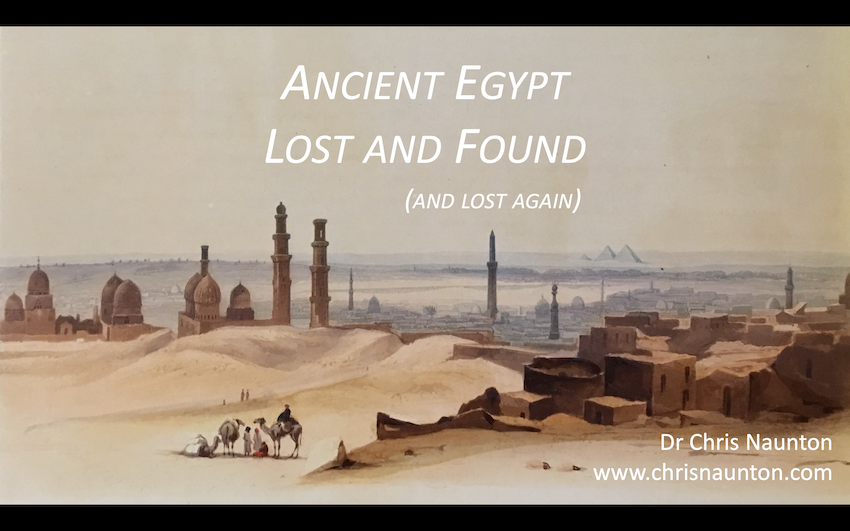
The archives of 19th and 20th century Egyptologists shed light on how the archaeology of ancient Egypt was revealed. It’s a story of great discoveries but curiously many of the sites and monuments that were revealed have disappeared again since…
Carnet degli Egittologi / Egyptologists Notebooks
lunedì 13 dicembre, alle ore 18:00 / Monday 13 December, 6.00 pm
Ospitato da Museo Egizio, Torino / Hosted by the Museo Egizio, Turin
CONFERENZA IN INGLESE con traduzione simultanea / Lecture in English with Italian translation
Further details: https://museoegizio.it/esplora/appuntamenti/carnet-degli-egittologi-di-chris-naunton/
ROYAL MUMMIES, ROBBERS & CACHES
Two afternoons of lectures hosted by Kemet Klub (Bristol, UK)
Sunday 13 and Sunday 20 March, 2 – 5 pm (UK time)
Price. £27.50 To book your place: contact Ali on 01275 791562 or email ali.dave@blueyonder.co.uk.
EGYPT’S SILVER PHARAOHS
24 March 2022
Hosted by the Carlisle and District Egyptology Society

The STORY of EGYPTOLOGY – WATCHALONG + Q&A
Wednesday 13 July, 7.00 pm (UK time)
via the History Hit YouTube Channel
Update: a recording of the ‘watchalong’ will be available on the History Hit YouTube channel for a month after the live event – see here and below:
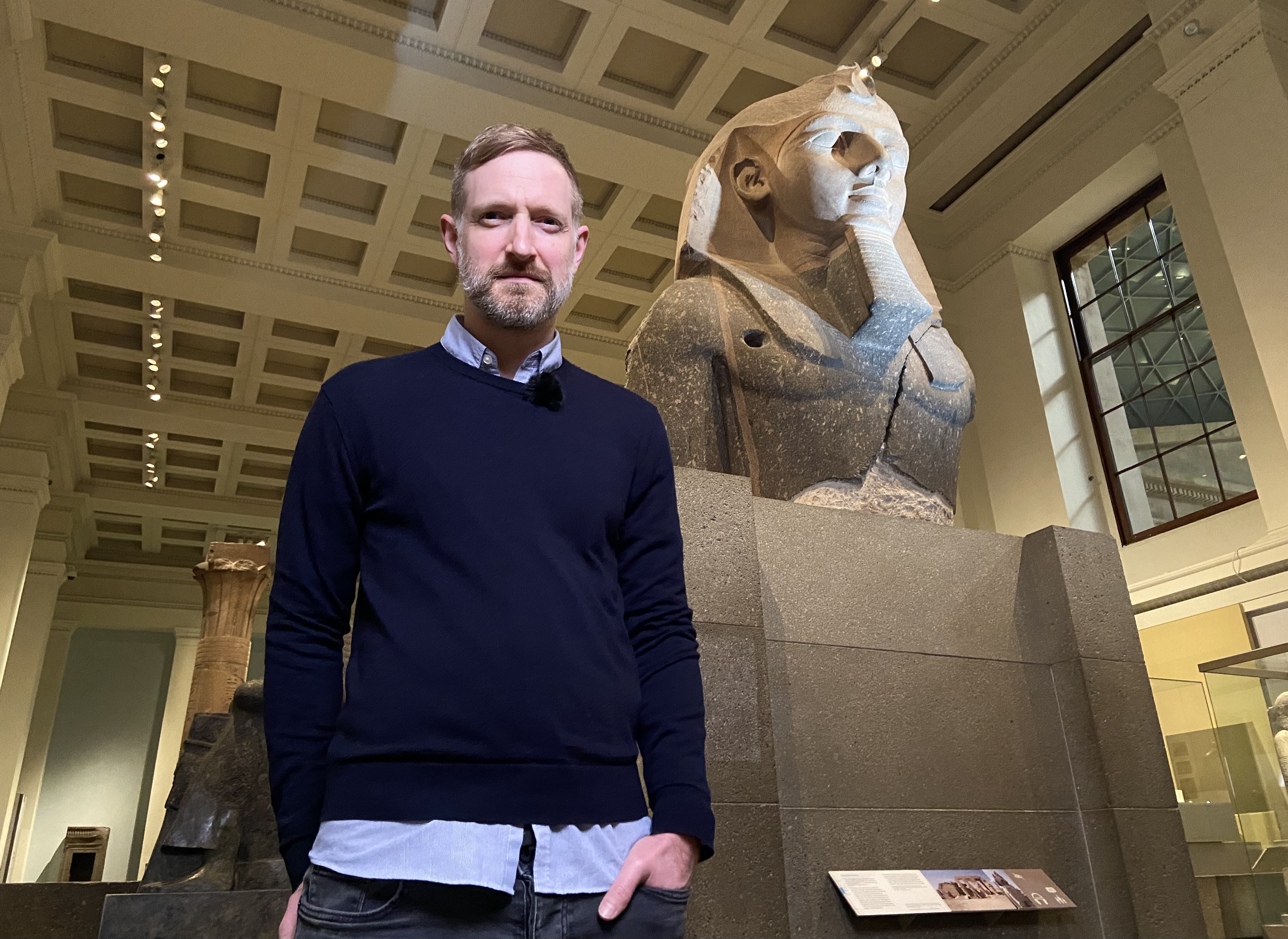
This is your chance to watch my new film, THE STORY of EGYPTOLOGY online along with me, Mark Edger (Director) and Milo Cumpstey (Dir of Photography). The film is a History Hit production and the team there have kindly agreed to host this event via their YouTube channel. There will be no fee to pay and no need to register; all you will need to do is click on a special link (which I will post here and via social media in due course) at the appointed time, then just sit back and enjoy the film. We’ll be watching with you. Please do post any comments, questions etc that you might have as we go along – we’ll do our best to answer as many as we can.
Order of play:
7.00 Welcome & intro
7.05 FILM
8.00 Q&A with me, Mark & Milo
8.30 END
Do come along, We’d love you to watch the film (trailers below) and we want to know what you think! If you have any questions please let me know via this page. It should be fun, look out for the link nearer the time. See you there!
Egyptologist Dr Chris Naunton explores the story of how Ancient Egypt was rediscovered, and how its incredible sites and treasures were gradually decoded. Starting with the earliest travellers who ventured inside the pyramids, Chris traces how this curiosity exploded into Egyptomania in the 18th and 19th centuries. Beginning with the French invasion under Napoleon, we discover how Egypt was explored, plundered and eventually deciphered as increasingly scientific approaches were taken. Highlights include the audacious treasure hunting by Belzoni, the painstaking decoding of hieroglyphs and Flinders Petrie’s introduction of modern methodology – all leading to Howard Carter’s opening of the tomb of Tutankhamun.
KINGS in THEBES
Wednesday 3 August, 6.00 pm (UK time). Fee £6. REGISTER HERE.
Thursday 4 August, 11.00 am (UK time). Fee £6. REGISTER HERE.
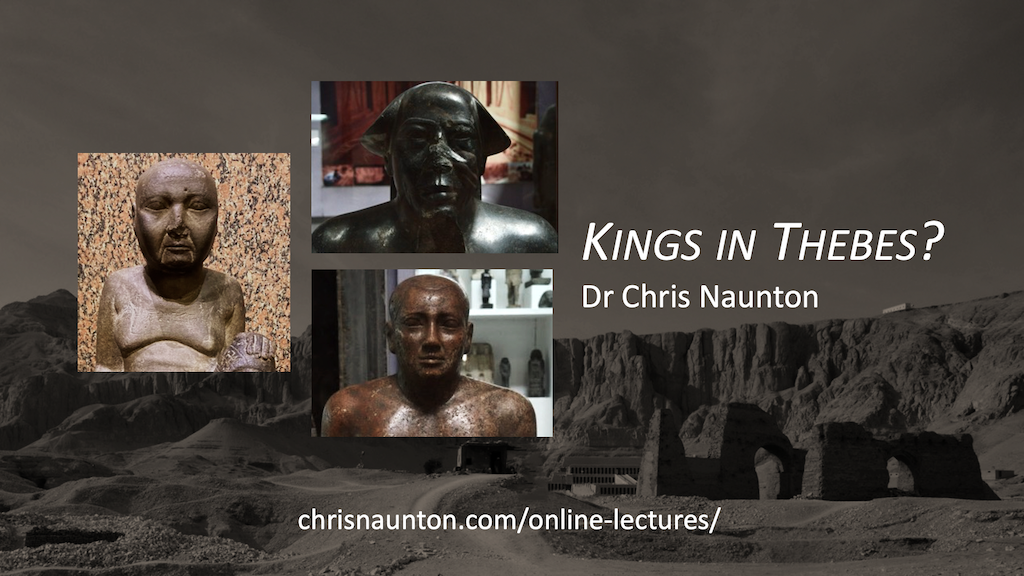
During the First Millennium BCE (Dynasties 21-30), what it meant to be ‘king’ or ‘pharaoh’ seems to have changed. This was a time when Egypt was often split into south and north – or even more fragmented than that – and it was subject to influence from various groups of foreigners. While the kings who were recognised by Manetho were generally based in the north, Thebes, in the south, repeatedly produced powerful local individuals who claimed the kingship, or wielded equivalent authority. Some who claimed kingship barely left a trace in the records and were perhaps not so influential; others who didn’t claim kingship seem to have been far more influential and wealthy, causing us to ask what it really meant to be ‘king’ during this era. This is the story of the powerful Chief Priests of Dynasty 21, Theban kings, Libyan Chiefs, and the owners of the three largest and most spectacular tombs anywhere in the country – Harwa, Montuemhat and Padiamunope of Dynasties 25 and 26.
A a guide to further reading and online resources is here.
CLEOPATRA TELLS ALL!
Virtual Storytelling Session in aid of the NSPCC
Wednesday 12 October 2022, 4.00 – 5.30 pm (UK time). REGISTER HERE
Registration is free but all attending are encouraged to make a donation via this page.

At last Cleopatra gets to tell her own story thanks to this new book: CLEOPATRA TELLS ALL! which was published by Thames & Hudson in June 2022 (more info here!). In this session for younger Egyptologists I’ll be explaining how the book came about, and reading some passages from it. And at the end there will be a chance for YOU to ask your questions!
Decipherment and the birth of Egyptology
An online panel discussion chaired by Dr Chris Naunton
Hosted by the British Museum
Thursday 1 December 2022, 5.30 – 6.30 pm (UK time)
For further information or to book: https://www.britishmuseum.org/events/decipherment-and-birth-egyptology
Update: a recording of this session is now available here and below:
The Archaeology Of Alexandria
Two afternoons of lectures hosted by Kemet Klub (Bristol, UK)
Sundays 11 and 18 December 2022. £28.50
For further information or to book: https://kemetklub.co.uk/product/the-archaeology-of-alexandria/
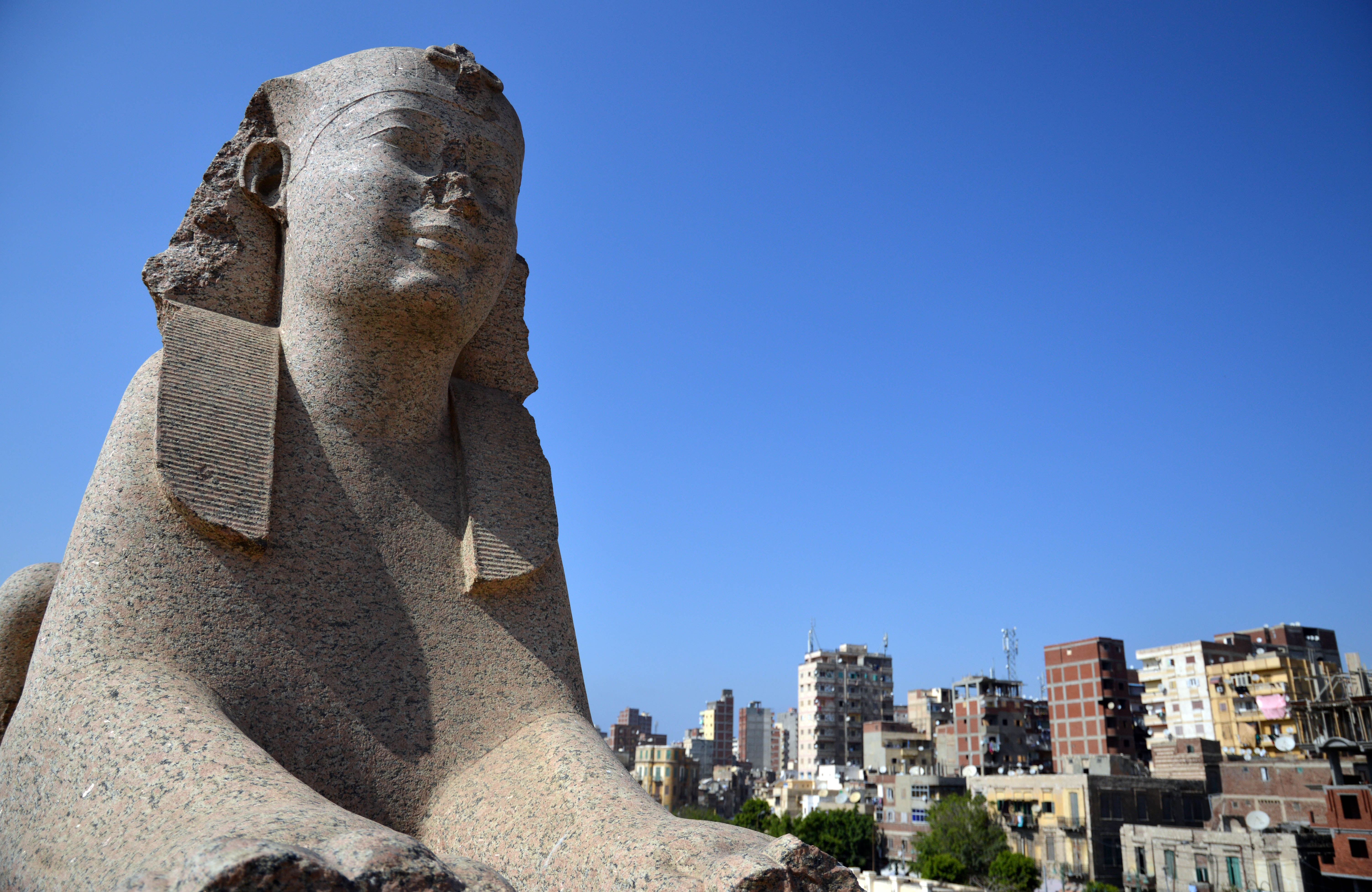
Alexandria was one of the great cities in the ancient world. Although Alexander the Great had died before the port he had founded could be built, his body was buried there, and it became the capital of the dynasty founded by his general Ptolemy (I), which came to an end with the death of the famous Cleopatra. Her tomb was also in Alexandria (probably!). Over the centuries Alexandria has been the scene of numerous pivotal events in ancient history. Many of its great monuments, including the lighthouse, one of the ancient wonders of the world, have been lost, but traces survived into modern times. Much that remains is now concealed beneath the modern city – Egypt’s second largest – with much more hidden under the waters of the Mediterranean.
GLASGOW: 10 June 2023: ‘The Royal Mummies – How the ancients and archaeologists helped us to see the faces of Egypt’s kings and queens’
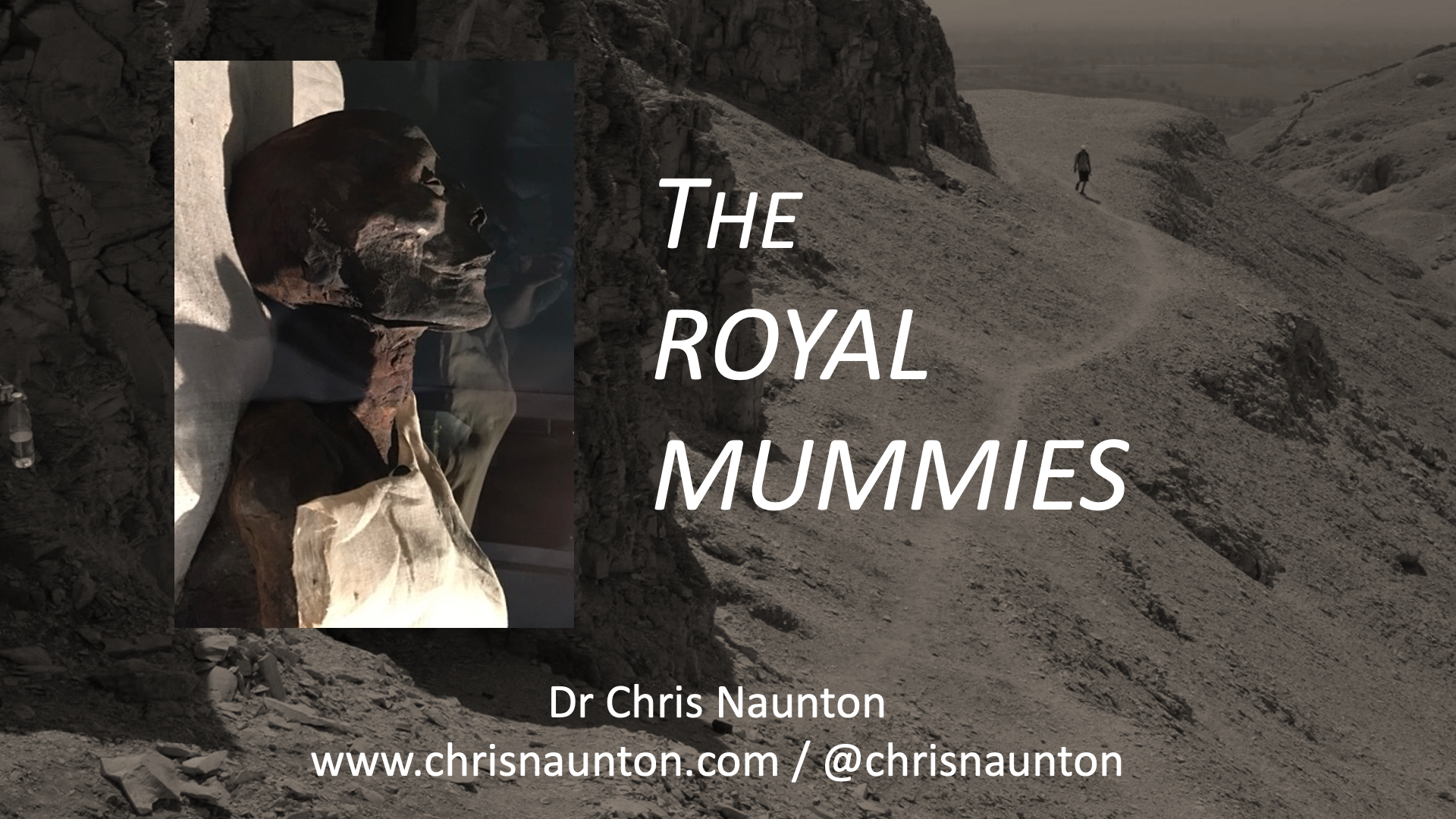
How is it that we have the bodies of so many important people – kings, queens and others – of the 17th to 21st Dynasties, but hardly any from before or after that time? The answer is an incredible story of tombs, robbers, a country desperate for cash (in ancient times!), and two of the most spectacular archaeological discoveries ever made…
Hosted by Egyptology Scotland
For more info / to book: https://www.eventbrite.co.uk/e/dr-chris-naunton-the-royal-mummies-online-only-tickets-530806816477?aff=erelexpmlt
ALEXANDRIA: FOUND & LOST.
Wednesday 9 August 2023, 6.00 pm (UK time). Fee £6. REGISTER HERE
Thursday 10 August 2023, 11.00 am (UK time). Fee £6. REGISTER HERE

Alexandria was one of the great cities in the ancient world. Although Alexander the Great had died before the port he had founded could be built, his body was buried there, and it became the capital of the dynasty founded by his general Ptolemy (I), which came to an end with the death of the famous Cleopatra. Her tomb was also in Alexandria (probably!). Over the centuries Alexandria has been the scene of numerous pivotal events in ancient history. Many of its great monuments, including the lighthouse, one of the ancient wonders of the world, have been lost, but traces survived into modern times. Much that remains is now concealed beneath the modern city – Egypt’s second largest – with much more hidden under the waters of the Mediterranean.
EGYPTOLOGY IN AN HOUR
Friday 18 August 2023, 4.00 pm (UK time).
No registration required, no fee to pay.
Broadcast will be via YouTube*: https://youtube.com/@ChristopherNaunton
UPDATE: The recorded version of this talk is now available here.
Ancient Egypt: where and when was it, and what made it the most instantly recognisable of all ancient civilisations, and the one that gets us all so interested? This is an Egyptologist’s take on what you need to know. Pyramids, obelisks, mummies, hieroglyphs, people with animal-heads standing side-on and walking like, well, Egyptians. Old Kingdom, New Kingdom, thirty Dynasties, a Kings’ Valley, a Queens’ Valley, two of the seven wonders of the ancient world, and some of its most famous names: Akhenaten, Nefertiti, Tutankhamun, Ramesses, Alexander the Great and Cleopatra, all of them pharaoh of Egypt, one of them the inspiration for a play of Shakespeare’s, another for one of Hollywood’s most famous villains. Bring your bull-whip and don’t forget your hat…
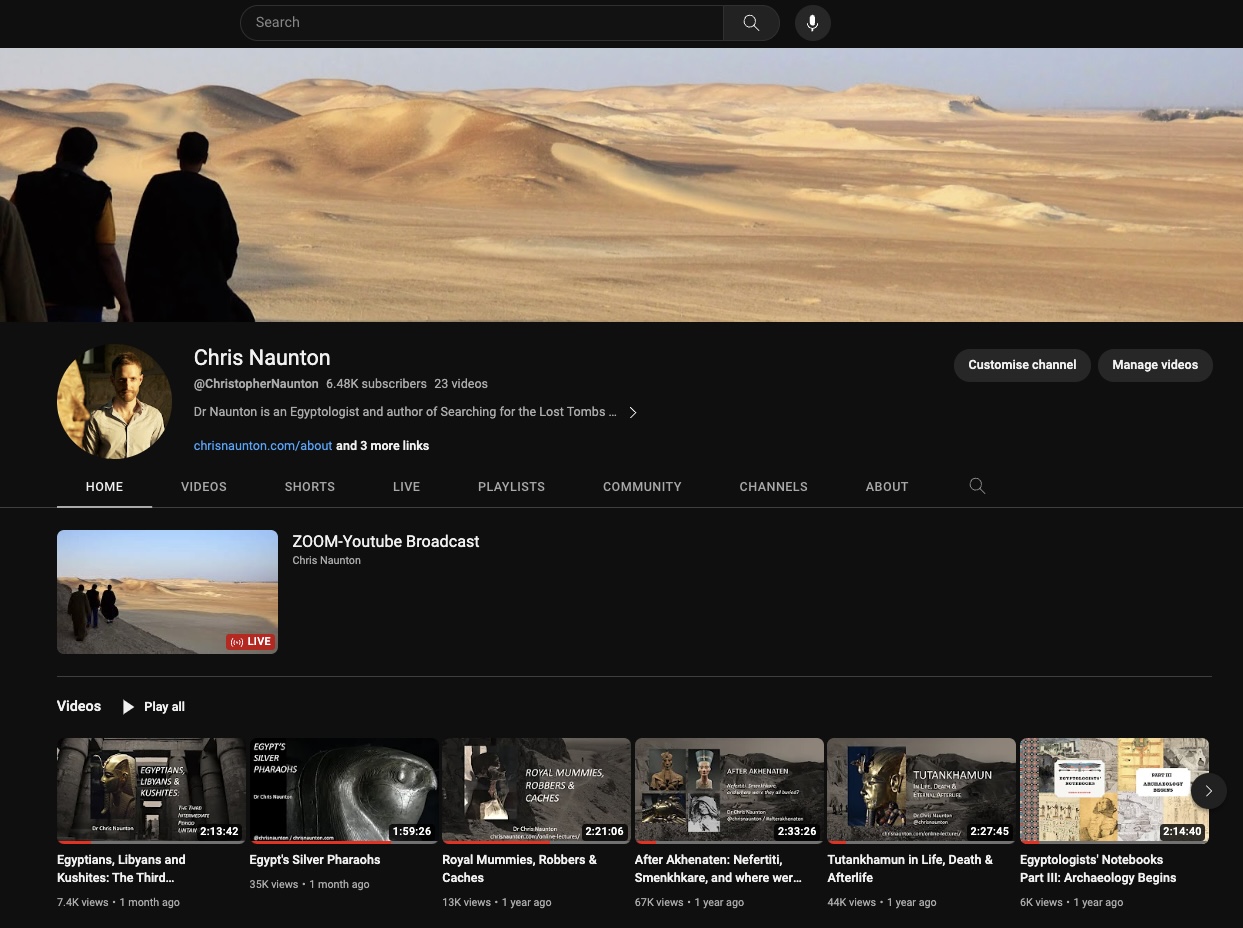
*This is an experiment to see how lecturing via YouTube works. You’ll need to find the stream which should be headed ‘ZOOM-Youtube Broadcast’ (see image below), then click on that to start the broadcast. I’ll be online a little ahead of time as usual but the talk itself will begin at 4pm. Hope to see you there!
DECODING HIEROGLYPHS: Young, Champollion and how the ancient system of writing works.

Tuesday 29 August 2023, 6.00 pm (UK time). Fee £6. REGISTER HERE
Wednesday 30 August 2023, 11.00 am (UK time). Fee £6. REGISTER HERE
In 2022 Egyptology celebrated 200 years since Jean Francois Champollion’s decipherment of Egyptian hieroglyphs. What was his ‘eureka moment’? Well, in fact, the anniversary is based on an announcement Champollion made in 1822, the culmination of years of hard work, on his part but also that of others. Furthermore, Champollion continued to refine his system, and the publication of his Précis du système hiéroglyphique des anciens égyptiens the following year (1823) was arguably a better monument to mark the conclusion of the quest to read the ancient texts. This talk outlines the series of deductions made by Champollion, but also Thomas Young and others, that allowed us to read those ancient texts, and shows how the language actually worked.
The forgotten history of women and Egyptians in Egyptology
Saturday 9 September 2023, 2.00 pm.
Chester Beatty Hybrid Friends Talk
In-person tickets for this event in Dublin are now sold out but you can join the talk online.
More info / to book please see here.
AMENHOTEP & AKHENATEN: strange and stranger…

Thursday 26 October, 1.50 – 3.30 pm (UK time)
Hosted by Carlisle And District Egyptology Society
More info / to book please see here.
EGYPT’S DAZZLING SUN KINGS
Two afternoons of lectures, Sundays 10 and 17 March 2024, hosted by the Kemet Klub (Bristol, UK).
For further info or to book see https://kemetklub.co.uk/product/egypts-dazzling-sun-kings/
Amenhotep III (left) and Akhenaten
Akhenaten probably attracts more attention than any other pharaoh among Egyptophiles. His revolution was swift, wide-ranging and apparently sudden. But to what extent can the changes he introduced be traced to the reign of his father Amenhotep III? This series of talks examines some of the key features of the Amarna period, and asks to what extent the changes were already underway when Akhenaten came to the throne, and whether his predecessor might even have continued to play a role after that point.
SEARCHING FOR THE MISSING TOMBS OF EGYPT
Wednesday 8 May 2024, 6.00 pm UK time (= 1.00 pm EST)
Live via YouTube – click here
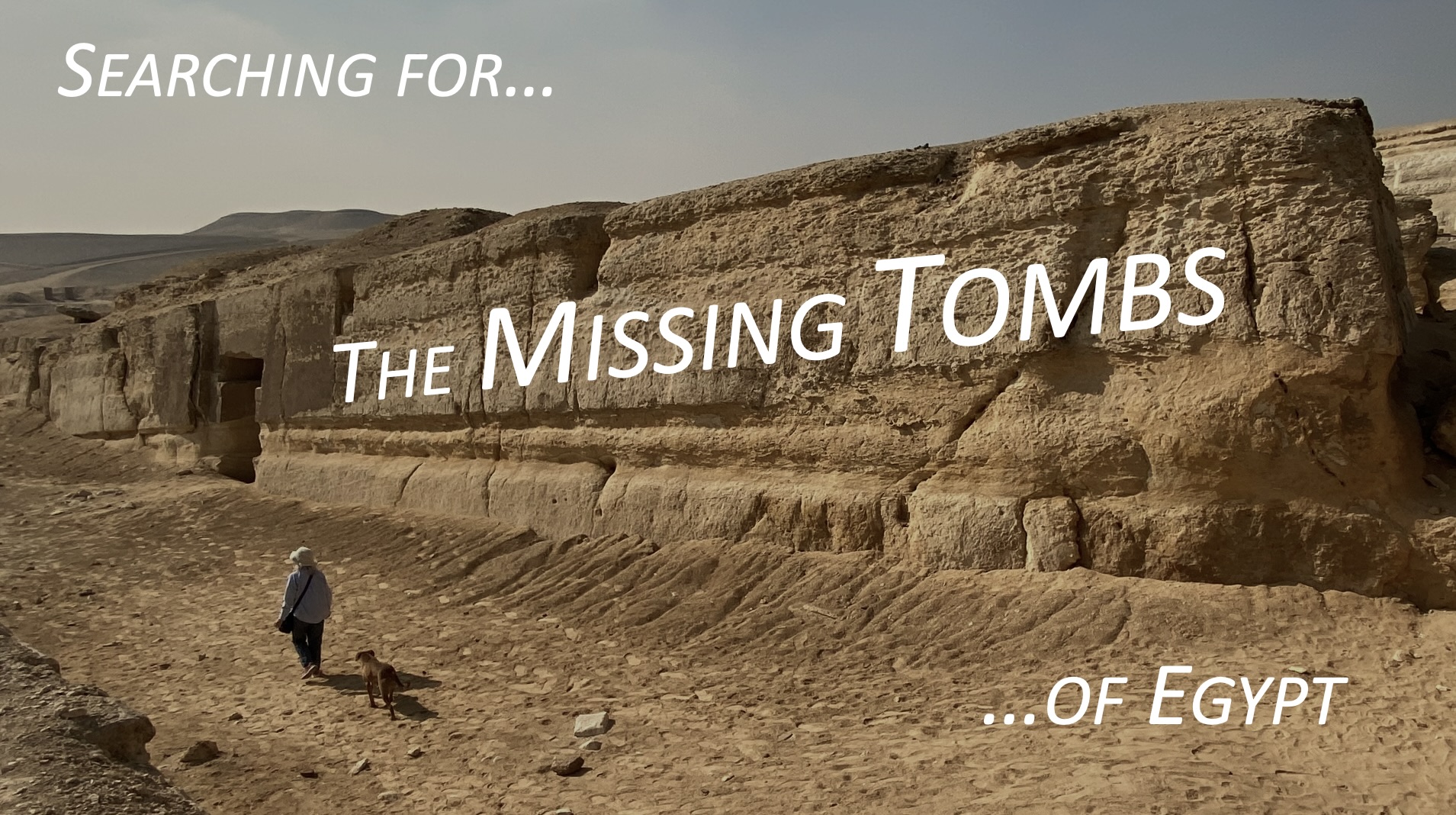
It’s incredible to think that so many of the tombs of the pharaohs of Egypt – who altogether ruled for over three thousand years – have survived and been discovered by archaeologists. Most of those that haven’t survived belonged to kings about whom we know very little and who perhaps ruled only for a short time, or during periods of instability. But there are conspicuous absences – tombs that belonged to great and well-known historical figures that no longer exist, or perhaps just haven’t been found yet… This is the story of the ‘missing’ tombs of Imhotep, Amenhotep I, Akhenaten and Nefertiti, Herihor, the kings of the glorious Saite Period, and even Alexander the Great and Cleopatra. What would they have been like, what treasures would they have contained, where were they, and could they still await discovery?
AMENHOTEP and AKHENATEN: EGYPT’S PHARAOHS OF THE SUN
Wednesday 10 July 2024, 6.00 pm UK time (= 1.00 pm EST)
Currently (August 2024) freely accessible via YouTube here and below:
Akhenaten probably attracts more attention than any other pharaoh among Egyptophiles. His revolution was swift, wide-ranging and apparently sudden. But to what extent can the changes he introduced be traced to the reign of his father Amenhotep III? This talk looks at some of the key features of the Amarna period, and asks to what extent the changes were already underway when Akhenaten came to the throne, and whether his predecessor might even have continued to play a role after that point.
The usual guide to further reading and online resources is here.
PYRAMID MYTHBUSTING: ancient Egypt, not ancient aliens…
Wednesday 7 August, 6.00 pm UK time (= 1.00 pm EST)
Currently (August 2024) freely accessible via YouTube here and below:
No subject in Egyptology attracts more theories than the pyramids, especially those of Giza. How they were built, who by, when and what for? We don’t exactly know how they were built, and for many, Egyptology’s answers to the questions about who, when and what for aren’t good enough. The recent TV series, Mysteries of the Pyramids with Dara O’Briain, addressed this phenomenon. The aim of this lecture is to show that, contrary to popular belief, the conventional view that the Giza Pyramids were built during the Fourth Dynasty by the ancient Egyptians, as tombs for their kings, remains the best interpretation of the available evidence, and will emphasise what that evidence is. There is no conspiracy, Egyptologists have nothing to hide, and do not stand to lose anything if new evidence emerges to cause them to alter their conclusions!
I wrote a few further thoughts on this subject here, and the usual guide to further reading etc is here.
HOW TO READ EGYPTIAN HIEROGLYPHS (and the Abydos Kinglists)
Thursday 5 September, 6.00 pm UK time (= 1.00 pm EST)
Live via YouTube – click here
PLEASE NOTE: This talk is now available to YouTube Channel members in the ‘Lapis’ category only. To become a member – or to upgrade from alabaster to lapis – please see here.
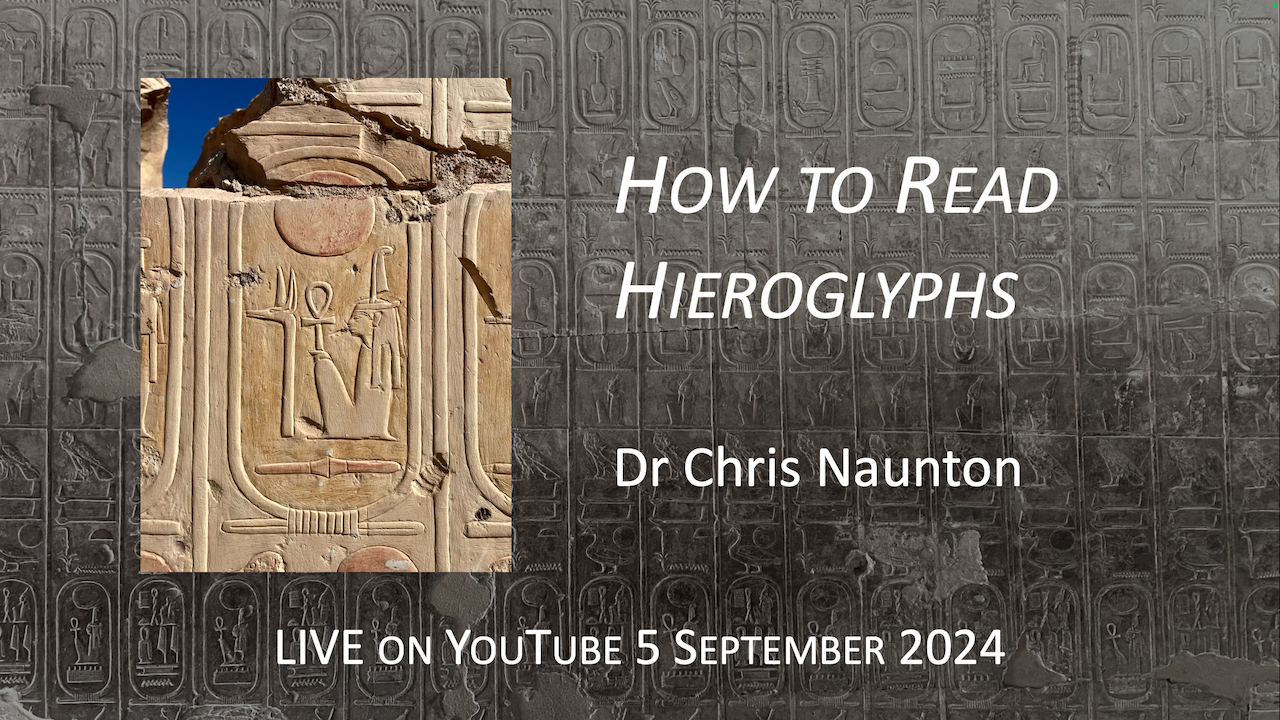
This lecture looks at the kinglists of Abydos. Sety I presided over one of the greatest periods in Egypt’s history but as the son of a commoner, the military general and first king of the line, Ramesses I, he clearly felt a need to assert his legitimacy. He did so in a grand temple at the sacred site of Abydos where he depicted himself and his son and successor, Ramesses II, at the head of a long list of kings’ names going back to beginning of time. This was intended to be the definitive list of the rightful rulers of Egypt, with Sety himself at the end of it. Ramesses followed his father by commissioning a very similar inscription in his own temple a short distance away. The kinglists provide both a fascinating insight into the ancient Egyptians’ sense of their own history, and some of the easiest inscriptions you could hope to read. This talk will examine the kinglists in detail and look at how useful they are in helping us to reconstruct Egyptian history and chronology, and what they tell us about the ancient historians’ own biases. And we’ll learn how to read a few of the names in the hope that anyone visiting the lists – in Abydos or in London – can have a go at reading them in person.
My usual guide to further reading is here.
The EGYPTIAN LABYRINTH – The Middle Kingdom and the Faiyum Region
Thursday 3 October, 6.00 pm UK time (= 1.00 pm EST)
Live via YouTube – click here
PLEASE NOTE: This talk is now be available to YouTube Channel members in the ‘Lapis’ category only. To become a member – or to upgrade from alabaster to lapis – please see here.

The Faiyum basin is a natural depression, a little west of the northernmost part of the Nile Valley into which water and silts flowed from the river creating a richly fertile region. This oasis seems to have been particularly significant during the Middle Kingdom, when the new capital city, Ity-Tawy, was established nearby, and the Ptolemaic Period when it was extensively cultivated. Several Twelfth Dynasty kings built pyramids in the region, including Amenemhat III, whose vast mortuary complex appears to have inspired the much later legend of a ‘labyrinth’. This talk explores the rich history and monuments of the region, and asks if Amenemhat’s temple really was the labyrinth or if it perhaps still awaits us elsewhere….
A page of links and further reading to go with this talk is here.
MEGALITHS in ANCIENT EGYPT: The Osireion
Wednesday 6 November, 6.00 pm UK time (= 1.00 pm EST)
Live via YouTube – click here
PLEASE NOTE: This talk will be available to YouTube Channel members in the ‘Lapis’ category only. To become a member – or to upgrade from alabaster to lapis – please see here.
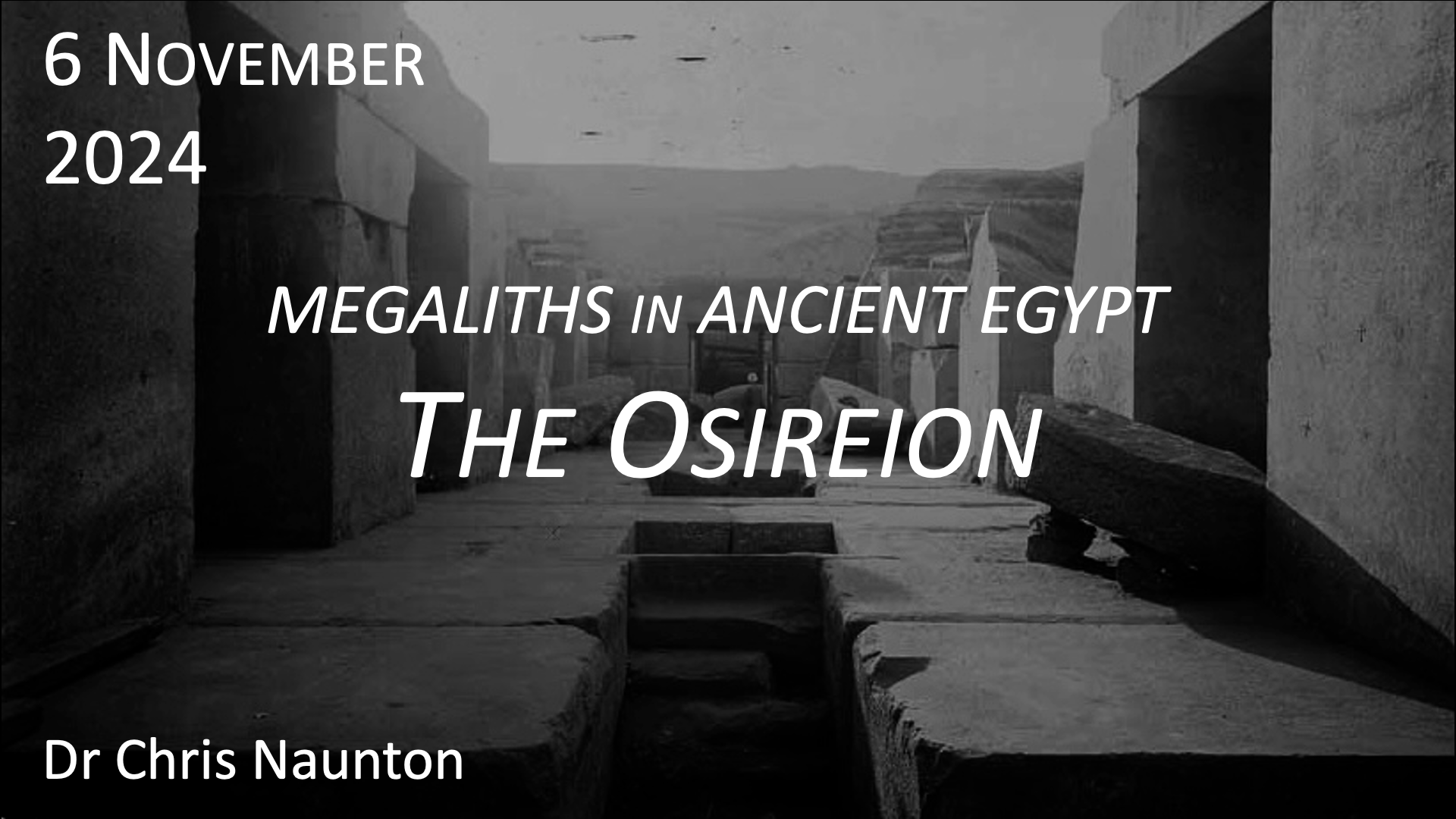
In 1903 the archaeologists Flinders Petrie and Margaret Murray made an extraordinary discovery to the east of the famous temple of Sety I at Abydos. At a level below ground they found a building constructed of huge blocks of granite, limestone and sandstone – megaliths – far larger than were usually used in Egyptian monuments. Numerous cartouches of Sety I suggest this was an extension of his monument, and the decoration resembling texts and images from tombs in the Valley of Kings in an entrance corridor have led to the conclusion that it is a funerary monument although not a tomb – perhaps a cenotaph. Its unique design has led to much debate among scholars about its age and purpose ever since its discovery.
The usual page of links and notes on further reading to go with the talk is is here.
The FIRST KINGS of EGYPT – Osiris, Isis, Horus and Seth
Thursday 19 November, 6.00 pm UK time (= 1.00 pm EST)
Live via YouTube – click here
PLEASE NOTE: This talk will be available to YouTube Channel members in the ‘Lapis’ category only. To become a member – or to upgrade from alabaster to lapis – please see here.
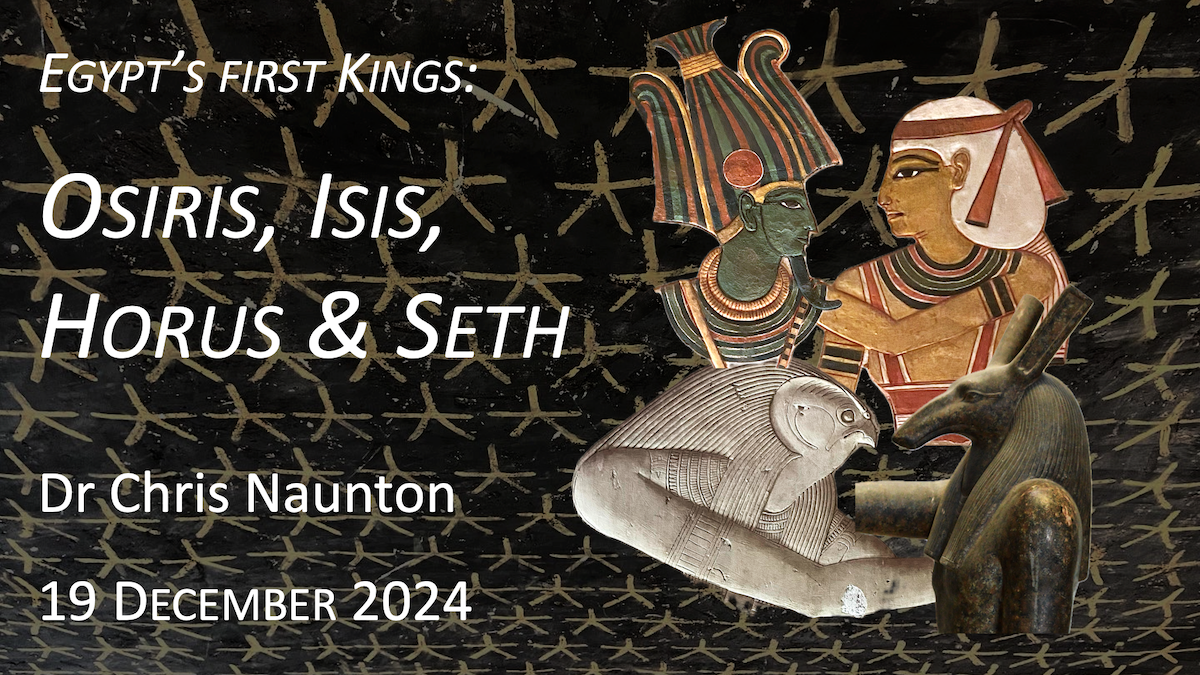
Egyptian religion is fantastically complex involving literally thousands of gods, and a series of myths which have only survived in fragments and which often seem to contradict one another. The best known, and best attested is the story of Osiris, mythical king of Egypt who was slain by his jealous brother Seth, then avenged by his son Horus. Osiris resultingly became the Egyptians’ preeminent funerary deity and all kings were believed to become as one with him in death, which each new pharaoh became the living manifestation of Horus upon their accession. This is the story of the most famous of all the Egyptians’ many myths and legends.
Kinglists & Writing Egyptian History
Monday 13 January 2025
Hosted by the Manchester Ancient Egypt Society (MAES)
THE SERAPEUM and animal cults in ancient Egypt
Tuesday 21 January 2025, 6.00 pm UK time
Live via YouTube – click here
PLEASE NOTE: This talk will be available to YouTube Channel members in the ‘Lapis’ category only. To become a member – or to upgrade from alabaster to lapis – please see here.

The stereotype of ancient Egypt often involves animals, especially cats, and mummies, and it’s true that in later periods of Egyptian history the mummification animals became a huge industry. The most important animal cult was that of the Apis bull at Memphis and the most spectacular expression of animal mummification the gigantic tombs of the mummified bulls known as the Serapeum at Saqqara. This talk takes a close look at these catacombs and their history, and the cult of Apis, and animal cults at Saqqara and elsewhere in Egypt more generally.
HATSHEPSUT Egypt’s female pharaoh
Tuesday 18 February 2025, 6.00 pm UK time
Live via YouTube – click here
PLEASE NOTE: This talk will be available to YouTube Channel members in the ‘Lapis’ category only. To become a member – or to upgrade from alabaster to lapis – please see here.

Hatshepsut became pharaoh during the reign of her step-son, Thutmose III, who had succeeded his father when he was just a child. She reigned for c. 20 years and left some spectacular monuments including the ‘red chapel’ and several gigantic obelisks at Karnak and her mortuary temple at Deir el-Bahri, a masterful combination of architecture and the natural landscape. She may even have been the founder of the Valley of Kings. She didn’t have it easy however: convention required that pharaoh be male and she was sometimes depicted with male characteristics, and on her death her stepson – now an adult – resumed the throne and dated events as of he had been ruling since his coronation as a child leading to the interpretation – now challenged – that Hatshepsut had usurped the throne. Whatever the circumstances, her name was subsequently erased from the monuments and she was left out of the official king lists of later times. In any case, Hatshepsut’s story is undoubtedly one of the greatest ancient Egyptian history has to offer.
REKHMIRA: anatomy of an ancient Egyptian tomb
Tuesday 18 March 2025, 6.00 pm UK time
Live via YouTube – click here
PLEASE NOTE: This talk will be available to YouTube Channel members in the ‘Lapis’ category only. To become a member – or to upgrade from alabaster to lapis – please see here.

The decoration in Egyptian tombs provides a vast wealth of information about various aspects life in the ancient past. No two are the same; certain themes are common but many tombs contain scenes that are unique and speak to a great desire for personal expression. One of the finest is that of Rekhmira, vizier under Thutmose III and Amenhotep III. The tomb is of a shape (’T’) typical at the time, but with a long corridor with an unusual ceiling that slopes upwards to a great height. Some the most eye-catching scenes include a hunt, the construction of a temple, the sculpting of statues and an idyllic garden with a pond. Perhaps the most important part of the decoration will be missed by many visitors, however: an inscription describing the ‘duties of the vizier’, perhaps the best evidence we have what this crucially important role at the royal court involved.
Osiris: Myth And Monuments
Two afternoons of lectures hosted by Kemet Klub (Bristol, UK)

Sunday 6 April 2025:
The myth of Osiris and
AND
The journey to the next life
Sunday 13 April 2025:
Abydos and the tomb of a god
AND
The Osirieion
In 1903 the archaeologists Flinders Petrie and Margaret Murray made an extraordinary discovery to the east of the famous temple of Sety I at Abydos. At a level below ground they found a building constructed of huge blocks of granite, limestone and sandstone – megaliths – far larger than were usually used in Egyptian monuments. Numerous cartouches of Sety I suggest this was an extension of his monument, and the decoration resembling texts and images from tombs in the Valley of Kings in an entrance corridor have led to the conclusion that it is a funerary monument although not a tomb – perhaps a cenotaph. We now know it as the Osireion, and in combination with the temple it seems to have been a unique and elaborate manifestation of the king’s union, in death, with Osiris. These talks explore the monument and the myths that were so central to the Egyptians’ myths of kingship, death and eternal resurrection.
Price £36.00 To book please visit https://kemetklub.co.uk/product/osiris-myth-and-monuments/
SENENMUT – Hatshepsut’s Right-Hand Man
Tuesday 29 April 2025, 6.00 pm UK time
Live via YouTube – click here
PLEASE NOTE: This talk will be available to YouTube Channel members in the ‘Lapis’ category only. To become a member – or to upgrade from alabaster to lapis – please see here.
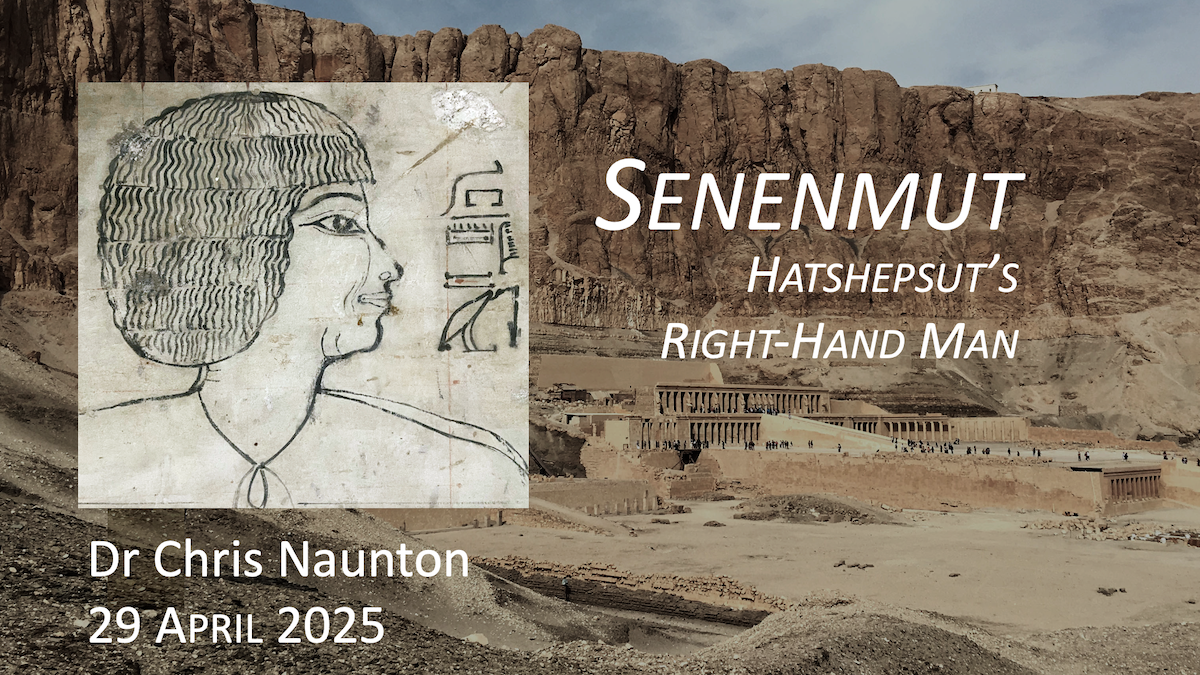
Senemut is one of the best-known officials from ancient Egypt. Although from a lowly background he rose to prominence as tutor to princess Neferure, daughter of Thutmose II and his wife Hatshepsut, and eventually became Chief Steward of Amun when Hatshepsut herself became pharaoh. As such he was responsible for her construction projects and was perhaps the architect of her great mortuary temple at Deir el-Bahri. Senenmut is an indispensable part of Hatshepsut’s story and there has been much speculation about the nature of their relationship. This talk explores his career and monuments, and his part in the story of one of Egypt’s greatest rulers, Hatshepsut.
THE GOD’S WIFE of AMUN – Egypt’s Foremost Priestess
Thursday 29 May 2025, 6.00 pm UK time
Live via YouTube – click here
PLEASE NOTE: This talk will be available to YouTube Channel members in the ‘Lapis’ category only. To become a member – or to upgrade from alabaster to lapis – please see here.

The role of God’s Wife of Amun appeared at the beginning of the New Kingdom and was held by some of the most prominent and important women in Egyptian history. As the wife of Amun himself, the woman who held this title was an intermediary between humankind and the gods, a role otherwise only undertaken by the king. In additional to their spiritual importance, the God’s Wives were also economically and politically important, and their appearance and disappearance at various points in history was undoubtedly related to the politics of the time. This talk reviews the evidence for these most important women and what we can learn of the often very interesting times in which they lived.
THE BATTLE of QADESH – Ramesses the Great vs The Hittites
Thursday 19 June 2025, 6.00 pm UK time
Live via YouTube – click here
PLEASE NOTE: This talk will be available to YouTube Channel members in the ‘Lapis’ category only. To become a member – or to upgrade from alabaster to lapis – please see here.

Ramesses II is not known as ‘the great’ for no reason: his life and reign were exceptionally long, he had an enormous number of wives and children, he built on a grand scale up and down the country and beyond his borders. And he was renowned as a great warrior – all great pharaohs were, to some extent, but at Qadesh we are led to believe that Ramesses was personally responsible for quite some heroics against his enemy, the Hittites. The Egyptians’ battle against them at Qadesh is one of the best attested in ancient history and is depicted in the great detail on the walls of several of Ramesses’ great temples. The peace treaty that eventually ended hostilities is documented in both Egyptian and Hittite sources. This is the story of one of the great battles, between two of the great powers of the ancient world.
THE HYKSOS, Ancient Egypt and the Bible
Thursday 24 July 2025, 6.00 pm UK time
Live via YouTube – click here
PLEASE NOTE: This talk will be available to YouTube Channel members in the ‘Lapis’ category only. To become a member – or to upgrade from alabaster to lapis – please see here.

At some point following the collapse of the central authority of the kings of the Twelfth and Thirteenth Dynasties, a new line of kings came to rule the north of Egypt. They were foreigners, of uncertain origin but probably from somewhere in the southern Levant, and they were based at Avaris in the north-eastern Delta. Later historians of Egypt writing in Greek referred to them as ‘Hyksos’ a word that derives from the ancient Egyptian heqa khasut meaning ‘ruler of foreign lands’. At least one of the historian Manetho’s ‘dynasties’ of Egypt, the Fifteenth, was a line of Hyksos pharaohs. They were eventually defeated by the Theban Egyptians of the Seventeenth and Eighteenth Dynasty lines who, following their eventual triumph, reunified the country, and soon began taking control of people and territories to the north and south, in part to ensure that no such trauma as the Hyksos period could ever return. Who were they? What evidence did they leave behind? How were they remembered (and how has this influenced our perceptions of them). And what relation might they have to the Biblical story of the Exodus?
The Karnak Cachette – Fishing for Statues
Thursday 28 August 2025, 6.00 pm UK time
Live via YouTube – click here
PLEASE NOTE: This talk will be available to YouTube Channel members in the ‘Lapis’ category only. To become a member – or to upgrade from alabaster to lapis – please see here.
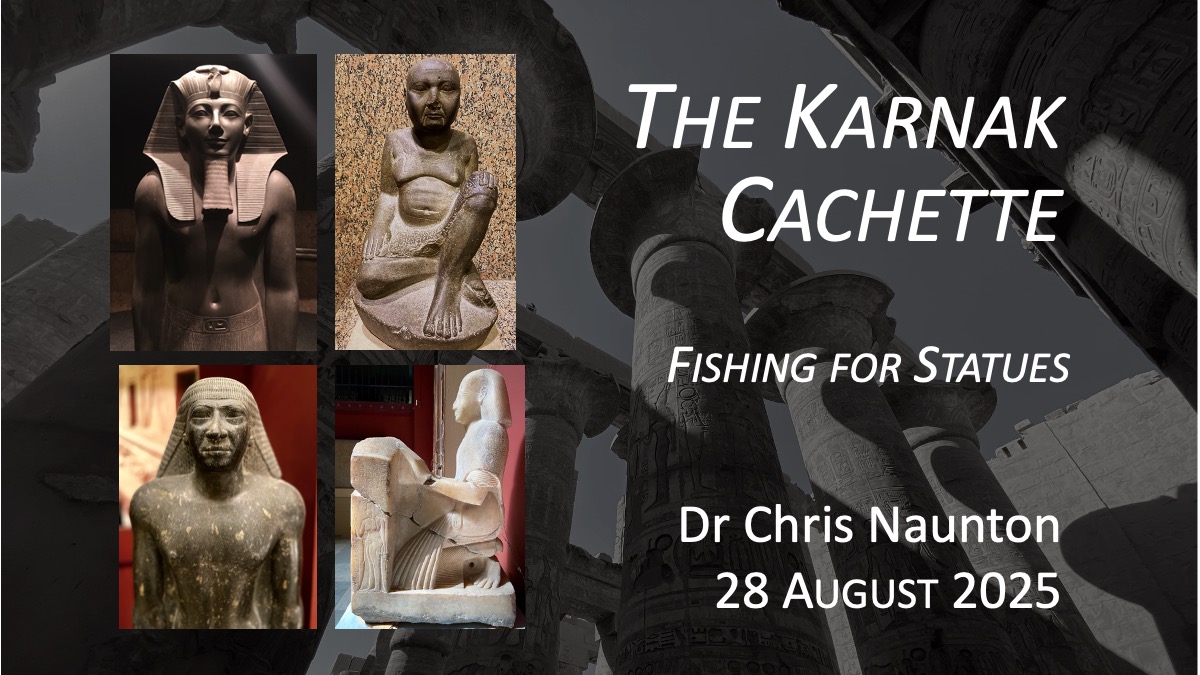
In 1903 the French excavator George Legrain made one of the most spectacular discoveries in the history of archaeology in Egypt. Beneath the pavement of a court at Karnak where the main part of the temple meets the north-south axis, a cache of a staggering 800 statues of kings and elite officials was discovered, including some of the best known in the Egyptian sculptural canon. Many of these statues have been immensely important in providing information about the history of Egypt from the Old Kingdom down to Ptolemaic times. What exactly did Legrain find and how did all these statues come to be buried there in the first place?
Searching for the Missing Cities of Egypt
Friday 26 September 2025, 6.00 pm UK time
Live via YouTube – click here
PLEASE NOTE: This talk will be available to YouTube Channel members in the ‘Lapis’ category only. To become a member – or to upgrade from alabaster to lapis – please see here.
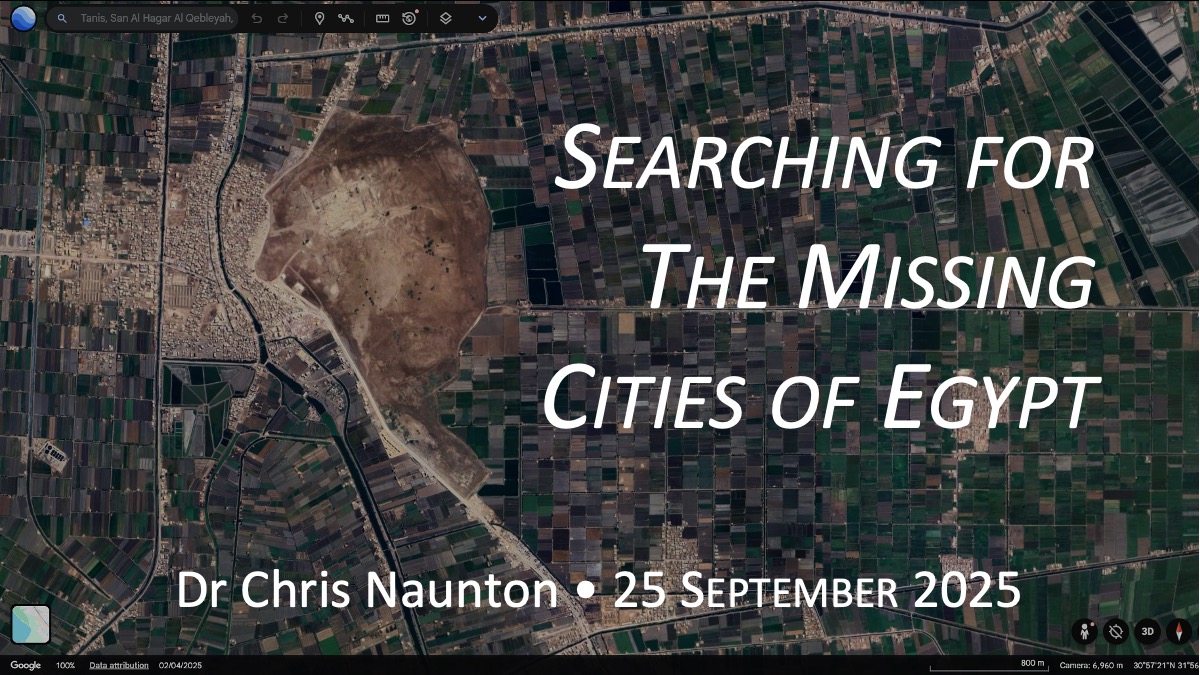
People often ask, ‘we know so much about Egyptian temples and tombs, but what about where people lived? What about their houses, villages, towns and cities?’ Two centuries ago, although temples and tombs were very visible to the earliest Egyptologists in Egypt itself, the country’s great ancient cities were much harder to identify, and often only known from classical accounts. Alexandria was a disappointment to many, Memphis seemed to have disappeared, and where was Thebes? Two centuries and more of Egyptological research have given us the names of countless more important settlements, and archaeology has revealed the whereabouts of some of them, but not all… Which cities are still missing, and which might still await discovery?
Roman Egypt in the Eyes of Strabo
Friday 17 October 2025, 6.00 pm UK time
Live via YouTube – click here
PLEASE NOTE: This talk will be available to YouTube Channel members in the ‘Lapis’ category only. To become a member – or to upgrade from alabaster to lapis – please see here.
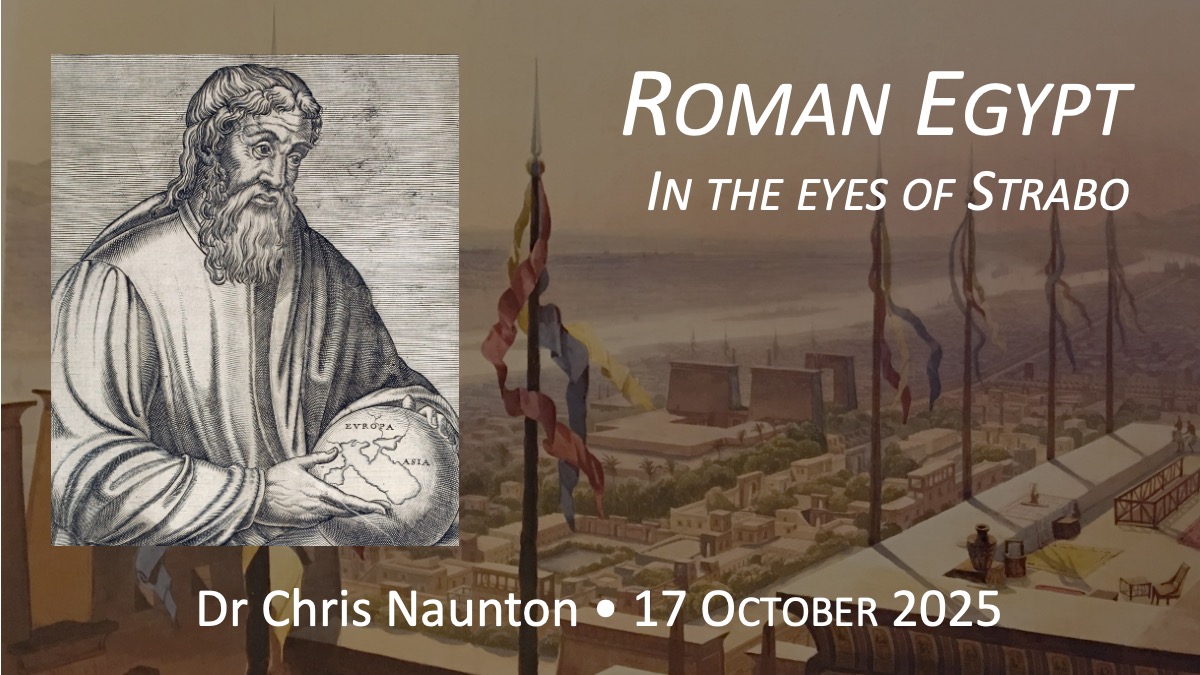
Just as the earliest Egyptologists relied heavily upon the Ptolemaic historian Manetho to begin piecing Egyptian history together, explorers turned to Strabo for an account of Egypt’s geography and its towns and cities. He provided detailed descriptions of the sights a visitor to Egypt in the early Roman period would encounter – a tantalising glimpse of what was there just over two thousand years ago. It has proven to be a useful guide for archaeologists attempting to identify their sites with the places Strabo and others described. But inevitably much has been lost since. This lecture describes the awe-inspiring early Roman Egypt he knew.
Searching for the Missing Cities of Egypt
Two afternoons of lectures hosted by Kemet Klub (Bristol, UK)
Sundays 16 and 23 November 2025
Full details to follow soon!
Mentuhotep II and the Rise of Thebes
Thursday 27 November 2025, 6.00 pm UK time
Live via YouTube – click here
PLEASE NOTE: This talk will be available to YouTube Channel members in the ‘Lapis’ category only. To become a member – or to upgrade from alabaster to lapis – please see here.
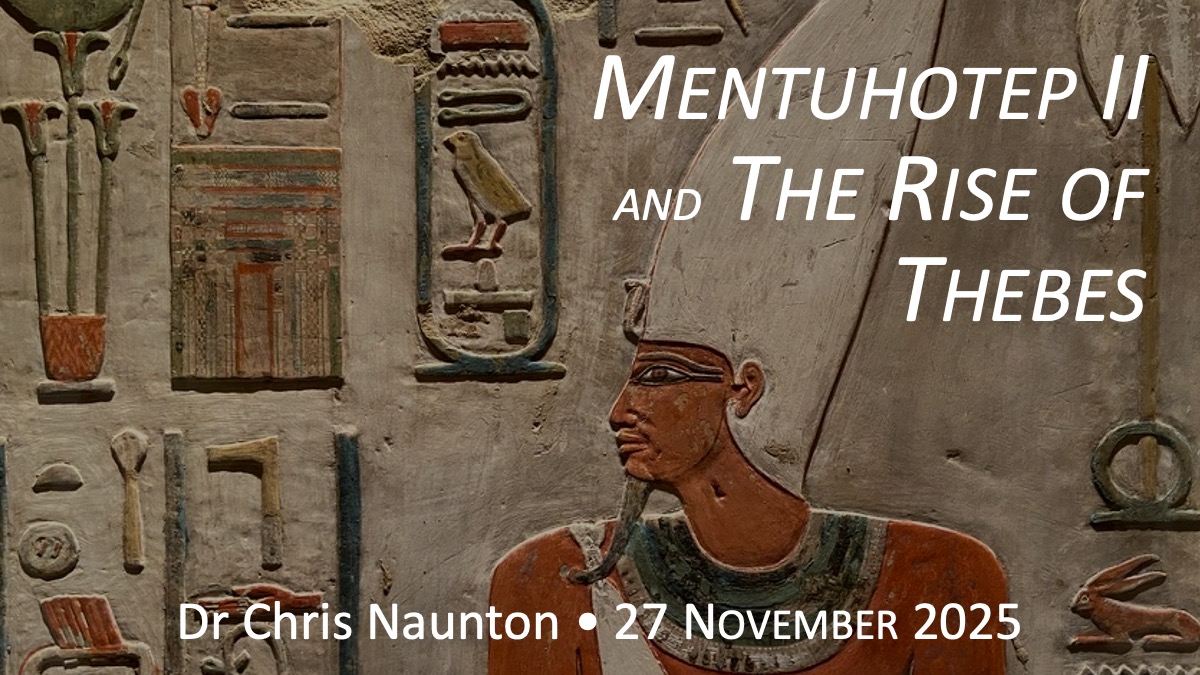
Egypt’s ancient history is sometimes defined as a series of ‘peaks and troughs’, periods of highly centralised government when the country was rich and powerful, and times when the central administration collapsed, leaving the country divided between various lines, often opposed to one another and vying for total control. When the Old Kingdom, the great age of pyramid building, ended Egypt entered what we now refer to as the ‘First Intermediate Period’ which remains relatively poorly understood, even today. This was brought to an end by one of the most remarkable of all pharaohs: Mentuhotep II, a king of the Theban line known to Manetho as the 11th Dynasty. He defeated his rivals in Herakleopolis, and reunified the country. As a Theban this brought not only Mentuhotep and his line to prominence but also, for the first time, his city and one of its most important deities: Amun. This is the story of the king and on of Egypt’s greatest monuments, his mortuary temple and probable tomb at Deir el-Bahri.
The Tomb of Thutmose II… FOUND!
Tuesday 23 December 2025, 6.00 pm UK time
Live via YouTube – click here
PLEASE NOTE: This talk will be available to YouTube Channel members in the ‘Lapis’ category only. To become a member – or to upgrade from alabaster to lapis – please see here.
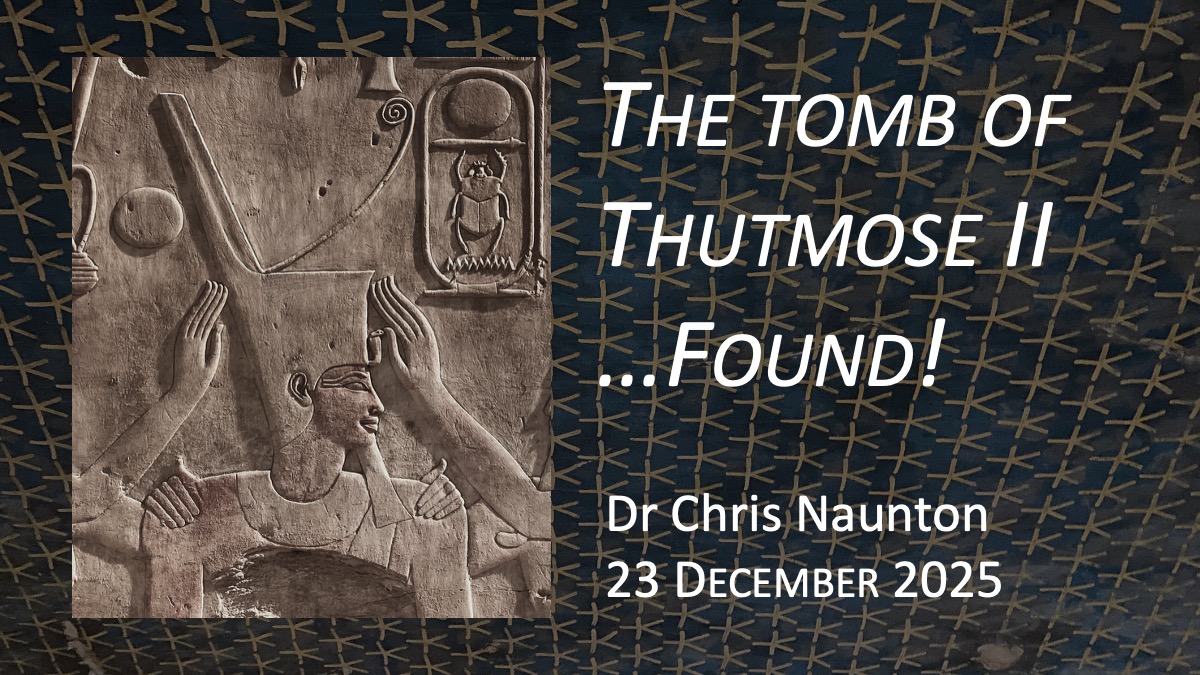
One of the last great ‘missing tombs’ of the New Kingdom was discovered in 2022 by a team led by Dr Piers Litherland of the New Kingdom Research Foundation. It was found, however, not in the Valley of Kings as might have been expected, but in the remote ‘western wadis’ in an area which, Dr Litherland’s excavations have shown, was much in use as a royal cemetery though previously it was mostly the tombs of queens that had been found here. The new tomb changes our perspective – might other kings’ tombs be found in the same area? And what does this tell us of the early New Kingdom kings’ quest to find a new, perfect place for the royal cemetery?
This talk expands on a piece I wrote for my website at the time the discovery was announced, here.
The Divine Child in Ancient Egypt
Wednesday 14 January 2026, 6.00 pm UK time
Live via YouTube – click here
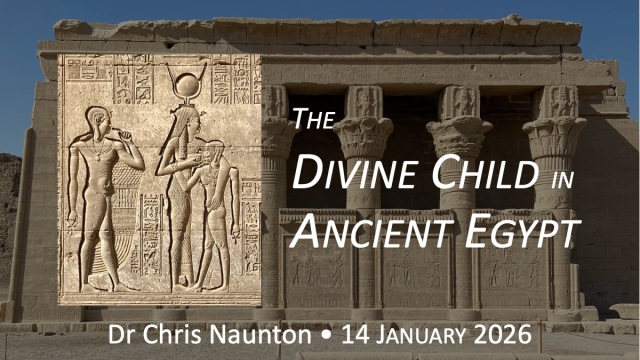
By the time of the Late Period one of the commonest icons in Egypt was the image of the mother and child, usually Isis and Horus. The concept of a divine child, of various kinds, was well-established by this time: it had been a device used by 18th Dynasty pharaohs such as Hatshepsut and Amenhotep III to emphasise their legitimacy and divinity; much later Cleopatra would use similar ideas to establish herself as a kind of divine mother, Isis, and by extension her son Caesarion, as Horus and the legitimate heir to her throne. The myth of Horus escaping the clutches of his uncle Seth and avenging his father’s murder was well developed by Cleopatra’s time and the ‘birth house’ had become an essential part of Egyptian temple design.
Butehamun: Tomb Inspections, Robberies & Caches
Wednesday 11 February 2026, 6.00 pm UK time
Live via YouTube – click here
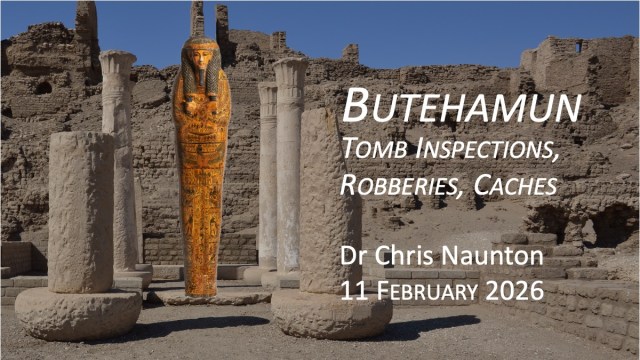
The story of the robberies in the Valley of Kings at the end of the New Kingdom is perhaps the most compelling in Egyptology. Thanks mostly to the ‘tomb robbery papyri’ we know of attempted robberies and the authorities’ responses: inspections, investigations, criminal trials and punishment. A series of graffiti allow us to follow the trail of these inspections and thanks to two of the most spectacular discoveries in the history of Egyptian archaeology we know that eventually reburying the mummies of the pharaohs in secret caches became the only way of protecting them. We have also come to know man who, more than any other, was responsible for the official response to the robberies: Butehamun.
 Dr Chris Naunton