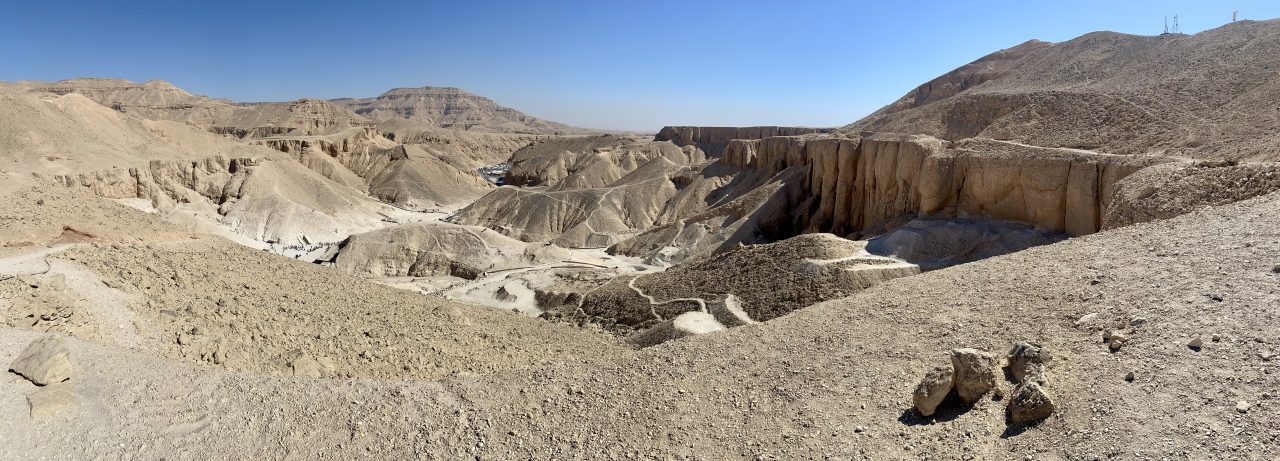
In Search of Petrie (part 2)

Flinders Petrie: ‘The Man Who Discovered Egypt’ will be broadcast in the UK on BBC4 at 9.00 pm on 28 March 2012 (and NOT 26 March as previously advertised).

To Egypt!

image

On 4 January, Producer Deborah Perkin, Cameraman Rob McDougall and I set off with Sound Recordist Mark Nash for Egypt, initially to Luxor. There we were met by our genial and extremely efficient facilitator, Magdy Rashidy and his team. Magdy would be with us for the next six days as we travelled around Egypt, again on a very tight schedule.

Abydos

Our first day, Thurs 5 January, took us to Abydos. We had particularly wanted to film at this site as it is so important both for Egyptology and for Petrie’s story. His pioneering work there, carried out on behalf of the EEF, is still indispensable. Deborah was also very keen that we should try to film an archaeological dig in action and so I called on an old friend, Josef Wegner, who has been excavating at the site since the 1990s. Joe had been generous enough to offer me my first experience of field archaeology in Egypt when I wrote to him as a Birmingham University postgraduate student looking for opportunities in 2000. I spent a month as part of Joe’s South Abydos team, drawing pottery he had excavated at the Middle Kingdom temple-town of Wah-Sut, South Abydos in May 2001, and gaining invaluable experience of the lifestyle on excavation in the Nile Valley. Joe has since moved the focus of his work from the town, which sprang up around the cult of the deceased Senusret III, to the rock cut tomb built for the king at the foot of the cliffs to the south west.

image

The entrance to the tomb of Senusret III. The cement pillars will support a shelter which will help keep the tomb clear of wind-blown sand which pours into the tomb continually, hindering the excavations and rendering the monument inaccessible in between seasons

image

Photo taken inside the tomb during the excavations in 1902-3. When walking through this part of the tomb – now completely cleared of debris – on camera, Joe explained that Petrie said this was one of the most beautiful architectural spaces he had ever seen

The tomb had first been excavated by Arthur Weigall and Charles Currelly working under Petrie’s supervision in 1902-3. I had never visited it before but had read Joe’s report on the re-excavation of the tomb in Egyptian Archaeology (EA 30 (2007), 38-41) and was very excited to see it. I knew also that Joe’s reis (foreman), Ibrahim, was a Qufti, a man of the village of Quft (see below), and therefore a spiritual (at least) descendant of the skilled workmen trained by Petrie. As it involved a large and spectacular royal monument and, I suspected, large numbers of workmen, I had a hunch that it might make for good television, and I was not wrong. Joe’s site proved to be thronging with workmen and the clatter of buckets full of sand being passed from one man to the next, up and out of the tomb.

image

Buckets are passed from one man to the next inside the tomb

We couldn’t have known it but the site also gave the crew something of an ‘Indiana Jones’ introduction to a working archaeological site in Egypt: entering the subterranean tomb proper required us all the half-climb, half-slide down a sandy slope of some 20 metres – camera equipment and all. Joe was very generous with his time, showing us around the tomb, and discussing the logistics of a modern excavation, comparing and contrasting it with a typical Petrie dig. After spending half a day with him on site – which flew by – he invited us to join him and his colleagues for lunch at the American house at the site, which was a pleasure for me as it was the first time I’d been back since spending a month living there over ten years before. We then filmed a little in the sherd yard outside the house and then headed for the Sety temple and desert beyond. 

Quft and the Quftis

A bumpy two-hour drive took us to Sohag where we stayed overnight before travelling the following morning to Quft to meet a regular member of EES field teams (see e.g. here) and a Qufti himself, Reis Omar Farouk.

image

With Reis Omar outside one of the houses belonging to his family

Omar showed us around the village where he and his family, many of whom are also employed as the reis for various archaeological projects. Petrie was acutely aware of the importance of employing reliable and highly skilled excavators if he was to recover the maximum possible amounts of archaeological material and information. At Quft he found the perfect collaborators:

“we found … as in every place, a small percentage of excellent men; some half-dozen were of the very best … faithful, friendly, and laborious, and from among these workmen we have drawn about forty to sixty for our work of two following years at Negadeh and at Thebes.” Petrie, Koptos (London, 1896), 2.

They and their successors would go on to work with Petrie for many years at sites throughout Egypt, and some even travelled with him to excavate in Palestine later in his career, as one of Omar’s relatives, Reis Nahas, explained to us with great gusto. The Quftis have played an enormously important role in Egyptian archaeology ever since.

image

Relatives of Reis Omar, including Reis Nahas at far left, outside the family house, each of them a skilled digger and reis

I was delighted that we were able to spend time with Omar and his family. I sometimes felt during the revolution, when Egypt received so much coverage in the international press, that villages like Quft and their inhabitants, who represent the majority of the population in the country, were underrepresented. I was pleased we were able to bring a little of Upper Egyptian village life into the film, albeit in the background. It also seemed very timely that we should feature the Egyptian workforce in the programme; they were fundamental to Petrie’s accomplishments of course, and have recently been the focus of several important studies, such as Stephen Quirke’s Hidden Hands.

We visited Quft on a Friday, the Sabbath day, which led to an unexpected opportunity for us: Angelo Sesana, director of excavations at the temple of Amenhotep II, on the west bank in Luxor, was also visiting Quft to see his own reis, Omar’s brother, Aly. Not only did this provide us with the opportunity to film a team visiting their Qufti colleagues, but it led Aneglo to invite us to film his excavation, to our great delight. Although the temple of Amenhotep II is not among the sites most famously associated with Petrie, he did work there and, importantly for us, it was at the temple that Petrie was working when he appeared in a painting we had wanted to show, and is also provided the crew with a second excavation to film in a very spectacular setting.

The temple of Amenhotep II

And so, after an afternoon filming on a felucca on the Nile, and an evening capturing the atmosphere of the souk, we began the next day filming with Angelo, Reis Aly and the rest of their team. The excavation takes place over a wide area with numerous activities underway simultaneously. In addition the setting was quite spectacular: the temple itself is badly ruined but the Ramesseum to the south provides a glorious backdrop. The crew fell in love with the scene, Rob likening it to one of those drawings made for children of a building site or the circus with so many different people and activities to look at all at once.

image

A shot of the crew taken in between takes at the temple of Amenhotep II. L-R: Deborah, Rob and Mark

After a wonderful morning at the temple we filmed some general views (‘GVs’) of the desert and one of the most enjoyable sequences on the shoot, recreating Petrie’s unique method for establishing whether or not the tinned food he had buried in the sand at the end of the season would still be edible when he returned the next year: he threw the tins against a wall, and any that didn’t explode were good to eat!

We then had to race against time to complete some sequences in the Ramesseum before the light fell. One of the great joys of filming somewhere like Egypt is that light is generally so good, but at the end of the day the sun falls from the sky very quickly, which is fantastic to watch, but very difficult if you are trying to film in consistent light, as for the last hour or so it changes minute by minute.

Cairo

The following day, Sunday 8 January, we flew to Cairo first thing in the morning and drove straight to the Egyptian Museum, where many of the objects Petrie found are now kept. Here, we interviewed Yasmin El-Shazly, the head of documentation at the Museum, about the ‘Faiyum Portraits’ which Petrie discovered at Hawara, which are celebrated as the oldest portraits in the world.
image

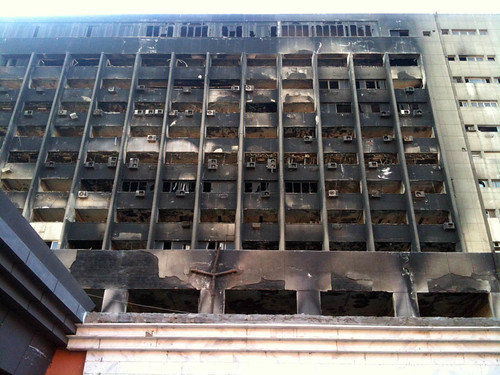
The burnt out National Democratic Party building

After a brief lunch in the Museum, in full view of the now burnt out headquarters of Mubarak’s National Democratic Party, we headed to the Egyptian Parliament building to film a series of pieces to camera about the changing political situation in Egypt during Petrie’s years working there. This felt like a great privilege at this momentous period in modern Egyptian history, and we were reminded of the sensitivity of the situation by a platoon commander who emerged from the barracks opposite to keep an eye on us. He was very friendly and polite but made it clear that he would be ‘listening to every word’. As if performing for the camera wasn’t nerve-wracking enough… 

Coming next in Part 3: Giza, a donkey, pink underwear, Tanis and Jerusalem!

Programmes on the Past: a recent EES seminar

The effective use of mass media has been centrally important to the work of the Society since its beginnings, when Amelia Edwards regularly re-cast the letters sent by Flinders Petrie from Egypt as dig reports for The Times.

A report on Flinders Petrie’s work at Tanis for the EEF published in The Times, 30 May 1884

Television in particular has been the subject of scrutiny by historians of archaeology in recent years (see e.g. the recent event featuring Sir David Attenborough organized by the Cambridge Division of Archaeology Personal Histories Project, and this article by Don Henson of the CBA), and series such as ‘Animal, Vegetable, Mineral’, now widely regarded as having been the first in a line of iconic, archaeology-related BBC series along with ‘Chronicle’ and ‘Timewatch’, are a valuable record of the way in which archaeology has been presented to the public, and an important source for the study of the history of our discipline. In the last half-century television has also played an important role in helping the EES to ‘spread the word’ about its work.

For several years during the 1970s the Society regularly arranged showings of the latest Egyptology-related films for members. As the Annual Reports of the time record, these included films on work at Saqqara, “Professor Harrison’s medical investigation of the Tutankhamun mummy”, “the Ray Smith El-Amarna project, “Nefertiti and the Computer””, and The Night of Counting the Years which was also shown at Doughty Mews in 2010. Having begun to make more use of multimedia including video in the last few years, we decided it was time to revive this practice by showing excerpts from a series of films featuring EES work, and on 25 February 2012 hosted a seminar entitled ‘Programmes on the Past: ancient Egypt on television’ at Doughty Mews.

From the opening titles of the Chronicle: Memphis: Capital of Egypt film

The films shown were as follows:

Discovery: The Fortress on the Nile (on work at Qasr Ibrim)
Chronicle: Memphis: Capital of Egypt,
Chronicle: For the Love of Egypt (a dramatization of Amelia Edwards’ work for the EEF)

We had also invited several people who appeared in the films on behalf of the EES to discuss their involvement, and share their thoughts on the way their work was portrayed: Dr Robert Anderson, the Society’s Honorary Secretary from 1971 to 1982 who appeared in Fortress, and Dr David Jeffreys, Field Director of the Survey of Memphis (SoM) and Professor Geoffrey Martin, former field Director of the joint EES-Leiden expedition to the New Kingdom Necropolis at Saqqara,* both of whom appeared in Memphis: Capital of Egypt. John J Johnston, the Society’s Vice-Chair and an expert on Egypt in popular culture, provided an introduction to For the Love of Egypt

Our special guests as they appeared on-screen. L-R: Robert Anderson in Fortress and David Jeffreys and Geoffrey Martin in Chronicle: Memphis

Robert was responsible for the Society’s events programme throughout the 1970s when the film showings were arranged. From his willingness both to show such films to EES members and to appear in them himself it is evident that he was aware of their value as a channel for communicating with the public. Although his main role on the day was to discuss his involvement in the Fortress documentary Robert had also appeared in a Chronicle film entitled The Key to the Land of Silence (available to view via the BBC Archives here) on Champollion’s decipherment of hieroglyphs. Robert is shown at the beginning of the film teaching an evening class on Egyptian language. The classes were hosted by the EES at Doughty Mews throughout the 1970s, another practice begun by Robert and revived only recently, and the footage was shot in the very room in which the seminar took place, providing a neat introduction to the day.

Robert Anderson and William Adams examine some recently discovered papyrus fragments at Qasr Ibrim during the Fortress documentary

The Fortress on the Nile documentary featured Robert and colleagues in action at Qasr Ibrim and discussing a series of historical issues, particularly the identity of the Nubian X-Group. Robert recalled that he had had considerable influence on the script and narrative thread of the film, which came as no surprise to those present: the film is very thorough, lasting approximately 90 minutes during which a series topics are dealt with in considerable detail.

By contrast, the second film on Memphis dealt with three major archaeological projects in only an hour. The first of these was the Society’s Survey of Memphis, and the second the joint EES-Leiden expedition to the New Kingdom Necropolis at Saqqara. The third project was unconnected to the EES work and was not shown at the seminar. Interestingly both David Jeffreys and Geoffrey Martin regretted not having greater control over the programme as edited for broadcast, in both cases partly due to the important work of colleagues – which had been filmed – having been cut.

It was particularly interesting to see the investment made by the BBC in presenting the work in an engaging way, and in particular that aerial footage had been shot and a 3-D reconstruction of the temple of Ptah at Memphis especially created for the programme, providing viewers with an excellent visualization of the site, of the kind that was beyond the Society’s own means at the time, as, sadly, is still the case today. From the Society’s point of view it is frustrating that we do not own any rights to, or even copies of, the aerial footage – which David explained had explicitly been promised to the Society – or 3-D reconstruction. These sequences in particular would potentially be of great use to us now in our efforts to articulate the work of the SoM.

Aerial shot of the ruins of the Ptah Temple at Memphis

A plan overlaid onto the same shot as that above

3-D reconstruction of the temple based on the same plan as that above

Showing the section on the New Kingdom necropolis at Saqqara from the same film seemed especially timely. This section concentrates on Professor Martin’s rediscovery of the tomb of Tutankhamun’s Treasurer, Maya and his wife Meryt, which turned out to be very finely decorated. After many years painstaking work uncovering, recording and studying this beautiful monument, the final publication of the relief decoration is currently in press and due to appear in the next few weeks. 

Images of Osiris and Nepthys from the tomb of Maya and Meryt

It is perhaps difficult to imagine, for those of us who have only been involved with the EES in recent years when the Society has received very little media attention, but the discovery of the tomb caused a sensation at the time and was widely reported in the national and international media, as this ITN news report from 10 February 1986 attests. Professor Martin spoke very engagingly however of the difficulty of balancing the demands of the media with those of the work. Although the Society must undoubtedly have benefitted from the exposure brought to the project, it seems the experience was not an entirely happy one for Professor Martin.

Finally, John Johnston provided an introduction to For the Love of Egypt, a dramatization of Amelia Edwards’ work in founding the EEF. Amelia’s mission was, first of all, to found an organization devoted to the investigation of ancient Egyptian sites and monuments, and having done that, to share the knowledge gained with the public both for the good that brought in itself and for the purposes of generating further interest and funds. Amelia made use of all available channels to popularize the Society and its work – excavation memoirs, a popular travelogue (1,000 Miles Up The Nile) and countless articles for newspapers and journals. She deliberately cultivated a relationship with the press, and it seems highly likely that her interests would have extended to other media, including television, had she been around today.

Amelia Edwards as played by Margaret Tyzack in For the Love of Egypt

Television companies and learned institutions like the EES have not always been easy bedfellows, however. Although the aims of both parties, i.e. the sharing of knowledge, are broadly the same, there is a certain incompatibility which can lead to certain frustrations of the kind alluded to during the seminar. Broadcast television is, by its nature, somewhat ephemeral: a film may be shown to millions on television but then swiftly disappears and becomes inaccessible even to contributors (notwithstanding home video recording, DVD releases and now iPlayer). The television company moves swiftly on to the next project, but films of this kind might potentially be used over and over again by an organization like the EES. From a televisual point of view, the material might date very quickly to the extent that it becomes unusable, but from the archaeological point of view an overview of work such as that of the Survey of Memphis retains its currency for decades. And yet the EES has little or no access to the material. I hope that in future we might be able to improve this situation, by cultivating better relationships with organizations such as the BBC, as Amelia might have done, and the forthcoming Petrie documentary, the first the Society has been involved in for a number of years, is perhaps a step in the right direction.

Three of the four contributors to the very enjoyable seminar: L-R Robert Anderson, David Jeffreys and John J Johnston

*Although formerly a joint EES-Leiden project the expedition is now solely a project of the National Museum of Antiquities at Leiden and Leiden University and is supported by the Friends of Saqqara.

In Search of Petrie (part 1)

Flinders Petrie: ‘The Man Who Discovered Egypt’ will be broadcast in the UK on BBC4 at 9.00 pm on <<UPDATED 16 03 12>> 28 March 2012 (and not 26 March as previously advertised)

Egyptology and television

As I mentioned in my first post I’ve been giving a lot of thought to the way the Society communicates, and in researching its history I’ve been very struck by our use in the past of mass media, including newspapers and television, to tell the world about what we’re doing. This was a perfect fit with the EES’ remit to educate the public – on a grander scale than we could achieve otherwise – and a perfect opportunity to promote its work. 

image

The EES Survey of Memphis team shown driving to the site at the beginning of the BBC Chronicle film ‘Memphis: Capital of Egypt’ (1991).

Having started to form a few ideas about how the Society changed its approach to communicating with a wide audience over the years (see my last post), and with a great deal of emphasis placed recently on the need to promote the EES and to reach new audiences, it seems very timely that we should now be involved in a major television documentary for the first time in years.

The EES returns to the small screen

Having made ‘Egypt’s Lost Cities’ a film featuring Sarah Parcak which was broadcast on BBC1 in May 2011, the factual department at BBC Wales were inspired to make a follow-up. This time they would focus on the history of archaeology in Egypt, and in particular on Flinders Petrie, the father of archaeology.

image

Flinders Petrie c.1886

My colleagues and I were involved in the development of the first programme, contributing thoughts and ideas as to what Sarahs methods might be used to test; we even hosted a meeting with the production team at Doughty Mews which was attended by Sarah and geologist Judith Bunbury, a regular member of EES field teams who appeared in the film as well. At that time, the team were also thinking of producing some short films for the web only, as a complement to the main production, and they asked if I would consider appearing in them. Thinking that this might provide the Society with some valuable exposure, I said I would, and did a short screen test for the job.  This must have been reasonably well-received as, although the short films were never made, to my surprise I was subsequently approached to present the new film about Petrie. A second, more thorough screen test was arranged so that a commissioning editor could decide whether or not to give this first-time presenter the job. Fortunately, in early September 2011, he agreed and production, under the leadership of Senior Producer (and, on this film, Director) Deborah Perkin, began.

In the following weeks, Deborah carried out the bulk of the research, and then began writing the treatment, and finally a script. I acted as a consultant throughout, helping to provide ideas, books and articles from the library, archival photos and other documents (of which there is a great deal relating to Petrie at Doughty Mews of course), and suggesting possible contributors and locations for filming. It was decided early on that the shoot would take place in the UK in two bursts either side of Christmas, and of course in Egypt and Israel.

Flinders Petrie: a giant of our subject 

Deborah and her colleagues at BBC Wales had been inspired to make the film by the constant references made to Petrie by the Egyptologists and archaeologists they encountered during the filming of What Lies Beneath. His influence on our subject is still enormous and yet few people outside the field have heard of him. Its the aim of our film to set the record straight.

Petrie is a legendary figure, a giant of our subject. His entry in the new edition of Who Was Who in Egyptology is one of the longest of all. He published over a thousand books and articles, and more often than not was the first person ever to do any serious archaeological work at the most important sites throughout Egypt and Palestine. His voracious appetite for new information never left him, he was never satisfied, and seems never to have been put off the task in hand, no matter how difficult. Time and again he found energy and funds where others would have given up, and where there were no established methods available for recording or interpreting what he had found, he simply invented them himself, and in the process laid the foundations of modern field archaeology.

image

Photograph taken by Petrie at Tanis shortly after a rainstorm in February 1884.

Of course, the EES has a very strong connection with Petrie. His first excavation in Egypt, at Tanis, was undertaken on behalf of the Society (then the Egypt Exploration Fund), which was in the very early stages of creating a reputation for itself. Petrie was invaluable to the Fund in helping establish its credentials in excavation but also publication, for which Petrie set very high standards in terms of the quantity and variety of material included, and the speed with which the volumes appeared in the hands of subscribers.

Filming begins

image

The blue plaque on the wall of the house in which Petrie lived in Hampstead

Filming began on a cold but sunny morning in December (13th) 2011 in Hampstead where Petrie lived for much of his life. From there our small team – Deborah, Rob McDougall (Lighting Cameraman), Ali Pares (Sound Recordist), Peter Shuff (Runner) and I – travelled to UCL, where Petrie became the first Professor of Egyptology in Britain; then to the Institute of Archaeology, where a collection of material he excavated in Palestine is kept, to record an interview with curator Rachel Sparks; to the Petrie Museum (Debbie Challis and Stephen Quirke), and finally the offices of the Palestine Exploration Fund which sponsored his first excavation in the Levant and where a great deal of Petrie-related archival material is kept (Rupert Chapman and Felicity Cobbing).

image

Preparing to film a ‘walking shot’ in the Petrie Museum

A great start

As I had been warned, the days were long – 10 to 12 hours – and quite unrelenting. There is so much to say about Petrie, and he covered so much ground, that the only way to do the subject justice was to try to cram in as many locations, contributors and stories as possible. This meant, however, that we were always battling against constraints of time, and in London against the traffic, and traffic wardens etc. I found those first two days of filming somewhat exhausting: there was a lot to do for all of us, and a lot for me to learn but it was very exciting at the same time, and a privilege to hear so many expert colleagues enthusing about our subject. I think we all found that very encouraging. We’d made a great start, but the adventure was only just beginning: the next sequences would be shot in Egypt. 

More on this in Part 2!