UPDATE 9 November 2013: A new version of the film discussed below will be broadcast on Channel 4 in the UK on Sunday 10 November, at 8.00 pm. ’Tutankhamun: The Mystery of the Burnt Mummy’ focusses on the events surrounding the king’s death and burial, specifically the theories that he died in a chariot accident and that his mummy may have spontaneously combusted inside the tomb. I will post a few additional thoughts on this in a subsequent blog entry but what is below holds true for the project overall.
—–
Notwithstanding the events in Egypt which have given us all such cause for concern in the last few days, I’ve also been quite excited lately because a film I made last year about Tutankhamun will be broadcast this week, first on the History Channel in Canada on Sunday, on PBS in the US on Wednesday, and on the National Geographic Channel in several other countries around the world including Australia, Germany, The Netherlands and the UK (Sat 13 July 8 pm BST).
The face of the second of Tutankhamun’s three coffins
The film, ‘Tutankahmun Decoded’ / ‘Ultimate Tutankhamun’, focuses on the life, death, and Earthly afterlife of the famous boy-king. The central question we – myself, the production team, and our expert contributors – wanted to ask of the evidence was: how can it be that this young man, who reigned so briefly, came to be almost instantly and comprehensively forgotten for thousands of years until the discovery of his near-intact tomb made his name and image among the most recognisable of any figure from history?
Tutankhamun has been with me for most of my life. I don’t exactly remember when my fascination with the king and his treasures began but it was already there by the time Christopher Frayling’s wonderful four-part BBC series, ‘The Face of Tutankhamun’, was broadcast in 1992 when I was fourteen years old. My mother recorded the series on VHS cassettes which we still have at home with her handwritten labels on the side. It had been there a year earlier when I tripped over a stray crash mat in the gym at school and landed on my chin. The resulting bruise looked like a little beard prompting a witty class mate to name-call ‘Tutankhamun!’. And everyone laughed. I never thought then that I would make a film about the real Tutankhamun.
Tutankhamun in 2013: anything new to say?
Howard Carter (standing at left in cloth cap) gained much of his early excavation experience during the EES excavation of the temple of Hatshepsut at Deir el Bahri in the 1890s, many some years before his discovery of the tomb of Tutankhamun
Egyptologists like me have been thinking a lot about Tutankhamun over the last year or two. 2012 was the 90th anniversary of Howard Carter’s discovery of the tomb and in recent years new research has opened up the discussion about his mummy and the cause of his death, in particular the CT scanning of the body in 2005 and the study of DNA from this and several other royal mummies, the results of which were announced in 2010. One other crucial factor was our knowledge that, contrary to what you might think, most of the material from Tutankhamun’s tomb has never been thoroughly studied and published, not even the death mask itself.
Cameraman Gary Clarke sets up a shot of the death mask of King Tut which provides one of the best known human images in the world and yet has never been properly studied
A great deal yet to be said!
It’s an interesting aspect of Egyptology, and no doubt of many academic fields, that not everything is published, and publication is only the last step in a long process that begins with the discovery of evidence and is then followed by meticulous recording (we are all familiar with the stereotype of the archaeologist carefully brushing the dust away from whatever has just been found) and perhaps years of study and research to establish context, parallels, significance etc. In the case of the treasures of Tutankhamun, the sheer scale of the discovery, the quantity of material, has so far defeated Egyptology. It would have been far too much for Carter to have published the material in his own; with hindsight his decision to publish a three-volume narrative overview of the discovery, The Tomb of Tut-Ankh-Amen, was perhaps the only sensible approach he himself could take. Efforts were made following the discovery to publish the material systematically according to object groups, originally by one the most influential figures in Egyptology, the great scholar, organiser and financial backer, Sir Alan Gardiner. Detailed studies have continued to emerge since(see the list, here) but only slowly, and the job is by no means finished.
In such circumstances, as is the case with many unpublished archaeological excavations, we are forced to fall back on the notes, photographs, drawings and other documentation made at the time of the discovery. Here, Carter’s brilliance is clear. His records, now kept at the Griffith Institute in Oxford, are thorough and detailed, describing the objects recovered and their condition when found, but also the process – the challenges he and his colleagues faced in uncovering and removing everything safely, and the solutions they came up with to overcome them. His drawings are fine enough almost to be considered works of art in their own right, and the Griffith Institute has done us all an enormous service in making most of this material freely accessible online.
New investigations
Our intention with the film was to take a comprehensive look at the evidence and the results of recent studies, to go back to Carter’s records to see if there was anything further that needed investigation, and to provide a new overview of what we know. The result is, I hope, an entertaining new look at the story, and the great irony that the political circumstances of the times and the accident of a great environmental event meant that Tutankhamun was almost completely forgotten within a few years of his lifetime, going completely against the wish of every Egyptian ‘to cause their name (that is, their memory) to live’; and yet, it may have been precisely these actions, deliberate in some cases, which meant that from 1922 onwards, his name would live again, perhaps more so than that of any other figure from ancient Egypt.
The cartouche of Tutankhamun giving his praenomen, or throne name, ‘Nebkheperrure’, the ‘Lord of the forms of Re’
Numerous investigations were carried out for the project involving specialists from all over the world. We look at the burial equipment and the possibility that the death mask may originally have been made for someone else. We discuss the tomb, which doesn’t match what you would expect of a pharaoh’s final resting place and seems ill-prepared to receive the vast quantity of goods that Carter would find crammed inside it. We examine the mummy which suggests that all was not quite right at the time of the king’s death, providing evidence of massive trauma on the left hand side of the torso in particular, that the mummification process was not to have been carried out to very high standards, and that the body may even have been burned somehow. We also examine the efforts made by Tut’s successors to erase his name from the records, and the comprehensive concealment of his tomb by a flash flood, which ensured it avoided the fate of almost all other royal tombs of the period which had been plundered by the end of the New Kingdom.
The debate goes on
Left: Producer Laura Jones with Sound Recordist Callum Bulmer in the tomb of Tutankhamun; Right: Cameraman Gary Clarke and Director Sean Smith in the Egyptian Museum, Cairo
In making the film my colleagues, in particular Producer Laura Jones and Director Sean Smith, and I were very careful not to claim that the theories we advance should be taken as definitive or final. For my part I felt strongly that our job was to provide new ideas, backed up by carefully chosen experts from the right fields, and to take the debate forward. We hope to entertain and we want to get people thinking, but we don’t want to end the debate. What would be the fun in that?
Many people have already asked me if we will be publishing the results of the studies commissioned especially for the film and I hope we will, although subjecting the research to ‘peer-review’, the scientific scrutiny that is required to verify the credibility of academic research, across so many diverse disciplines will not be easy. Of course, much of our story also draws on research which has already been published, such as Steve Cross’ flash flood theory which was published by the EES in The Journal of Egyptian Archaeology(JEA 94 (2008)), as ‘The hydrology of the Valley of the Kings’. It is very important that we try to publish the rest of the story as well. Television is a vital part of Egyptological discourse and when a film like this generates new ideas and interpretations, or means of presenting them, they should be captured and added to sum total of knowledge in the field in the same way as published books and articles are. I have discussed before the problem of a ‘disconnect’ between academic Egyptology and what you might call ‘public Egyptology’ – on television in particular (seehere). I feel very strongly that those of us on the inside have a duty to share with the public both our knowledge of ancient Egypt but also how we as a discipline came to acquire that knowledge. This is one of the essences of what we are trying to do at the Egypt Exploration Society (EES) by providing a bridge between scholars and the public.* Just as we must share our ideas, there should be a way of ensuring that the efforts of television companies can be made available to the academic world. I believe that cultivating good relations between Egyptologists and the media will help to address this problem.
Behind the scenes
Gary inside the burial chamber of the tomb
I’ve been thinking about how much fun the shoot was but I think that rather than providing a very long, diary-style account (as I did in a fit of excitement around the time my last documentary was broadcast, see here) I’ll post a few more behind-the-scenes photos like the ones above over the next few days, with a few notes explaining what made the experience so special.
I really hope those of you who see the film enjoy it. I hope you’ll find something new in it and that it gets you thinking. If the film achieves all that I’ll be pretty satisfied that we’ve done what we set out to do.
—–
*Cultivating relations with the media, and with the television industry in particular, has been an important part of our strategy for raising the Society’s public profile for some time now. Getting the Society’s name ‘out there’ by showing staff like myself and others to be taking the lead in delivering cutting edge Egyptology to the public is a vital means for us to build credibility and recognition. The EES is on a mission to help preserve and share knowledge about Egypt’s past and we need the public’s support to do this. If you would like to help, we’d love you to get involved by becoming a member or making a donation. Thanks!
I have just returned from my fifth visit to Egypt as EES Director, and will be back again in a week or so. It hardly needs saying but being in Egypt, ensuring that we do everything we can to achieve our aims in Egypt, is a top priority of mine.
The view of Zamalek, Cairo looking south-east from the balcony of the flat I stayed in during my recent visit to Egypt
One of the essences of the work my colleagues and I have been doing recently is to ensure that we are clear about what we want to do, and that we revise our activities where necessary so that the resources we have are put towards achieving those aims most effectively. By and large our efforts have focussed on the UK (for good reasons); we’re doing what we can to extend our reach (see here, under ‘New audiences’) but Egypt also requires particular attention of course.
In my view, aside from field research, we have not been doing enough in Egypt in the last few years. Fortunately, there is currently great enthusiasm for us to change this situation.
Discussions
Every one of my recent visits has been enormously instructive, useful and enjoyable. I have made a point of trying to meet as many friends and colleagues as possible, to talk to them about the situation in Egypt generally, and with specific reference to archaeology. I have spent a lot of time talking to colleagues at the Ministry of Antiquities, trying to find out how we might be able to help, and how our aims might fit with what is needed in Egypt at the moment. I have also had several extremely useful discussions with colleagues at the the Egyptian Museum and Grand Egyptian Museum (GEM), the British Embassy and British Council, the American Research Center in Egypt, and elsewhere.
Meeting Mr Mansour Boreik, MSA Director General for Upper Egypt at Karnak in November 2012
I have learnt that the EES’ profile is low – much too low – even amongst the archaeological and British expat communities. Despite this, however, I have also learnt that there is an enormous appetite for us to offer more, and much optimism that we can achieve this. Many view the Society as a sleeping giant in fact, an organisation with a great and glorious past that could hit the heights again if it chooses to do so.
Delegates at SOAS after the ‘Forming Material Egypt’ conference in May 2013. L-R: Abdelrazek El-Naggar, Alexandra Villing, Tarek Tawfik, Stephen Quirke, Maher Eisa and Daniela Picchi.
The recent ‘Forming Material Egypt’ conference organised principally by Professor Stephen Quirke of the Institute of Archaeology at UCL, offered an additional opportunity for discussion – of some of the practical issues relating to the survival of ancient Egyptian material in Egypt and dispersal to Museum collections around the world, and how, in post-revolutionary Egypt, we might work together more effectively to tackle these issues. The Society helped to provide the funding needed to bring three specialists over from Egypt – Drs Maher Eisa and Abdelrazek El-Naggar from Fayoum University, and Professor Tarek Tawfik from Cairo University – whose leadership of the discussions was invaluable in making the conference a success.
In general, these discussions suggest that the Society can be most useful in providing education and training – in the skills that will best equip the next generation of archaeologists and Egyptologists to look after the country’s history and heritage.
Here are a few ways in which we are already responding to this challenge.
A new role for the Cairo office
As part of a thorough ‘organisational review’ we have taken the opportunity to review the activities of the Cairo office and to ask ourselves if there is anything more we could do. Make no mistake, having a member of staff and a permanent base in Cairo presents us with a fabulous opportunity. No other British archaeological institution has either staff or a base in Egypt; I feel wonderfully privileged to be working for an organisation that has these things at its disposal but also very aware of the responsibility to make good use of this opportunity.
Mrs Faten Saleh at Saqqara in November 2012
As we announced recently the Society’s Cairo Representative of the last six years, Mrs Faten Saleh, will be retiring in a few weeks’ time and we are very sorry to be losing her. Faten has been invaluable to us in facilitating the work of our research projects (and several others affiliated to other organisations), maintaining our network of contacts particularly at the Ministry of Antiquities, distributing our publications, and maintaining our programme of lectures, trips and other activities for members. She has also been our ‘eyes and ears’ in Cairo, a constant source of valuable information about the situation in Egypt particularly since the revolution of January 2011 and it is no small part due to her efforts that our activities have continued almost entirely uninterrupted during this time.
We have now created a new post of ‘Fieldwork and Engagement Manager’ to run the Cairo office and Faten’s successor in this new role will be Essam Nagy. Essam has been working as an MSA Inspector at Karnak for the last few years and has also worked in the tourist industry which gives him a good blend of experience of both professional Egyptology and archaeology and the workings of the Ministry, and also of more commercial and public-facing work. My colleagues and I are very much looking forward to working with him.
Essam Nagy (at right) with the Chair of the Society’sTrustees, Dr Aidan Dodson, in Luxor, May 2013. Photo courtesy of Aidan Dodson
The new post will be full-time where previously it was part-time, in recognition of our ambition to do more. Facilitating the work of our field teams will remain a central part of the new role but it is in the area of ‘engagement’ that we particularly want to develop things.
Engaging
We want to develop our programme of educational events, placing less emphasis on the didactic and purely academic, and more on discussion and the practical.
In the past, our events in both the UK and Egypt have been intended to provide things that will be of interest to people, on a purely intellectual level. In Egypt however we have the opportunity to provide workshops, seminars and training which will be of practical use, as a greater proportion of our potential audience will be able to take what they have learnt to the sites, monuments and museums where they are working.
We need to be more active in seeking out the audiences that might benefit from what we have to offer, to establish what would be useful and then to tailor elements of the programme accordingly. We want to place less emphasis on the traditional lectures and more on events that stimulate discussion, such as seminars and workshops. The opportunity for colleagues, students and others to attend such events not only for what they can learn but what they can contribute can be a powerful incentive. With more events of this kind we stand not only to increase participation but also the number of expert voices as well, making them doubly beneficial.
Lectures are proportionally much less important to our programme of events in the UK than they used to be. When I first arrived at the EES in 2001 this was the only kind of event we put on. Today the programme is much more diverse, and one of the ways in which it has changed it has that it offers more opportunity to those attending to get involved. We run many more events now and they often involve smaller audiences which creates a greater intimacy and encourages – we hope – more contributions from audience members. When we do organise lectures of the traditional kind we are careful to ensure that we run several altogether in a single day and to build social activities into these events to allow participants to discuss what they have heard with the speakers and with each other (such as at our forthcoming study day on ‘Palaces and Residences in ancient Egypt’).
I feel that is now urgent that we bring this emphasis on participation – engagement – to the programme of events in Egypt. Attendances at the Cairo lectures have been lower than we would like lately and we must do everything we can to encourage the participation in greater numbers.
The MSA / EES Delta Workshop at the British Council in March 2013. L-R: Chiara Reali, the audience, Hisham Hussein
The successful series of Delta Workshops organised by my predecessor, Dr Patricia Spencer, ably assisted by Faten and others, provides a model for the kind of event we might try to stage more frequently in future. The three workshops held so far, in 2009, 2011 and 2013 have been very well attended, by colleagues from all over the world and especially from Egypt of course, providing a platform for sharing knowledge between colleagues and the opportunity to build networks of contacts.
Field Schools and other on-site training
There is a great potential synergy between the events programme run by the Cairo Office and the training opportunities our field teams now offer on a regular basis. With several teams in the field we are regularly sending dozens of specialists out to Egypt and increasingly we are making use of their talents not only to pursue our research objectives but also to offer the benefit of their practical experience in the form of tuition in archaeological techniques through the ‘field school’ model.
Students at Quesna begin to trowel back an area in the Ptolemaic and Roman cemetery during the 2012 field school.
HM Ambassador to Egypt Mr James Watt (at left) visited the Quesna field school in September 2012
At Quesna, Dr Joanne Rowland has run an extensive training programme in collaboration with the University of Minufiyeh and the Freie Universitaet Berlin for local students and inspectors for the last two years.* The school incorporates not only ‘hand-on’ training in archaeological drawing, photography, survey, finds recording and ceramics, but also site management and desk-based work on study and publication. Similarly at Tell Basta, Dr Eva Lange and her colleagues have coached several trainee archaeologists in a wide variety of techniques and Dr David Jeffreys, Director of the Society’s of Memphis, was among the tutors at the Mit Rahina (Memphis) Field School run in 2011 in collaboration with the MSA, ARCE and Ancient Egypt Research Associates (AERA). A second, advanced training school will be run at the site this autumn, if permissions are forthcoming, and Dr Jeffreys and other members of the EES’ team will again play a major role.
Mandy Mamedow teaches a ceramics class at Tell Basta
David Jeffreys leads the Mit Rahina Field School students on a tour of the site and its environment. Photo courtesy of the Ancient Egypt Research Associates
English language tuition
Another way in which the Society can be of direct assistance to our colleagues at the Ministry of Antiquities is through the provision of English language tuition through our association with the British Council in whose premises in the Agouza district of Cairo our office is located. In response to a request from the Ministry we were able to provide two of their employees with places on the Council’s English courses from January this year. Thanks to the generosity of the Council’s Egypt Director, Mark Stephens, with whom I have had several very useful and interesting conversations lately, we will be extending the offer to a further five MSA employees from September 2013.
Faten Saleh (at right) with the two MSA employees to whom the Society and British Council have provided English language tuition in 2013
Improving access to our published work
One unhappy consequence of the (rising) cost of publishing research in traditional printed form is that in some cases our reports have become relatively expensive to buy, and therefore inaccessible to some, to a certain extent defeating the object of publishing i.e. making the information publicly accessible. This problem is particularly acute in Egypt where people are less wealthy, and the difficulty and cost of importing Egyptology titles makes building a library almost impossible. In time, the advent the digital revolution may prove to be something of a leveller, making access to published Egyptology as easy for Egyptians as for anyone else but for now a lack of infrastructure and resources means access to the relevant content is restricted to a small minority. In any case Egyptology has not yet completely embraced the digital revolution and a significant proportion of content is still available in printed form only.
Even the grandest libraries, such as that in the Egyptian Museum, have very limited resources
We have always taken steps to ensure that copies of our titles are available in Egypt. We are required to provide the Ministry with five copies of everything we publish as a condition of receiving permission to work in the field, and we have always made our titles available for purchase at the Cairo office. We are now making a concerted effort to make our books more widely available however. We are beginning to ship excess stock to Cairo with a view to providing copies free of charge to certain libraries and institutions which don’t have the resources to purchase them.
Director of the Library of the Egyptian Museum, Magdy Khalifa, with a pile of EES books about to accessioned to the collection
I was somewhat surprised and dismayed recently to find that the library of the Egyptian Museum, one of the most prestigious Egyptology libraries in the world which is entered via a grand doorway to the left of the main entrance of the Museum itself, contains very few EES titles from the last few years. I’m very pleased to say that we have already started to put this right, thanks to the efforts of Faten Saleh, who arranged for the transfer of an initial shipment of titles from the Cairo office. Following a very productive meeting with the Director of the Library Mr Magdy Khalifa two weeks ago I am determined that we should try to provide more for his collection and that we should extend this initiative to other libraries as well.
Support for Egyptian archaeologists
Excavations at Saqqara: the tomb of Rashepses with the Step Pyramid in the background
Every year the Society provides support for young Egyptologists through the Centenary Awards – grants provided to small-scale research projects with discreet, distinctly achievable aims. It seems particularly appropriate given the mood of change among colleagues in the archaeological community in Egypt that one of two grants made this year went to an Egyptian archaeologist, Hany El-Tayeb, for his work on the Old Kingdom mastaba tomb of a man called Rashepses. The money provided by the Society through the Centenary Fund was the only financial support available to Hany this year; the funds provided to him previously by the Ministry of Antiquities have had to be withdrawn due to budgetary constraints following the revolution.
Hany El-Tayeb inside the tomb of Rashepses at Saqqara
I visited Hany’s project with the Chair of the Society’s Trustees, Dr Aidan Dodson and his wife, Dyan, at the beginning of this month. The tomb was first recorded by Lepsius, then lost until it was re-excavated by Quibell in the first years of the 20th century, then buried underneath the sands again. Not only has Hany rediscovered the tomb, he has also uncovered a number of chambers not known to the earlier excavators, neither of whom recorded the decoration in any detail. Hany is conducting the first thorough excavation of this important monument and will in due course record and publish the splendid painted reliefs that cover the walls. Until that time, I cannot show you any photographs and you will have to take my word for it: the decoration and its state of preservation is quite breathtaking in places. We are hoping that the first publication of the project will appear in Egyptian Archaeology in the coming months.
Aidan and I were delighted and proud at the Society’s association with Hany’s work. Without the EES’ support the work could not have taken place at all. This is (to my knowledge) the first time we have been able to support an entirely Egyptian-led project in the field, and we both thought it particularly appropriate that it was for work at Saqqara, the site of so many of the Society’s most significant discoveries such as the Sacred Animal Necropolis and the tombs of Horemheb and Maya.
The right direction
Egypt is a much-changed country since the revolution. The challenges of looking after such an incredibly rich historical legacy and inheritance are numerous and extensive, especially given the many other issues confronting the country and its people. There seems, however, to be a great optimism and renewed willingness to discuss openly the challenges faced, and there is certainly a great enthusiasm at the Society that we should play a part in helping to meet these challenges. I hope you will agree that we’re taking steps in the right direction.
**This sentence edited 9 June to add collaborators’ names.
**Further photos from my most recent trip to Egypt, including my visit to Hany El-Tayeb’s work at Saqqara, are here; more photos from the ‘Forming Material Egypt’ conference are here.
It’s now just under 18 months since I took over as the Society’s Director. If you had asked me at any point in my 12 years at the Society if I was busy I would have said ‘yes, very’ but I have never been so relentlessly busy with seemingly ‘urgent’ business as I have been in the last year or so, and time has flown by as a result.
The lack of activity on this page in recent months is testimony to this!
The vehicle used by the Society during its excavations at Amara West in the years following the second world war. Doing a great job but in need of renewal – a little like the Society today?
Much of the ‘urgency’ stems from our desire to maintain momentum as we try to bring about significant changes to the way the Society operates, and much of this work is taking place ‘under the bonnet’. I have come to think of the Society as being a little bit like a car in recent years: it was running smoothly enough for a while (pre-British Academy grant), it then ran out of petrol (withdrawal of the British Academy grant), we got it going again with a hefty push from a friend (our members) and the petrol can in the boot (the Excavation Fund and other reserves), and tuned the engine up to get it running a little faster (improving things in areas such as events, communications, fundraising, archives), but now that we want to make sure it can continue to run efficiently for many years to come we need to get under the bonnet, and make a few more changes which, though substantial, will not be immediately obvious from the outside.
I hope that makes sense…
The context for the current changes
As I have said on many occasions in recent years, the Society has been undergoing a process of change for some time now. In some areas the changes have been quite quickly and obviously apparent. Our events programme provides a good example of this (see my earlier post, here). We have been aware of the need for modernisation and change for some time but of course such widespread change cannot be brought about with the click of one’s fingers (sadly) and can only evolve over a much longer period for several reasons:
Change can be hard: in an organisation like the EES in which so many people are involved and whose work and aims inspire such passionate devotion, it is too much to ask that everyone reach the same conclusion about where the organisation should be, all at the same time. Change, in our case, is a journey, and bringing everyone with us requires patience and above all effective communication internally (I have also discussed this before, here).
We are, of course, having to maintain ’business as usual’ while working to bring about this change. The reviewing, rethinking, unpicking and rebuilding required takes lots of time and energy and we have to do this while continuing to deliver the very full programme of fieldwork, research, publication, and events that our members and others have come to expect.
Moreover, we have had to do all this while our financial position has been much more difficult following the withdrawal of the British Academy grant, and in fact our first reaction to this was to redouble our efforts, expanding our activities in certain areas, especially publication, communication online, events and in cataloging and conserving our archival collection (see my thoughts on the work we have done in this area, here). As a result we have set ourselves some pretty high standards.
An edited version of the following paragraphs first appeared in Egyptian Archaeology 42 (Spring 2013). This was a summary of my presentation to the Society’s membership at the AGM in December 2012 which, although it took place just under a year after I took over as Director, mainly concerned the year ending 31 March 2012, just a few weeks after my term of office began. My intention was not only to report on the year’s work but to put our activities over the last few years into context, and to show how things have been changing for some time. This was important to me from a personal point of view: in some ways I was setting the scene at the point I took over as Director, at a time when my colleagues and I were beginning to consider how to bring about the next wave of changes.
Presentation to the AGM
The Society’s AGM in December 2012 took on a slightly different feel from the meetings of the past. Following the revision of the Society’s Memorandum and Articles of Association the year before the meeting was chaired not by the President as had previously been our practice, but by Dr Aidan Dodson, the current chair of the Board of Trustees. The Chair had previously been the person to deliver the report on the year – 2011-12 in this case – but this role has now been passed to me, as Director.
This was my first AGM in the role, and in the months since I took on the post I, along with my colleagues, have given a great deal of thought to where the Society is at present, where it has come from, and where we want it to go. With this in mind I thought it would be useful and appropriate not only to report on the year gone by, but to put that year into the wider context of the last five. The Society has undergone a great deal of change in that time and it seemed the right time to look back at what has happened and what we have achieved. Fortunately, despite the many challenges we have been faced with, the picture is very good.
Fieldwork & Research: retrenchment, change and new investment
Under the heading of ‘fieldwork and research’, the last five years have been a period of retrenchment and change. Following the initial reduction (2007) and then complete withdrawal of the British Academy grant (2009) expenditure on fieldwork reduced, initially.
The black vertical lines in the graph represent the points at which the BA grant was first reduced to 50%, and was then withdrawn completely. The graph shows that expenditure on fieldwork has, necessarily, reduced as a result, but also that restricted funds (in blue) i.e. donations made by members and others specifically for fieldwork, have become much more important at the same time.
The loss of the grant forced some unfortunate changes on the Society and made continuing our involvement in fieldwork at two important sites, Amarna and Qasr Ibrim, impossible. Work has continued at Amarna however under the auspices of a newly created ‘Amarna Trust’ in partnership with which we have continued to produce Excavation Memoirs on work undertaken at the site. A series of Memoirs on Qasr Ibrim have also been published by the Society during this time.
Above and below: investment in the Amarna and Qasr Ibrim projects has continued through the publication of fieldwork undertaken in the past
In 2008 and 2009 we took the opportunity to invest small grants in external projects as a means of extending our support for cutting edge work without committing ourselves in the longer term. This allowed us to associate with one site, Ismant El-Kharab, that was entirely new to the EES, and to further our support for work at a series of sites the Society has investigated in the past including Amarna (The Panehsy Church Project), Sesebi and Tell Basta. The existing project at the latter site has subsequently been adopted by the Society as one of its own and was among the EES projects which worked in Egypt during 2011-12, alongside those at at Kom El-Daba, Luxor, Memphis, Quesna, Sais and Tell Mutubis.
Focussing not on digging itself, but on the results
When considering the initial reduction in expenditure on excavation and survey etc. we must remember that what is important is not the fieldwork itself but the results it brings. With that in mind we can especially pleased with the investment made in publication in the recent years. Along with continuing to produce JEA and EA on an annual and twice-yearly basis respectively, we have produced many more Excavation Memoirs and other site reports in the last five years than we had previously: 20 in 2007-12 compared with 12 in 2002-07.
Furthermore eight Graeco-Roman Memoirs were produced in the last five years, compared with 3 in the five years previous to that.
In addition we are now providing much more in the way of short articles and photos in print via the revamped EES Newsletter, but also online, where we have made more photos available than ever before along with our first videos. Our extensive use of social networks such as Twitter and Facebook is helping us to bring this content to audiences who would otherwise never come across the Society and its work.
Events, Archive and Fundraising
Our events programme has expanded dramatically in the last five years, and we have given more attention to the invaluable collections in the Lucy Gura Archive than ever before. I discussed both these areas of our activity in previous posts here (archive) and here (events) respectively.
We have also substantially increased our investment in fundraising in recent years, for obvious reasons, and the annual campaign has, since the first was launched in 2008, been a crucial source of additional income for various field and other research initiatives including many of those described above.
The Next Steps
In summary, following the initial reduction in field expenditure, we have continued to maintain and develop our presence in Egypt, seeking out and creating new partnerships and placing renewed emphasis on bringing past work to fruition through publication. (I am in Cairo as I write this and hoping to something about progress in this area very shortly!). We have also sought new sources of funding, to create new funding models and to rebuild our field research programme, by collaborating with other institutions and bringing new, lower-cost field projects under the Society’s wing. In the next few years we aim to align all our activities more closely to the current strategy for engaging our various audiences. A new Fieldwork and Research Committee has recently been created to develop a strategy that allows us to have the biggest impact in terms of new scientific information, but which is also sufficiently fascinating for a wider audience. We also aim to develop a dissemination strategy that allows us to make accessible all of the scientific info already gathered in the past for the good of the scientific community– to make good on the obligations relating to past work but which also puts that work into context so that its significance for a wider audience is clear.
It’s been an exciting journey over the last few years and it’s not finished yet!
………
So where are we at the moment?
As I hope the above makes clear we have, in recent years, striven to make as much progress in modernising the organisation as possible while maintaining and improving our existing programme. Certain aspects of our work were simply too big for us to make much headway until recently however.
The internal communication I refer to above, if effective, allows for a consensus view to be reached on important issues but this does not do away with the need for difficult decisions to be made and this requires effective leadership and clarity as to where responsibilities start and stop. The changes at the very top level within the Society – the composition and role of the Board of Trustees, especially vis à vis the Director and other staff – have been essential in providing both. The Society’s governance structure was subject to a long process of evolution over a number of years concluding with a final revision of the Society’s Memorandum and Articles – the governing document by which we are legally accountable – which was approved by the membership a the AGM in December 2011. The revision of the role of Director at the time I took the job on with effect from 1 January 2012, was also a part of this.
We have been working very hard in recent months to ensure that we have the right staff team in place in London and Cairo to maintain and improve the current programme while also allowing sufficient time to maintain progress in bringing about the bigger changes. A thorough ‘organisational review’ began in earnest in the second half of 2012 and is now almost complete having led to a few changes to the staff team. We have also invested a great deal of time and energy in building processes to allow us to monitor progress, and ensure that our plans can be implemented and that staff can develop in their roles. We have a great team and as a result are very well placed to keep things moving forward in exactly the way we want.
Now that the set up is right, we can begin to reform our activities in three areas:
Fieldwork and Research
Publication (or better, dissemination of the results of that work, which need not necessarily mean ‘publication’ in the usual sense)
Premises (Doughty Mews)
In all three cases our aim is to ensure that the resources we have can be used to best effect. This involves reviewing what we are doing at present, asking ourselves what needs to be done, what is it that can most usefully be done and will bring about the greatest benefits, and then in due course identifying priorities, making the necessary decisions, and, probably, rebuilding.
I had two main aims in writing this post: the first was to provide the context to what is going on at the moment, and secondly to provide an idea of what is going on and to emphasize that even if it doesn’t look like much is changing, and the results are not apparent for a while, change really is underway. ‘Urgent’ business notwithstanding, I will try to keep you all informed!
As I wrote (anonymously) in the introduction to the Society’s latest Newsletter, “life has a different rhythm over the summer months and the period allows us the opportunity to take stock” – in other words to review and make light of what we have been doing.
Front cover of the most recent issue of the Society’s Newsletter (#5, Summer 2012)
The Newsletteris now five issues old; it evolved out of the old ‘News & Events’ leaflet partly in response to a concern I had had that we were not doing as good a job as we might be of ‘reporting’ on the full range and extent of our activities, by which I really mean showing off everything that we were doing(!). In the past we hadn’t always taken every opportunity to make light of all the work we were doing. For example, although our activities in the field have always been well-covered, by our Excavation and other Memoirs, the Journal of Egyptian Archaeology and our magazine, Egyptian Archaeology, the Newsletter fills what had become something of a hole by reflecting the increasing interest placed on the Society’s archives, and plays a major part in our aim to make the material in it more accessible through the regular features it includes on items in the collection and aspects of the Society’s history. The expansion of ‘News & Events’ into the Newsletter is at once a part of the expansion of our activities over the last few years and a reflection of other aspects of that expansion.
As we approach the autumn I am again thinking about ‘reporting’ as I begin to turn my attention to the Society’s annual report and AGM. These provide us with the opportunity to make a statement about the year’s activities. Something I have been thinking about this year in particular is not so much that the report and meeting don’t cover the full range of our activities – they do, albeit in brief – but that they do so only in the context of a single year; they provide no indication of development over a longer period than that. As this will be my first cycle of report and AGM as Director, and with an organisational review currently under way it seems appropriate to make a statement about where we are, how far we have come in recent times and what more there is to do – where we are going.
A very successful season of events
John Romer provides a lecture for EES members in April 2012
Something else I said in the intro to the most recent Newsletter is that “We can also look back on a very successful season of events…” The rapid expansion of our events programme in the last few years was the initial trigger for the expansion of the Newsletter and to an extent the two have grown ‘in synch’ with one another. And so, as something of a dry-run for a wider report to come later in the year I’d like to present here an overview of the expansion of the events programme since 2008.
The main objectives of the Society’s events programme are as follows:
•To convey the results of the Society’s work in the field to as broad and diverse an audience as possible;
•To put this work into context by presenting the research of other scholars and institutions whose work complements that of the Society;
•To offer opportunities for the public to enhance their understanding of Egypt’s past regardless of their level of prior knowledge;
•To promote the work of the Society;
•To provide members and the wider public with the opportunity to participate in our work by engaging with scholars and contributing to the debate on a variety of key issues.
In the past few years the Society’s events programme has changed dramatically. The old programme of free midweek lectures was replaced in 2002-3 with two ticketed study days per year, held usually in June and October respectively, which resulted in an overall increase in attendance and income. In 2007-8 the summer study day was expanded from one to two days, and a half-day event prior to the AGM and annual lecture (free to members) in December were also added. In addition, two seminars at Doughty Mews were scheduled for the end of that year. From the beginning of 2008-09 onwards the number of events (especially seminars and free lectures at Doughty Mews) has increased dramatically each year.
A few key statistics
The total number of events organised by the Society has grown from no more than a handful in 2007-8, to 12 the following year (08-9) then 18 (09-10), 24 (10-11) and 25 last year (11-12).
Graph showing the expansion in the number of events organised by the Society in the UK between 2006 and 2012
EES members at the well-attended study-day on ‘Isis, Orisis, Horus and Seth’ at the School of Oriental and African Studies in London in December 2011
The total attendance has also risen correspondingly to 652 in 2008-9 then 605 (09-10), 1,035 (10-11) and 749 (2011-12).* The ‘spike’ of 1,035 in 2010-11 was caused by the third British Egyptology Congress, an event which has only occurred once during the years surveyed here and was the best attended of the period. Removing the attendances figure for the Congress reduces the overall figure for the year to 813 showing 2010-11 to have been a ‘bumper’ year but generally in-line with a picture of steady growth overall.
*Figures do not include the annual lecture held in December following the AGM; this is free to members.
Increasing the number of events has not only provided more opportunities to engage with our members and the wider public, it has enabled us to cover a much broader range of topics, a wider variety of cutting edge research projects focusing on many different aspects of Egyptian culture and heritage. It also allows us to respond more quickly and effectively to developments in other areas of activity; we can, for example, share new discoveries or promote new publications by arranging events at short notice, and a more effective use of online communications allows us to promote these events to a wide audience at short notice as well.
More and more speakers
As the programme has expanded we have invited more experts, increasingly from overseas, to speak at our events than ever before. Here, Dr David Jeffreys, Prof Jason Thompson, Dr Jaromir Malek, Prof Donald Reid, Prof Stephen Quirke and Will Carruthers take questions from the audience at the end of the ‘Disciplinary Measures’ conference in June 2010
We are now making much fuller use of our extensive network of contacts and knowledge of current research: since 1 April 2008 our events have featured well over 100 different speakers – increasingly from overseas – from numerous institutions in addition to the Society’s own staff, Trustees, Field Directors and others.
Our events also provide a platform for colleagues to present their work to a broader audience than they might otherwise normally engage with. The essence of the Society’s role is to provide a bridge between scholarly research and the general public and our events are a vital means of achieving this.
The closer we can bring our audience to the experts the better! Here, Egyptologist and epigrapher/artist Will Schenck demonstrates the copying of a relief onto acetate for members at Doughty Mews
New audiences
Since 2010 we have concentrated on reaching those for whom we might previously have been inaccessible for one reason or another, and broadening our appeal to groups of all ages, and levels of experience / prior knowledge. Where previously almost all our events were held in London, often on our own premises where we can offer participants the use of our very substantial library, we are also now hosting events throughout the UK – in Coventry, Durham, York and Manchester, Norwich, Edinburgh and Oxford in recent months – and partnering with other organisations by running joint events to reach new audiences.
We also now broadcast several events online each in order to engage more effectively with our supporters overseas and anyone else who is unable to attend events in person, and I am delighted that in just over a week’s time we will be running our first event designed specially for, and available only, via the web – a ‘webinar’ on ‘Cultural Property and the antiquities trade in Egyptology’ to be broadcast via USTREAM.
Dr Jo Kyffin teaching hieroglyphs at Doughty Mews
The programme also now includes series of classes on a variety of themes including tuition in Egyptian hieroglyphs. We are very keen to ensure that the fullest possible use is made of the library and archive resources housed at our London HQ and organising classes has been a very effective way of achieving this. Furthermore group visits to the collections (most recently from UCL (postgraduate students), RAMASES and Archives for London) have increased in recent years and are now a regular part of our activities along with open-house events, normally organised as part of wider festivals connected with the local area or archaeology and heritage generally. Group visits and attendance at open-house events is not including in the statistics above. In addition the Society now also provides the venue and facilities for series of non-EES classes, and for seminars organised in conjunction with the Association of Curators of Collections of Egypt and Sudan (ACCES) Seminars, of which the Society is a core partner.
Collaborations and outreach
The Society’s Chair Dr Aidan Dodson and I talk to guests after the EES / National Museum of Scotland study day in Edinburgh in May 2012
We have also increased the number of events run in conjunction with partner organisations, combining audiences, expertise and resources to mutual benefit. These organisations have included The British Museum, The British Egyptian Society, University College London, The School of Oriental and African Studies, The British Institute for the Study of Iraq, Birkbeck, The Ancient Egypt and Middle East Society, The Palestine Exploration Fund, the Herbert Art Gallery & Museum, Coventry, the University of Durham, Norwich Castle Museum and Art Gallery, Egyptology Scotland, The National Museum of Scotland, Edinburgh, the Friends of Saqqara, Leiden, and RAMASES with whom we are co-hosting a study day entitled ’Environmental Change in Egypt, Ancient and Modern: nothing new under the sun (god Ra)‘ in October this year. Statistics for attendance at these events is not recorded where ticket sales were handled primarily by partner organisations therefore overall attendance at events is in fact higher than is given above.
Finally, EES staff, Trustees, Field Directors and others regularly give talks promoting the society and its work to a wide variety of specialist interest and other groups around the country as another initiative to reach new audiences. Since 2010 EES staff alone have presented lectures to The Bloomsbury Summer School, Colchester Archaeological Group, The Friends of the British School at Athens, The Société d’Égyptologie of Geneva, The North Kent Egyptology Society (RAMASES), The Society for Lincolnshire History and Archaeology, The Southampton Ancient Egypt Society, The Staffordshire Egyptology Society, The Egyptian Society Taunton and Wessex Ancient Egypt Society, the Essex Egyptology Group, the Institute of Classical Studies, Thames Valley Ancient Egypt Society, The Richmond Archaeological Society, Sussex University Archaeological Society.
See you soon!
As I keep saying, communication is at the very heart of what we do, and spreading the word as widely and effectively as possible is the great challenge for us. The expansion of our events programme and the enthusiastic to that response from our members, collaborators and everyone we have encountered along the way is, I think, something of which everyone involved with the Society can be proud. Our current events are listed here – I hope to see you soon!
Gathering information and communicating it effectively is the very essence of what the EES does, and several of my previous posts have dealt with the ways in which we communicate with our various audiences (see e.g. ‘A new home(s)’). Ensuring that internal communication at the Society is as effective as possible is another priority of mine and will, I’m sure, be essential if we are to achieve our aims.
The current EES staff team, L-R: Roo Mitcheson, Faten Saleh, Jo Kyffin, Patricia Spencer, me, Alice Williams and Rob Tamplin.
Opinions differ
As many of you will already know the Society has been undergoing a period of transition in the last few years. This has on occasion led to some very interesting, you might even say ‘robust’(!), discussions. These were necessary: in the weeks and months following the withdrawal of the British Academy grant we were forced to ask some very hard questions of the organisation: How can we continue to fund what we do? If we can’t continue in the same way how might we adapt? What opportunities does this offer for us to refine what we do for the 21st century?
Often we were forced to make some very difficult choices: should we do X or would it be better for us to do Y? As you might expect those of us who were involved didn’t always see eye to eye on all the issues. Asking these questions meant teasing out what the EES meant to all of us: What does the Society do? What is it for? What could, and indeed should, it be doing in future? Surprisingly perhaps, the answers were not always the same, even among those who had worked together at the Society on the Board, or the staff, or for our field teams. People held different views and often perhaps were not aware that theirs was not the only view.
‘Opinions differ amongst the staff!’: A frame from the 1930s Amarna film (see here) showing a staged argument between the team members – L-R: Stephen Sherman, John Pendlebury, H W Fairman, Ralph Lavers and Hilary Waddington. Perhaps some things never change!
With hindsight the lines of communication between all the many people involved were perhaps not always as good as they might have been. We have tried very hard to improve this in the last couple of years and in the last few months in particular. I want to ensure that everyone involved in the organisation is aware of what we are doing now and what our ideas are for the next few years. By ‘everyone’ I mean all those with a stake in the organisation: our members and other friends and supporters, and everyone working for us, on the Board, the staff – in London and Cairo – our field teams and the many others who are involved in research projects that are now at the post fieldwork stage. By continuing to improve communications we hope to ensure that everyone has the opportunity play a role in driving the organisation forward and to sign up to what we are trying to achieve, fully aware of what that is.
We have made good progress towards this in the last couple of months, with a series of carefully planned initiatives.
A visit to Egypt
Jeff Spencer showing me the excavations at Kom el Daba.
First was my visit to our field teams in March which I wrote about in an earlier post (‘8 Days in Egypt’). While getting to know the teams a bit better I was pleased to see so much so much mixing of expertise from one team to the next: Angus Graham visited Jo Rowland at Quesna for a few days to help with the analysis of some drill core samples (see ‘Stuck in the Mud!’); Reis Omar Farouk lent his archaeological and logistical expertise to both Angus and Jo’s teams this Spring; geologist Ben Pennington transferred from Angus’ team at the end of their season to work with Penny Wilson; and of course Penny, and Jeff and Pat Spencer are long term collaborators on the Society’s Delta Survey, the umbrella under which they are working at their respective sites, and all enjoyed a very productive day field walking at Nashwein this year (see here). I hope that this mixing is helping the emphasise that every member or every one of our field teams is part of the one institution – the EES – and working towards a set of common goals, albeit through different projects, with their own distinct aims.
Field walking at Nashwein. L-R: Penny Wilson, Patricia and Jeff Spencer.
A gathering in London
Secondly, at the beginning of this month (June) we gathered the Field Directors together for a meeting at Doughty Mews and took the opportunity to ask them to present the results of their most recent work to a small group of our most generous supporters, and also, the following day, to the Trustees. I have made every effort to ensure that the latter are as well informed of what the organisation is doing as possible; it’s easy to take this for granted but the Trustees are all very busy people with numerous other commitments, and only meet six times a year. There has been a presumption in the past that Trustees will keep abreast of things by all the normal channels – EA, the Newsletter, our website etc. – but in practice this hasn’t always been possible and in any case there is, of course, a great deal to be gained from face-to-face contact.
EES staff, Trustees and Field Directors outside the London offices on Doughty Mews.
A visit from Egypt
Thirdly, as promised in my earlier post, the Society’s Cairo representative, Faten Saleh, was invited to London for a few days to meet the team in London, to get a better idea of what goes on at Doughty Mews, to discuss improving coordination of activities in London and Cairo, and to attend what turned out to be a very busy and well-received study day on the ‘Grand Designs’ of Amenhotep III, and the launch of Geoffrey Martin’s new volume, The Tomb of Maya and Meryt I. Those members who attended the study day certainly seemed to appreciate having Faten with them: she received a spontaneous round of applause when I pointed her out at the start of the event, and many took the opportunity to introduce themselves to her during the course of the day. We on the staff all enjoyed having Faten with us enormously and I hope that when she returned to Cairo last weekend she had not only gained a broader perspective on the activities of the organisation, but felt more a part of a team.
Faten Saleh chats to a member at the launch of Maya and Meryt I.
A team of 200
The study day was a particularly satisfying occasion for us: that we had put together a popular event was clear from the number of tickets sold (approximately 200). Our study days are our best attended events and provide a wonderful opportunity for us to enjoy more face-to-face contact, particularly with the membership. I also felt we had been particularly successful this time in providing a platform for EES research (Angus Graham’s Theban Harbours and Waterscapes Project), and using the other speakers to put that work into a wider context so that the value of the EES contribution to understanding a particular aspect of ancient Egyptian history – the monuments of Amenhotep III in this case – was clear, at the same time providing a well-rounded and appealing day of talks overall.
The reception after the ‘Grand Designs’ study day. Photo courtesy of Aidan and Dyan Dodson.
I also took the opportunity at this event to invite not just the Field Director, Angus Graham, but also several members of his team, of whom Morag Hunter, Sarah Jones, Aurelia Masson and Marie Millet were able to join us. I wanted to show them how their efforts in the field fit into the wider work of the Society, to bring them closer to the members, staff and others more involved in the UK end of things, and to emphasise their role as part of the wider EES team.
Angus Graham, Aurélia Masson and Marie Millet (both behind the lady with the grey bag) in discussion with members after the study day. Photo courtesy of Aidan and Dyan Dodson.
The more we can we can gather people together in the ways that we have in the last few weeks the more effectively we will engender the idea that we are all a part of something, with a shared vision and aims in common, and ensure that everyone feels involved. I want everyone to feel that they are part of a team, to understand what the team is trying to do and what their own role is within that.
Bringing everyone together over the last few weeks has been a very rewarding experience. There is a very positive feel about the Society at the moment which seems to be shared by our members, staff, Trustees and field teams, and I like to think that the feeling of being part of a team is something to do with that.
If you’re not yet part of the team why not come and join us?
EES staff, Trustees and Field Directors share a joke with the cameraman (me!).
The fourth edition of Who Was Who in Egyptology, the first new edition of this important work since 1995, is now in press and will be available by the end of June.
The front cover of the new, fourth edition of Who Was Who in Egyptology
The Editor, Dr Morris Bierbrier, has become a fixture at Doughty Mews over the last couple of years, adding a vast amount of new information, many entirely new entries, and significantly more photographs. The new volume is exactly 600 pages long – a substantial increase on the last edition. Having been responsible for the production editing (and hence the volume’s appearance a little later than originally planned – see below) I am absolutely delighted that Morris’ efforts are finally coming to fruition, and had a bit of fun producing the short film below in celebration.
Short film including a time-lapse portrait of the Editor, Dr Morris Bierbrier, at work during the preparation of the new edition and a selection of the newly added photos.
A great asset
Who Was Who is a great asset of the Society’s: it is the definitive reference tool for the study of the history of Egyptology and confirms the Society’s position as one of the leaders of the field. I tried to capture its importance in the blurb for the back cover:
“The civilization of ancient Egypt has been a source of fascination for explorers and scholars for centuries, and has occupied a special place in the imagination of the public ever since early travellers’ descriptions and illustrations of the strange culture of temples, tombs and hieroglyphs began to circulate around the world. Egyptology in the Twenty-first century is a multi-disciplinary science practiced by specialists across the globe. The story of its development from a hobby for the educated and wealthy to a highly formalized academic discipline provides the key to understanding how and why we know what we know about ancient Egypt. The endeavours, achievements, talents and failings of the main practitioners, and the social, political and economic circumstances in which they lived and worked have all shaped our understanding of Egypt’s past. This biographical dictionary tells the story of the most important contributors and will be an indispensable reference tool for scholars and enthusiasts alike.”
When I first proposed the new edition to the board of Trustees in 2008 we were trying to reduce costs in all areas in response to the withdrawal of the British Academy grant (see below). The Board agreed to go ahead however on the basis that print costs would be recovered through sales, which we felt were likely to be good – as I hope turns out to be the case! – and that production costs would be minimal, as I would scan all the images and set the volume to page myself in my spare time. This is the kind of thing I enjoy doing(!) and the scanning and consequent creation of a digital archive of Egyptologists’ portraits was very much in-line with our existing digitisation work, and potentially of great use. The only downside to this arrangement was that, in the event, it was difficult for me to find as much spare time as I had hoped I would to do all this (perhaps predictably). This has led to the volume appearing later than I had originally hoped (see this announcement from 2008) but I like to think it will be well worth the wait nonetheless!
I have also tried, in the Foreword, to put the new edition into context alongside a series of other history of Egyptology-related initiatives we have undertaken at the EES in the last few years, and to explain what this has all been for. This is the kind of thing I want to use this blog for and so, as promised in my last post, I have decided to reproduce a version of the Foreword here. So, let me tell you a story…
The EES and the History of Egyptology
In late 2008, when it first decided to publish a fourth edition of Who Was Who in Egyptology, the Egypt Exploration Society was undergoing a series of changes brought about initially by the withdrawal of British Academy funding, but also by a new Charities Act – the law governing the way that charities such as the EES operate – and a need for modernisation in general. This was the latest chapter in the history of the EES, which in 2012 celebrates its 130th anniversary. The Society, and those associated with it, has in that time made an enormous contribution to Egyptology. It has a glorious history of its own and it is appropriate therefore that the EES should be the publisher of Who Was Who, the definitive reference tool for anyone studying, or interested in, the people who have shaped our subject.
Some of the great figures to have been associated with the EES, L-R: the Society’s founder, Amelia Edwards and archaeologists, Flinders Petrie, Howard Carter and John Pendlebury
Two of the most important of the Society’s assets have been given much attention as a result of the recent changes, and are well represented in this book: The Lucy Gura Archive (and not least the photographs it contains) and the Society’s own rich history of contribution to Egyptology and archaeology in Egypt. The recognition of the importance of these assets was a significant step, offering the Society the opportunity to capitalise on the growing popularity of the history of the subject, and thereby to engage with new audiences, engender a spirit of pride in the institution’s history among members, and raise awareness of its most significant achievements.
Back to Basics
The Academy’s abandonment of the model by which the EES and other organisations like it could apply for a ‘block grant’ to support its research activities caused the Society to think hard about what it wanted to do and how it could find the funds to achieve its aims. In many ways, this meant re-focussing on the fundraising and public engagement to which Amelia Edwards had devoted so much of her energies, and without which the Society could never have been created. In 2008 the Society ran a campaign inviting members to provide the necessary financial support for a series of small-scale, sharply focussed research endeavours, fittingly named the ‘Amelia Edwards Projects’. Initially, this was an experiment: we wanted to know whether our already very generous members would be able and willing to provide us with additional funds, and also what kinds of projects they might be prepared to support.
An Oral History of Egyptology
Kenneth Kitchen during the interview for the Oral History of Egyptology Project
In addition to two traditional field research projects, members were invited to support a new ‘Oral History of Egyptology’ project. The proposal was to conduct interviews with senior Egyptologists in the U.K., recording their memories of life and work in Egypt, of the social, political and economic conditions which have shaped that work, and of colleagues, including, in some cases, some of the great figures who appear in this book. Fortunately, and most encouragingly, the project received the required support and, since 2008, conversations have been recorded with Kenneth Kitchen, H. S. Smith, Eric Uphill, Jessie Aldred (wife of the late Cyril Aldred) and Robert Anderson. A series of interviews conducted by Rosalind Janssen in the 1990s have also been converted to digital format and the entire collection now forms a part of a digital archive. Excerpts from the interviews have been made available online (see here and below) and it is hoped that the project will continue for many years to come.
Cataloguing and Re-housing the Lucy Gura Archive
Following the successful launch of the ‘Oral History’ and other ‘Amelia Edwards Projects’, and encouraged by the tremendous response to the 2008 campaign, it was decided that a second fundraising campaign, in 2009, should focus on a single objective: the ambitious programme of digitising and re-housing the material in the Lucy Gura Archive.
Opening slide from a presentation used to promote the 2009-10 fundraising campaign
The Archive was named after the late Lucy Gura, an enthusiastic EES member who died before her time, in recognition of a very generous donation made by her family which was used to begin the digitisation. In 2007 approximately 15,000 glass negatives taken in the field by the Society’s excavators between 1883 and the outbreak of World War II, were scanned, creating a back-up, and immediately making the collection more accessible to staff and researchers. Since then many of these photographs have appeared in the Society’s print publications and online, and staff can deal with researchers’ image requests far more quickly than previously. The purchase of a high quality photo scanner in 2008 allowed the digitisation to continue, smaller groups of material being selected according to researchers’ needs.
The Society’s scanning equipment and an image from the tomb of Maya & Meryt which was digitised in preparation for final publication of the decoration in this beautiful monument.
A commitment for the long term
The campaign in 2009 represented a commitment on the Society’s part to ensuring the long-term preservation of the original material. The money raised was initially used to pay for the compilation by Alice Williams of a catalogue of the material, which has allowed the collection to be searched more easily.
Alice Williams inspecting the unpublished manuscript for The Cemeteries of Armant II during the cataloguing of the collection
The records created will in due course be combined with existing indices of correspondence and photographs, and also the ‘distribution lists’ which record the objects excavated by the Society and divided to it by the Egyptian Antiquities Service for circulation to museums around the world. The Society’s intention is to make the catalogue and indices available online so that the entire collection can be searched remotely. Importantly, the catalogue has also provided a clearer idea of the scale of the task and a start has now been made on re-housing the most vulnerable parts of the collection. In 2011 a room, which had been Professor Ricardo Caminos’ kitchen while he still lived at no. 4 Doughty Mews, was refurbished, and work began on the thousands of photographs taken during the Society’s 1920s and 1930s work at Amarna and in the temple of Sety I at Abydos. Specialist conservators and students were brought in to undertake the work, re-packing the glass negatives in acid-free paper envelopes to be placed in sturdy, conservation-standard boxes (see more here). It is hoped that this will provide a model, demonstrating what can be achieved and helping the Society to raise further funds for this kind of work in future.
Sam Taylor and Charlotte Anstis at work re-packing glass negatives in the Lucy Gura Archive
All this work has, unsurprisingly, brought many interesting things to light, and resulted in the publication of a series of short articles, particularly online and in the recently revived EES Newsletter. These form a valuable complement to the entries in Who Was Who. One particularly interesting group of material is the film footage shot by John Pendlebury and co. at Amarna over the course of several seasons in the early 1930s. This material has also now been digitized and a series of excerpts made available online (here and below), including some which show the people involved in the work, several of whom, including Pendlebury, Mary Chubb, H. W. Fairman, Ralph Lavers, and Hilary Waddington, are included in the new edition.
Dr Bierbrier’s work in producing this volume is part of the Society’s wider efforts to study and raise awareness of the history of Egyptology, and in part a reflection of its own contribution to, and place within, the subject. We hope the much-expanded fourth edition of Who Was Who will consolidate its status as a fitting tribute to the collective achievements of those who have striven to improve understanding of Egypt’s history, and an indispensable resource for anyone studying it.
As I began to draft this post I was on a train from Providence, Rhode Island to New York having spent the last few days at the 63rd Annual Meeting of the American Research Center in Egypt (ARCE) which ran from Friday 27 – Sunday 29 April, 2012. I had been meaning to attend the Annual Meeting for several years, either to present the results of my doctoral research or to raise awareness of some of the things we had been working on at the EES, but had never found the right opportunity. This year, my first as EES Director, seemed to present the perfect moment to make my debut.
The State Building in Providence, just across the way from the Renaissance Hotel where the ARCE Meeting was held (http://flic.kr/p/bF9n9A)
ARCE and the EES
ARCE and the EES have many things in common: both are membership organisations with many professional Egyptologist members but most of whose subscribers are ‘ordinary’ members of the public; both provide financial and logistical support for field research projects in Egypt, and each publishes the results of their projects’ work through monographs, a scholarly journal, a colour magazine and online; both encourage the development for early-career Egyptologists through grants and fellowships; and each runs a programme of lectures and other events for members. ARCE’s Annual Meeting is a centrally important part of this, bringing together the leading American scholars in the field and a scattering from overseas as well and the Society’s own British Egyptology Congress (BEC) is partly modelled on ARCE’s Annual Meeting.
They also differ in various ways of course, perhaps most significantly in that while the Society can no longer rely on the British Government to provide substantial financial support as it used to through the British Academy, ARCE has been very successful, in recent years, in attracting support from the United States Agency for International Development (USAID), mostly to fund the wonderful conservation projects they have undertaken at a variety of sites throughout Egypt.
The importance of personal connections
I had wanted to go the Meeting for several reasons. Presenting the results of one’s work in person is a fundamentally important part of scholarly discourse, but this doesn’t just mean standing up in front of an audience and giving a lecture: it is as much about the opportunity to meet friends and colleagues with shared interests, to share thoughts and ideas, and to develop personal relationships. Much of this is best done face to face, over coffee or beer, or by the book stall. As discussed in my first post we have been trying to get away from the old-fashioned, institutional, passive voice, to move towards communicating with a warmer, friendlier voice(s); I believe, as we continue our efforts to raise awareness of the Society and its activities, that it will be equally important to show not only what the EES is and does, but who it is as well. Putting faces to names – and, by association, to institutions, research projects and other activities – is one of the most valuable aspects of events such as the Annual Meeting.
I also wanted to see how ARCE handles various activities which are similar to ours, from the running of the meeting itself, to the presentation of its projects. I wanted to see its fundraising operation in full-swing, and of course to meet the people responsible for the work: staff, Governors (the equivalent of our Trustees) and the local chapter representatives who are responsible for providing lectures and other activities in the various regions of the US. Fortunately, I was lucky enough to be invited to dinner the evening before the conference by Robin Young, of the Orange County, California Chapter, who introduced me to several people before the event had even begun – a wonderful start!
The meeting was held in Providence, Rhode Island and co-sponsored by Brown University whose beautiful campus lies just up (the very steep) College Hill from downtown, just the other side of the State Building from the Renaissance Hotel where the Meeting was held. Providence is a relatively small city, easy for a Londoner to get around on foot, and a pleasing mix of historic houses and other buildings around the university, and more modern developments around the river which snakes its way through the centre of the town.
But first, a detour
This cleverly lit stela of Raneb (or Nebra) grabs the attention at the start of the ‘Dawn of Egyptian Art’ exhibition at the Met.
I had decided to combine my trip to providence with a day in New York City, to see the fascinating new ‘Dawn of Egyptian Art’ exhibition, and another to visit the Museum of Fine Arts, Boston whose wonderful collection I had never seen before. I enjoyed both immensely and was very pleased to see so many EES-excavated objects on display in both places. Boston in particular is a very good place to see such pieces as it was the clearing house for the redistribution of objects to the many American museums and other institutions which supported the Society’s excavations in the early days.
Hathor-headed column capital excavated by Naville on behalf of the EES at Bubastis and now in Boston. See Naville’s photograph taken on site here.
In fact the MFA has one of the finest collections of scientifically excavated objects in the world as, along with the EES objects it also has huge quantities of wonderful objects excavated by G. A. Reisner’s Harvard University – MFA Expedition expeditions to sites such as Giza, El-Bersha and Kerma.
An exquisitely detailed and polished part of a colossal travertine statue of Menkaura in the MFA, Boston.
The Museum is rightly proud of this. The newly redisplayed Old Kingdom galleries are filled with fabulous objects from the Giza excavations, and also make liberal use of archival photos showing the pieces at the time of discovery, and an information panel emphasises that the Museum holds not only the objects but the excavation records as well. It was very good to see the importance of archives emphasised in a public context like this and of course it made me think of our efforts to raise awareness of the importance of the Society’s own Lucy Gura Archive. The Society never kept the objects it excavated of course but the connection remains, and it is a long-held ambition of mine to ‘reverse-engineer’ one of its famous excavations by reuniting the objects and the documentation as the curators at the MFA have done so successfully, with an exhibition – if not physically, then virtually. Watch this space…
And then, the Meeting
The conference itself was a joy. Egyptology is very much an international discipline: most of us travel regularly and often only see each other at events like this, or in Egypt, as anywhere else. I got to see some old and dear friends, and made a good few new ones too, some of whom I already knew through their work, correspondence we had shared etc.
There were, I gather, 350 participants at the conference, including around 120 speakers. The papers were divided across four parallel sessions which made for some difficult decisions, and, as is always inevitable when you have to miss out on at least 75% of the presentations, I had to miss a few that I would very much have liked to have seen, but nonetheless I came away having heard a great many very interesting talks. At risk of causing offence to anyone whose name I don’t now mention, highlights for me included: Catherine Roehrig’s presentation on recent work at Malqata (not least because Catherine’s colleague Peter Lacovara will be discussing the project at the Society’s forthcoming day of lectures on Amenhotep III’s ‘Grand Designs’); Nick Reeves’ marvellous detective work to reunite a series of objects which had come onto the market in Luxor without precise provenance, but which he can now show all belonged to the Overseer of the Builders of Amun, Amenhotep; and Michael Jones of ARCE, whose presentations I always think are wonderfully thoughtful and thought-provoking, on ‘Cultural Heritage Conservation Through Documentation’ which drew attention to some very striking examples of cultural heritage in Egypt which has only recently been lost and – to quote Jones’ closing line – “only exists in documentation.” It struck that this was the reiteration of one the main reasons for the EES’ creation and shows how important and urgent such work still is.
My own paper was entitled ‘The Egypt Exploration Society’s Archive and the History of Egyptology: A Progress Report’ and was intended to be a summary of our archive-related work over the last few years – in particular the Oral History Project, the fourth edition of Who Was Who in Egyptology, and the cataloguing and re-housing of the collections in the Lucy Gura Archive – and the background to it i.e. the withdrawal of the British Academy grants and the serious of changes to the Society’s activities and the way it is run that followed. This was in fact based in part on an introduction I have recently written for the forthcoming edition of Who Was Who which I intend to re-cast post in full here in the coming weeks once the book has gone to press.
It seemed to be very well received and several delegates came to talk to me afterwards to say the they had enjoyed it and, following my emphasis on the Society’s now-increased dependence on members’ subscriptions and additional contributions, that they would like to try to support the Society by becoming members. This was very gratifying, and very much in keeping with the rapid disappearance of the leaflets, newsletters and magazines which I had brought for display in the receptions areas around the lecture theatre where delegates gathered to drink coffee.
My paper was followed by another on a similar theme, ‘The First 150 Years of Egyptian Collections in Egypt through the Archives of the Milan University’ by Patrizia Piacentini who, with her team in Milan, has built a wonderful archival collection, including thousands of photographs some of which we have been able to incorporate into the new edition of Who Was Who thanks to Patrizia’s generous permission. I was very sorry to have to miss Peter Der Manuelian’s paper entitled ‘Digital Access to the Giza Necropolis: Past Progress, Future Plans’ on the Harvard / MFA Giza archive mentioned above due to it clashing with the session in which I presented my own paper but grateful for the opportunity to chat to Peter on more than one occasion during the weekend. Peter has been doing some wonderful work over many years which appeals to me both for the material itself and for his pioneering use of technology in making so much of it available online.
One of the most exciting and gratifying aspects of the conference was that several other papers also drew heavily on EES archival material: Steve Harvey (‘The Stela of Queen Tetisheri Revisited’) and Centenary Award holders Kei Yamamoto (‘Ayrton’s Cemetery F at Abydos: A New Look at an Old Excavation’ – see also here) and Timothy Sandiford (‘A City No Less than Thebes? The Ptolemaic Abydos Settlement Site 2010-2011 and 2011-2012 Excavation Season’) did a great job of making light of some of the Society’s early work at Abydos. In addition, another Centenary Award Project was described by Jennifer Cromwell (‘Unpublished Coptic Documents in Copenhagen’ – see here), and the Society’s involvement in the MSA/ARCE/AERA Mit Rahina Field School was duly acknowledged in papers by Hanan Mahmoud (‘Teaching Archeology at the ARCE/AERA Field School: Memphis 2011’) and Ana Tavares and Mohsen Kamel (‘More from Memphis: Excavations at the Middle Kingdom Settlement in Kom el Fakhry’).
The Society was also represented by Jo Rowland who presented the results of her fieldwork at Quesna and elsewhere in Minufiyeh Province (‘Quesna: Its Sacred Use and Position within the Socio-Political Landscape of the Central Nile Delta’), and by the chair, Aidan Dodson (‘The Egyptian Coffins in the Provincial Collections of the United Kingdom (ECPUK) Project’), who is a veteran of the Annual Meeting, and a very well known face on the Egyptological scene in the US. I was very grateful to have Aidan, and his wife, Dyan, on hand to introduce me to colleagues I had not met before, not least a few key ARCE representatives, and to make sure I got invited to the right parties!
Delegates amongst the collection of Egyptian objects at the Rhode Island School of Design during the Meeting reception. Photo courtesy of Aidan Dodson. (http://flic.kr/p/bU3HAr)
The reception at the Rhode Island School of Design. Photo courtesy of Aidan Dodson. (http://flic.kr/p/bF8Ymw)
Official receptions were held at the Rhode Island School of Design which has a small but very interesting collection of Egyptian objects, and in the Renaissance Hotel. I was really pleased to get the chance to say hello again to outgoing ARCE President Emily Teeter who has done the Society a great service in recent years by including a number of our images in various exhibitions and catalogues she has organised at the Oriental Museum of the University of Chicago. I was also delighted to meet the newly elected President, Sameh Iskander, whose presentation in ‘2011-2012 New York University Epigraphic and Conservation Expedition to the Temple of Ramesses II at Abydos’ I enjoyed immensely.
I was also really pleased to meet and compare notes on working in TV with Kara Cooney, presenter of several series on ancient Egypt for American television, and grateful for the opportunity to hear Carol Redmount speak about the current situation at El-Hibeh, the important site in Middle Egypt which has been extensively looted over several months since the 2011 revolution. I had previously read Prof Redmount’s reports and joined the ‘Save El Hibeh Egypt’ Facebook group which she has established to help spread the word about the situation, and I would urge all readers to do the same if you have not yet done so already! It was very disturbing to see the extent of the irreversible damage already perpetrated at the site but very inspiring to see the lengths that Prof Redmount has gone to try to stop it in the face of inertia on the part of the authorities, and encouraging to discover that the publicity campaign had been started by and enthusiastically supported since by concerned Egyptians.
Same time next year?
In all, I had a wonderful trip. It was thoroughly worthwhile for all the things I learnt about colleagues’ research, about the audience, and levels of awareness of, and opportunities to promote the Society and its work, and for strengthening connections with old friends and making new acquaintances. I very much hope this won’t be my last Annual Meeting and am already thinking about next year’s event, in Cincinnati!
Flinders Petrie: ‘The Man Who Discovered Egypt’ will be broadcast in the UK on BBC4 at 9.00 pm on 28 March 2012 and available on BBC iPlayer for one week thereafter.
Jerusalem
We were met at the border of Jordan and Israel by our facilitator for this part of the trip, Nitzan Almog, who was every bit as helpful and able to arrange anything we needed as Magdy had been in Egypt. One noticeable difference between the way the logistics were handled in each country was in the number of people involved: in Egypt we were accompanied at all times by Magdy, his assistant, two boys to carry our kit, a driver, press officer and policeman(!). In Israel Nitzan was the only person with us.
The old city of Jerusalem provided a spectacular backdrop for several sequences
Petrie spent the last decade and a half of his working life excavating sites in what was then Palestine, searching for evidence of ‘Egypt over the border’. He also spent his last few years living in Jerusalem where the climate suited him much better than that of the UK.
An enforced break
Our plan was to film in Jerusalem on the Thursday (12 January), and then to drive to Tell Hesy, the first site Petrie worked at in Palestine, on the Friday. Rob and Mark were to fly home on the Saturday while Deborah and I would stay on for another day to discuss plans and see a little of the city. Our plans were scuppered however. By Wednesday evening I had begun to feel unusually tired and a little queasy and by Thursday morning I really wasn’t feeling right. We managed to film an interview with archaeologist Shimon Gibson in the room at the Albright Institute in which Petrie lived with this wife Hilda in his last years, but after filming briefly at the next location it was clear I would have to withdraw for the day. Appropriately, I thought at the time given how I was feeling, this took place at in the hospital in which Petrie had died in 1942!
Petrie in the hospital in Jerusalem in which he spent his final days
With such a tight schedule to get through the crew decided to continue as the next sequence involved an interview at the Rockefeller Museum with curator Hagit Maoz-Lin (see this clip). However while the interview was in progress Rob was also taken ill leaving Nitzan to operate the camera. Filming was cancelled for the day and, having each been diagnosed with gastroenteritis and given a saline infusion in an emergency clinic, Rob and I were advised to spend at least one day recuperating. Fortunately we were able to revise the schedule to allow us to complete the necessary filming, but not without Rob and Mark flying home a day later than anticipated and Deborah and I losing our free day.
Jeffrey Blakely gestures towards Tell Hesy for the crew
Saturday was spent picking up where we left at the Rockefeller Museum before driving to Tell Hesy to meet Jeffrey Blakely, who has been excavating at the site for forty years. We had been warned beforehand that due to heavy rains the tell itself might be in accessible and indeed the road to the site was so muddy that we had no choice but to complete the last mile of the journey on foot, with all the kit. It was all worth it however: the lush green setting was quite beautiful especially as the sun start to set, and it was a pleasure to talk to someone as knowledgeable as Jeffrey. One of the reasons Petrie chose to dig at the site was that a wadi running alongside had cut into the side of the Tell providing a very visible profile of the successive layers of occupation that create the mound in the first place. It was the wadi which now prevented us from getting to the site itself. Jeffrey had never known there to be so much water in the wadi that you could hear it flowing; the noise very much contributed to the ambience and Mark was delighted to have the opportunity to record it.
Petrie’s headstone in the Protestant Cemetery in Jerusalem; note the scattering of potsherds on the top
This left one final morning for filming back in Jerusalem, principally in the Protestant cemetery in which Petrie is buried, and on the Mount of Olives with the old city as the backdrop. We were even more rushed than usual this time and managed six pieces to camera and a few general views and walking shots. It was exhilarating to have managed to get through so much so quickly but I had mixed feelings as we packed all the gear and headed for the airport: I would have loved to spend more time exploring the city (and less time in recovering from illness in bed!). I hope to be back before too long.
Mark and Deborah packing up the kit in the car park of our hotel in Jerusalem
Back to the UK
At this point we still had three further days’ filming in the UK, beginning with a visit to ‘Wilmington Man’ in Sussex with Petrie’s granddaughter, Lisette Petrie. Petrie had measured this hill figure while on holiday with his family including Lisette’s father, John. After more discussions of the Petrie family with Lisette and her own daughter, Susie, we headed back to London for an interview with EES Trustee, Margaret Mountford, at Doughty Mews. With no restrictions on the amount of time we could spend at the EES we filmed a series of pieces to camera well into the evening. We returned to the PEF to complete an interview with Felicity Cobbing and then sped off to the British Museum for a long day of interviews (Rupert Chapman and Neal Spencer), walking shots and then several pieces to camera after-hours in the Egyptian sculpture gallery.
Where’d all the punters go? Setting up a shot of the Rosetta Stone after hours at the British Museum
For our final day we filmed several sequences relating to Petrie’s appointment as Edwards Professor of Egyptology in the quad in front of the main building at UCL before heading to the EES for the final sequences. These included ‘establisher’ shots of me arriving at work and explaining what the EES does in 2012, and Petrie’s involvement with the Society and Amelia Edwards. As this was our very last day of filming any pieces to camera which we had had to leave out previously were also recorded here. I set a new personal best for the number of PTCs recorded in a single day and we finished (‘wrapped’, to use the lingo) almost on time at around 6pm.
Getting ready to film the shot of me balancing a candle on my head in the EES library
A steep learning curve but a great experience!
The very long days of travelling and filming had, in the end, flown by but they had been great fun. The crew were great to be around and to work with and I had settled into a routine for learning my lines that I was comfortable with. There were three main kinds of sequence in which I might appear. The simplest were the ‘walking shots’ in which I would shown, as you can probably guess, walking into or through a location to establish where the next sequence will take place and to allow the viewer to familiarise him/herself with it. From a personal point of view I’m really looking forward to having these as a reminder if some of the fabulous locations we visited. A little to my surprise I felt particularly proud to be filmed looking closely at Tutankhamun’s famous death mask. I do hope he makes an appearance in the final cut.
Interviewing our contributors was a little more challenging. My job in these situations was to tease out of them exactly the right information and views to keep the story moving along at the right pace, or to provide a smooth introduction to the next shot. This meant formulating exactly the right question as concisely as possible, something those of you who know me may imagine didn’t come altogether easily! The interviews were generally very good fun however. In many cases the contributors were friends with whom I felt immediately at ease. Others I met only a short while before filming started. In all cases it was a pleasure and a privilege to work with experts with such enthusiasm for our subject, each of whom brought something unique to the film. I was only sorry that we never had enough time to chat on or off camera.
Me in mid-piece to camera at Giza!
The most challenging parts for me were my ‘pieces to camera’ (PTCs): the scripted lines which I had to deliver while looking straight down the lens, often on the move – the walking and talking that, I discovered, is not as easy as it looks. I had optimistically thought that I would learn most of my lines at least the day before but quickly learned two things that meant this wasn’t necessary: 1) as we had had no read-through the precise wording generally changed depending on what sounded right and what I was comfortable with and 2) I found I could learn the lines for a single PTC – usually no more than 2-3 sentences at most – in 5-10 minutes before filming. As the budget hadn’t stretched to a recce before the shoot began the crew were new to just about every location which added to the time required to set up each shot. There was often little I could while this was help pending providing me with the opportunities I needed to familiarise myself with the lines for the next PTC.
Transmission nears…
As I write this the film is due to be broadcast tomorrow evening. We have had good reviews in the press over the weekend (with one notable exception…) which is very exciting in itself. I am a little nervous but really looking forward to seeing the finished product.
Amelia Edwards, the founder of the EES, would surely have used television to promote the Society had it been around in the 1880s. Her portrait on the stairs at the EES offices was used as the backdrop for several sequences
This is a wonderful opportunity for the Egypt Exploration Society; we are of course hoping that the viewing figures will be good and that in any case the film will bring the Society to the attention of many who would otherwise have no idea of its existence. Very few people can have had a greater impact on archaeology or Egyptology than Petrie, and the Society’s role in his development – and vice versa – cannot be underestimated. One of his greatest contributions was his insistence on making the results of his work widely known through rapid and thorough publication. He also understood the crucial importance, for the continuation of his work, of engaging the support of the public, through the EES and subsequently through his own Egyptian Research Account and British School of Archaeology in Egypt. I’m sure for these reasons that he would approve of this film, and the Society’s participation in it, and would encourage everyone to tune in!
The great man, Flinders Petrie, leaving colleagues trailing in his wake even into old age!
I have just returned from an all-too-brief but fabulously useful and interesting eight days in Egypt. This was my first visit as EES Director and my goal was to see as many friends and colleagues, particularly in the Ministry of Antiquities, as possible and to visit the five EES teams that are working in Egypt this Spring. This was something I had wanted to make a priority when I started the job, and to my delight it has been every bit as enjoyable and productive as I had hoped it would be, and much more.
It is, of course an exciting, if unsettled and difficult period for Egypt: the country is still waiting to see who will be its next president and what changes this will bring, and times are hard, particularly in those areas which rely most heavily on tourism as visitor numbers remain very low. Some are concerned at the reduction in the number of police on the streets, and there is currently an apparently inexplicable shortage of petrol which is making for long queues at the petrol stations throughout the country. Still, there is relief and joy that the revolution has brought the possibility of the changes the people want, and great hope and optimism in general.
A mixture of ancient and modern motifs among the graffiti which has sprung up around Midan Al-Tahrir since the revolution (http://flic.kr/p/bGoqAe)
It has also been a time of great excitement and optimism for the Egypt Exploration Society. We have, in the last few years, been through a lot of change brought about by a very challenging financial situation and the necessary modernisation that came with it. We have made great strides however: our financial position is much more stable and secure than it was a few years ago, and by looking very closely at all our activities and how everything is run we have been able to improve the financial situation at the same time as expanding our programme of activities in a series of key areas such as fundraising, the archives, events and online communications (I’ll be writing about these in more detail in the coming months). Having worked very closely myself on improving the Society’s work in The UK in the last few years in my role as Deputy Director, I am now relishing the opportunity to get to work on the Egyptian side of our operations.
Meetings, meetings
During the week I met numerous colleagues from the MSA including the Minister, Dr Mohamed Ibrahim, not only at their headquarters on Zamalek, the island in the centre of Cairo, but at each of the centres in which our teams are working. I visited the site of the Grand Egyptian Museum (GEM) by the Giza pyramids and met the Director General, Dr Hussein Bassir, who showed me around the extremely impressive Conservation Centre which is already up and running.
Work is under way at the new conservation centre at the Grand Egyptian Museum site
I also met with the British Ambassador, James Watt and his colleague Sam Grout-Smith, who were extremely hospitable and keen to hear more about the Society’s current work in Egypt. I met friends from the American University in Cairo, American Research Center in Egypt and Ancient Egypt Research Associates and elsewhere, and gave a lecture for EES members in Cairo. And of course I spent a lot of time with the Society’s Cairo representative, Mrs Faten Saleh, who accompanied me almost throughout, not least on my visits to the EES field projects.
Visiting the archaeologists and other specialists who make up our teams and their sites was really my top priority and my visit was timed to ensure that I could see as many of them as possible. If you had asked me beforehand, I would have said, having visited numerous archaeological projects – EES and otherwise – that site reports, online dig diaries, lectures etc are all very well, but there is no substitute for being there in person with the people doing the work. Everything from the journey to the site to the atmosphere among the team members, foreign and Egyptian, helps put the work in context. Of course you also get the opportunity to ask questions, however daft they might seem, which might be the key to helping you to understand what’s going on (“oh, I see…”). I thought I knew all this already but nonetheless I have been bowled over by what I have seen in the last few days. I feel I understand what our teams are doing much better than I did before and my enthusiasm for them all, which was never lacking beforehand, has increased dramatically.
Our adventure began last Tuesday (20 March) with a drive to Quesna in the central Delta (see this map) to see Jo Rowland and her team. The site is located atop a very large yellow sand gezira (mound) surrounded by fields, factories and a landfill site. At one end of the site lies a Ptolemaic and Roman mausoleum excavated by the SCA in the 1990s, a spectacular jumble of vaulted mudbrick chambers and the occasional stone sarcophagus, one with a very finely modelled human face. Jo’s excavations focus on the Ptolemaic and Roman cemetery nearby, in which a series of well-preserved and articulated human remains have been found, and in the 140m long sacred falcon gallery. Here, thousands of mummified birds were placed in ceramic jars and deposited in the galleries. This would of course have been similar in function to the catacombs devoted to a variety of sacred animals discovered by Emery at North Saqqara in the 1960s. It might not look like much at the moment but with Jo’s help it wasn’t too difficult to imagine a very impressive structure at the centre of local religious beliefs and one I thought might lend itself to some kind of virtual reconstruction. Jo also showed Faten and I the site of the Old Kingdom mastaba she discovered in 2011 but has not yet been able to excavate completely. We talked about the possibility of increasing the size of Jo’s team in the future in order to expose the entire monument; funds permitting this is something we would both like to do.
The atmosphere on-site in fantastic. Jo has the largest workforce of any of the teams I visited which, along with the constant banter, not least with Geoffrey Tassie (known universally as ‘Tass’ or ‘Mr Tass’) whose ‘shiq shaq shoq’ dance is extremely popular, makes for a very jolly working environment.
Left: Jo Rowland and her team; Right: Tass performs the ‘shiq shaq shoq’ for his colleagues! (http://flic.kr/p/bttBpw)
We left Jo and Tass and their team after a tour of the workroom and headed north to Kafr Es-Sheikh which Pat and Jeff Spencer and Penny Wilson were using as the base for their work at Kom El-Daba (not the Daba / Avaris of the famous frescoes but another site of the same name) and Nashwein respectively. We caught up over a delicious fish dinner then, after a good night’s sleep, set off in the morning, first to Daba in Pat and Jeff’s hire car.
It may not look like much more than a muddy area of lumps and bumps, but the mud at Kom El-Daba is in fact the remains of what was a sizeable town in Ptolemaic and Roman times. The team here are excavating the substantial remains of a Ptolemaic ‘tower house’, a type of building which could reach several storeys high. Daba would in ancient times have been much more high-rise than you’d ever imagine just from looking at the site as it is today. The work, a part of the Society’s wider Delta Survey, has now reached the point at which Pat and Jeff believe they have gathered as much information as is necessary and it is likely that they will decide to concentrate resources on another, uninvestigated site next year.
Pat and Jeff decided to end the working day early so that we could all drive to Nashwein to visit Penny on what was the first day of her season of Delta Survey work. The drive itself was great fun. This part of the world is so relatively remote and developing so quickly that there are no maps which can be relied upon to show the best roads. Jeff therefore uses satellite images to identify what look like the best roads – asphalt and with cars on – to a given site, and then uses other landmarks such as built up areas, canals, bridges which appear on the images to navigate the route which, in the absence of any signage is the best method available. I was given the job of reading the satellite image / map – I have never felt more involved in Egypt Exploration!
Nashwein is a another very large site. Penny will be unable to do more than a basic topographical survey and inspection of archaeological material visible in the surface before heading to a more involved excavation at another Delta site, Tell Mutubis. This in itself will be of enormous value however. It is difficult to overstate just how little we know of Delta archaeology: just to establish the extent, condition and date of these sites, and in some cases that they exist at all has been an enormous achievement of the Delta Survey and every piece of information, however small, adds to our knowledge.
Our next stop was to be Tell Basta, a few hours to the south-east. We decided to break the journey by stopping overnight in the city of Tanta and arrived in good time the following morning (Thursday) to join Eva Lange and the rest of her team. The Tell Basta project is collaboration between the EES, the MSA and the University of Göttingen. The Society’s involvement is relatively recent – the project has been in existence since the 1990s but we have only been involved since 2008, but of course the Society has had a very strong connection with the site since Naville’s excavations in the temple in 1887-9.
Edouard Naville among his workmen at Tell Basta. See further here.
The elite Middle Kingdom cemetery at Tell Basta with the palace just beyond (http://flic.kr/p/bGoqKe)
Though it is mainly famous for its temple, a jumble of massive, beautifully decorated and well-preserved stone blocks, the archaeological area is in fact much larger and encompasses domestic and cultic buildings, a palace and cemeteries, all of which dates from the Old Kingdom to Roman times and most of which has never been explored. The potential of the site is breathtaking. At present we have only a vague understanding of what is there and in the next few years Eva and her team plan to improve this situation by undertaking a comprehensive non-invasive survey (geophysics and augering) of the entire area, which will, we are hoping, lead to more focussed work on specific areas. One aspect of the work which the Project may be able to take on in the near future is the recording of the very fine decoration in the tombs of the Old Kingdom. We have been hoping to revive the Society’s epigraphic activities for some time and this would provide an ideal opportunity.
Luxor
After heading back to Cairo, Faten and I flew to Luxor the following day (Friday) to visit Angus Graham and his team which had just begun the augering phase of the Theban Harbours and Waterscapes Project. We met with Angus and his colleagues, Ben Pennington and Morag Hunter, that evening as we had all been invited to dinner at Chicago House. We had a great evening with old friends including the Director Ray Johnson and a good few new acquaintances as well. Luxor has changed a great deal in the last few years not least due to the excavation of the avenue of sphinxes in the centre of the town which continues to generate much discussion, and it was fascinating to talk to Ray and Chicago House architect Jay Heidel about some of the issues, and the fascinating, more recent – medieval and modern – history of the area.
The excavations of the avenue of sphinxes connecting the Luxor and Karnak temples (http://flic.kr/p/bttSgy)
The vast excavation trench has had a dramatic effect on the centre of the city (http://flic.kr/p/bttSfj)
I joined Angus and co first thing the following morning and was immediately reacquainted with my good friend and member of several EES teams Reis Omar Farouk (who also appears in our Petrie film, see my earlier post). We drove from the east bank across the bridge to the village of Nagaa Raml Al Alqalta to begin augering in the fields close by. This is the area that was, three thousand years ago, in the 18th Dynasty, the southern end of the entranceway to the Birket Habu, the massive, artificial harbour created by Amenhotep III in front of his palace at Malqata.
L-R: Morag Hunter, Ben Pennington, Warda el-Nagar (MSA Inspector) and Angus Graham analysing samples in the Birket Habu area, with the Theban mountains in the background (http://flic.kr/p/bttBy9)
Having undertaken a short season of geophysical investigations earlier in the year the team are now analysing the soil down to a depth of 9m in an attempt to improve their understanding of conditions in the area in ancient times, and specifically whether or not there was water, and of what kind – standing, flowing, seasonal etc. – here at the time of Amenhotep III.
It was a great thrill for me to see this work in particular. First of all I am very fond of the area: the fields and villages, set against the backdrop of the Theban mountains, are very beautiful, and I spent several seasons a few years ago living and working in the area with the Italian Mission to Luxor (and specifically the Tomb of Harwa). Secondly, I hadn’t realised how entertaining it would be to watch the augering in progress. Reis Omar and his crew have to really heave to get the auger in and out of the ground, and their circular procession around the kit as it is driven downwards looks like some ritual dance. Best of all, Omar leads them in song almost throughout. It’s very entertaining!
A short video of the augering in progress – listen out for the singing!
Over the course of several hours what is, in effect, a column of soil samples of up to 9m is brought out of the ground in sections, each from slightly deeper down than the last. Each time, once the drill head has been brought back out of the ground, the sample is then scraped onto a tray by Omar and then passed to Angus, Ben and Morag for analysis. I find it utterly fascinating that what looks like any old mud to the untrained eye might potentially tell us so much about the building and other activities of one of the most interesting characters in ancient history, Pharaoh Amenhotep III. I can’t wait to hear the results of the season’s work set into context by a series of other experts on the period at our study day in London on 9 June: ‘Grand Designs’: Amenhotep III and the landscape of Thebes
After a few more visits and social calls, including Reis Omar’s house in Luxor for dinner, I flew back to Cairo and then home the following day (Sunday).
The next steps
As I write this I’m still bursting with enthusiasm about the work our teams are doing, and elated at the atmosphere of positivity, energy and good humour I encountered at every one of the sites. It is my job now, along with my colleagues on the Board of Trustees and staff, to try to build on this and take things further forward. There are several areas in which I can see we might be able to make some progress:
•First of all I’d like to engender more of a spirit of community / collegiality between our field teams, and my colleagues on the staff etc. One of the happiest aspects of the trip for me was getting to know our teams that bit better, and I’m really glad from this point of view that Faten was able to join me. We are planning to involve team members as well as directors more directly in our events and to get them all together more regularly with everyone involved in the organisation – staff, Trustees, members and sponsors as well as fellow field workers
•I want to make sure that out teams and their work are as ‘visible’ in the archaeological and Egyptological communities as possible, and that they benefit from discussions with colleagues outside the EES by hosting more workshops (like the recent Delta event), seminars and social events particularly in Egypt, during the field season.
•I also want to make sure that our teams are as well coordinated as possible in terms of sharing resources – expert personnel and equipment etc.
•Most of all I want to ensure that each one of our projects is able to realise its potential, by supporting our teams throughout the process from fieldwork, to study and research, and finally, publication. We have in that past focussed only on supporting the fieldwork and publications costs but there’s an awful lot more to the process than just that. We aren’t going, suddenly, to be able to pay for everything but I think, with a little more flexibility and awareness of what might be able to do, we might be better placed to achieve our ultimate goal of finding out X about ancient Egypt and then telling the world about it.
All the above will come at a cost of course and will be subject to funds being available. However, the Society’s financial situation is much improved as I mentioned above and we are now much better placed than we were only a few years ago to raise funds for targeted initiatives in particular.
Presence
As you might imagine I have also been giving an awful lot of thought to the Society’s presence in Egypt, in terms not only of the work we are doing, but also of our profile among the Egyptological community and more widely, and the way the organisation is perceived. I was really pleased to hear colleagues talking so warmly about the Society and its work, and its long history and status as the pioneer organisation of its kind. We should all take great pride in that. I was a little concerned however that some felt a little ‘in the dark’ as regards our current projects, and activities in Cairo, but encouraged that everyone was hoping for a resurgence of sorts, and I think that without too much difficulty we ought to be able to bring this about with a few fairly straightforward initiatives. These might include:
•Improving the ‘education and outreach’ programme in Cairo as we have in London in recent years;
•Increasing ‘traffic’ between the UK and Egypt: we hope that Faten will be coming to London this summer and that Roo Mitcheson will visit Egypt later in the year;
•Using both these initiatives to improve educational opportunities for Egyptians and MSA employees in particular by:
1.Providing more educational activities – lectures, but also seminars, colloquia, short courses and tours – and offering a number of free places for MSA employees;
2.Bringing more Egyptians to the UK, to contribute to and/or benefit from our own education programme and from visits to other Egyptological institutions in the UK
Can’t wait to get back
All in all, this was a fantastic trip. It was a privilege to be able to see the fabulous work my EES colleagues are doing and I was really taken by the warmth and openness shown by everyone I met, and by their enthusiasm for what the EES is doing now and, perhaps more excitingly, what it could be doing in the coming years. I can’t wait to get going on all of this, and can’t wait to get back to Egypt.
Flinders Petrie: ‘The Man Who Discovered Egypt’ will be broadcast in the UK on BBC4 at 9.00 pm on 28 March 2012.
To measure the Pyramids…
We spent the next day at Giza, the first site Petrie worked at in Egypt, and perhaps the most iconic anywhere in the country. Petrie visited the site in 1880 and again in 1881-2 in order to measure the pyramids, which still seems like an incredible, and audacious feat for a man at the very beginning of his career. The setting, of course, is magnificent, and although we were very aware of the problems it has caused to the Egyptian economy, we were otherwise grateful that there were fewer tourists than one would normally expect at the site, and we found a spectacular but very quiet location on the south side of the pyramid of Khafre, which helped add to the magic a little.
This was the day on which I was required to play the part of Petrie more than at any other time during the shoot. I rode a donkey, as he did when he arrived at the site; Magdy and I scampered around with a tape measure and a copy of Petrie’s plan attempting to recreate what it must have been like for him trying to fix his survey points; there was even a little bit of dressing up involving a pink costume provided by the BBC. If you don’t know the story, you’ll have to watch the film!
My steed arrives
…and promptly steals the show
Magdy and I prepare to emulate Petrie by measuring the base of the pyramid of Khafra…
During the afternoon came perhaps the most rewarding moment in the entire shoot. Deborah and I had wanted to visit the rock-cut tomb at the site in which Petrie lived while working there. The problem was that we didn’t know exactly where it was and couldn’t find anyone who did. Magdy, with much help from our colleagues at the Ministry of State for Antiquities, was able to locate the tomb in a very rarely visited part of the site on a cliff side, just to the south of the causeway of the pyramid of Khufu. The earliest known photo of Petrie in Egypt, something of an icon for students of the history of Egyptology like me, was taken outside the tomb. Hands behind his head, barefoot, Petrie seems very much to be in his element. Deborah was very keen that we should recreate the scene, with me in the role of Petrie and I didn’t really feel I could refuse.
Petrie standing outside ‘his’ tomb at Giza in 1880 and our recreation of the scene.
Much as it was fun to do this, the real joy for me was in finding the tomb and looking inside it. It proved to be on one of several cut into this short stretch of cliffside which provided Petrie with a glorious view of the agricultural land of the Nile Valley in 1880, a view now almost totally obscured by a concrete structure a matter of yards from the front of the tombs. In any case however, even if this new building hadn’t been there, all we would have seen looking out from the tomb entrance was the sprawl of suburban Cairo and Giza.
Looking down the causeway of Khufu towards the sprawl
‘Petrie’s tomb’ is in fact two tombs knocked together. To my surprise several of the tomb entrances were inscribed although it was extremely difficult to make out many of the signs, and there was little trace of any decoration inside. Petrie slept on a hammock and we were excited to find the remains of some cord strung around a rail which had been fashioned from the rock. It seemed very unlikely that this could have been from Petrie’s own hammock but, not being sure, it was an intriguing possibility. The light at the end of the day was fantastic and Rob in particular was frustrated that filming was brought to a halt when the site closed before sundown. Still, it had been another excellent day.
Tanis
The next morning we headed to another of the sites I had recommended we visit. Tanis has always been a favourite site of mine: the Society has a very strong connection with it thanks to Petrie’s excavations, and it became an extremely important site during the Third Intermediate Period which was the subject of my postgraduate research.
Clear instructions for would-be archaeologists at Tanis
It’s also a wonderful combination of poorly- and well-preserved remains: poor in that little of the architectural form of the main temple is still visible, but well, in that the decoration on many of the blocks seems as fresh as it must have been the day the sculptors finished carving the reliefs. Importantly as well, it doesn’t look so very different now from the way it did when Petrie first visited – a romantic jumble of beautiful ruins – as his own wonderful photographs, which are now kept in the EES archives, show. This is how I saw it anyway, and I was hoping the crew would agree.
Rob and Mark set up a shot amongst the ruins at Tanis
Petrie’s photograph of a fallen colossus of Ramesses II, taken shortly after the great storm of February 1884
Fortunately, they crew did agree, and we spent yet another wonderful, but all too brief day at the site. In this case playing the role involved looking though a Victorian telescope from a prop store somewhere, and blowing into an old-fashioned whistle, as Petrie would have done at the end of the day’s work.
And that was the end of our filming in Egypt. The next day, Wednesday 11 January, we flew to Amman in Jordan for an overland journey to Jerusalem crossing over the border into Israel at the Allenby Bridge.
Coming next: Part 4: Jerusalem, Tell El-Hesy and back to the UK!


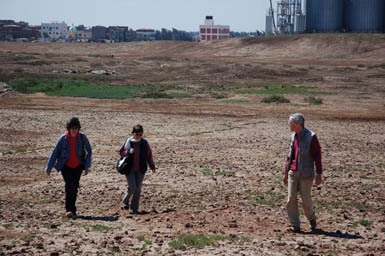


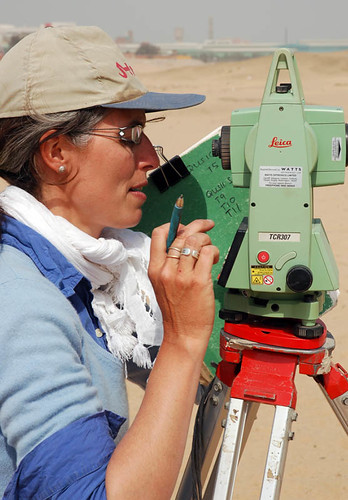


 Dr Chris Naunton