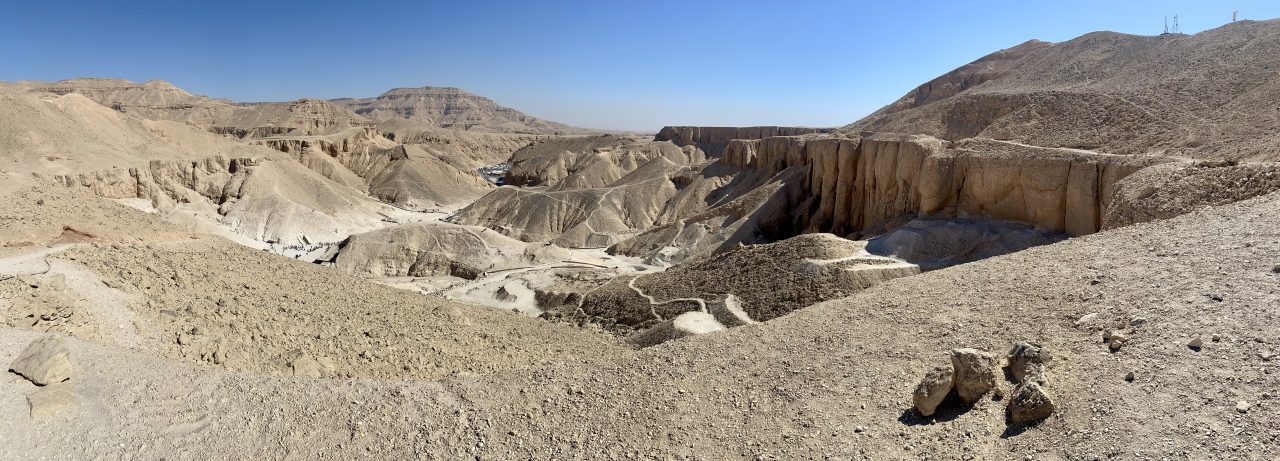
*I first drafted this piece in February 2023 but I’ve only just got round to finishing it, as a complement to my recent talk on ‘Pyramid Mythbusting’.
Three phenomena I’ve been able to observe over the twenty odd years I’ve been working in the field:
1) Giza and the pyramids, specifically the Great Pyramid and how it was built, probably attract more attention and more theorising than any other aspect of Egyptology. This isn’t surprising: the great pyramid is one of the very best known achievements of the ancient world, it is self-evidently a staggering achievement, it’s very old and we still don’t entirely understand how it was built.
2) This last thing naturally encourages people try to solve the mystery by applying their own ideas and skills often drawing on specialisms beyond Egyptology such as engineering or geometry. This is also unsurprising, but much more curiously, I’ve also often found that the people with these ideas don’t want to commit to telling you what they are on the phone (which I used to have to pick up when I worked at the EES) or on email. Their ideas are secret and can only be imparted via a meeting in person. They assume that Egyptologists spend our lives scratching our heads, desperately trying to figure out how the Egyptians erected such vast and precisely constructed monuments when in fact most of us are more likely to be absorbed in our own particular research interests (for how much longer after his invasion of Egypt did Piye continue to reign? Did Ankhkheperure Neferneferuaten and Tutankhamun rule alongside one another?) or just as likely consumed but something much more mundane (what time do I need to get to the station? Do I need to buy that book or should I try and find it at the BL?). They think that we will be desperate to know what they say when, sorry folks, new – and secret – ideas about how the pyramids were built are ten-a-penny and generally aren’t any more persuasive than any other ideas, they often involve specialisms I have no expertise in and therefore cannot apply any expertise to, and they’re impossible to prove in any case due to an absence of any real evidence.
I was delighted to see similar thoughts posted to X/Twitter not long ago by Dr Darren Naish who works in another field that attracts a lot of pseudo-science and alternative ideas:
”I should add that just about everyone involved in technical research is immersed in their own work, overworked and underpaid, and mostly unable and unwilling to spend time on stuff irrelevant to their own research programmes…”
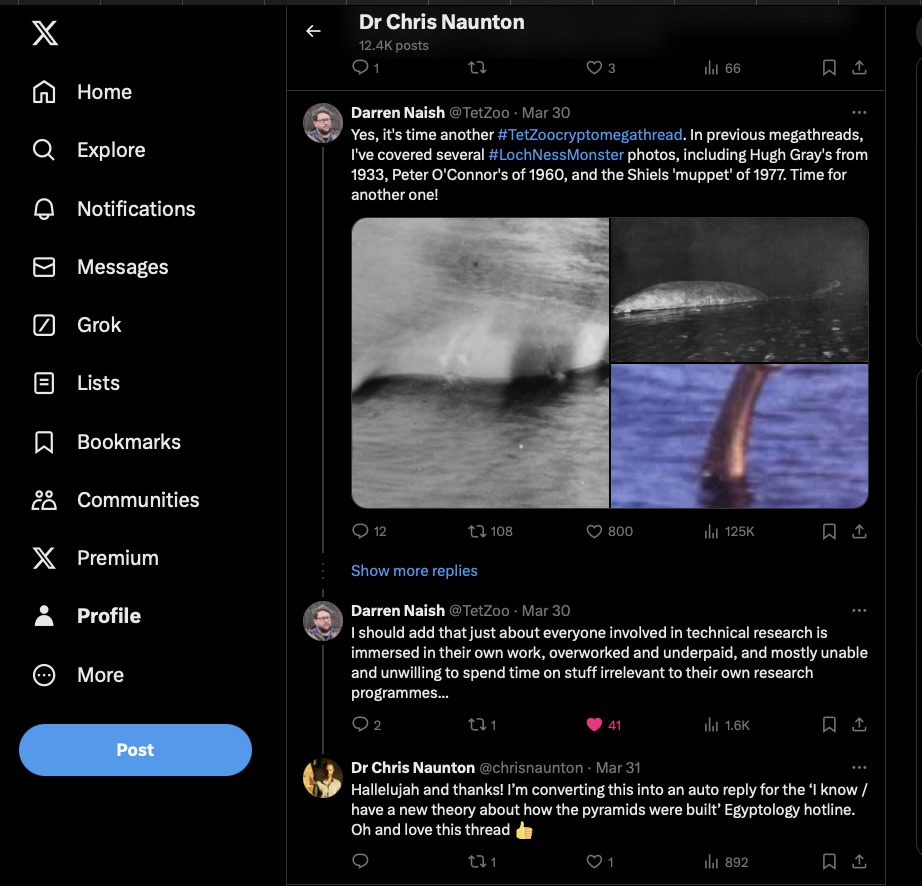
See here to read the original post on X/Twitter.
Unfortunately, when I’m unable to to engage with these ideas it probably only encourages the third of these phenomena:
3) The notion that Egyptologists are involved in a conspiracy, that we somehow know that the conventional wisdom about the date and nature of the Great Pyramid is wrong but that we don’t want to allow THE TRUTH to come out because… We stand to lose our reputations / credibility / cushy jobs etc.
I was moved to write this as a response to some comments made about some photos I posted of a part of Giza I hadn’t visited before – the Central Mastaba Field – which attracted a lot of attention from people with ‘alternative’ ideas about the things I had been looking at. I found myself rather frustrated about one or two of these comments (‘Why do you say it’s a tomb when there’s no evidence for it, you’re wrong.’ Me: ‘Well, actually…’) and wanted to try to explain why the conventional interpretation is actually very sound. I realised that doing so would take a while but could form the basis of a useful and, I hoped, interesting piece, and indeed this was the basis for my recent talk on ‘Pyramid Mythbusting’.
 Calling monuments like this one in the Central Mastaba field ‘tombs’ attracted some frustrating comments at the time! The series of photos I posted starts here.
I think there is a wider significance to this because of the phenomena of ‘fake news’ and a general disregard for expertise in favour of ‘alternative ideas’, as if the conclusions drawn by experts on the basis of the accumulated empirical evidence, years of study, practical experience etc. are no better or more valid than anyone else’s.
Egyptology has had a very long association with alternative theories and I freely admit that some of them helped encourage my own interest in ancient Egypt. But conventional Egyptology is a serious scientific endeavour, led by empirical evidence. There are huge gaps in that evidence – that’s the nature of the study of people and civilisations far removed in time from our own – but any conclusions we draw about the ancient past are rooted in the evidence.
Experts are a good thing…
Egyptologists are experts. Part of the skill of being an Egyptologist is in knowing stuff. Ask me to name the kings of the 18th Dynasty and I will reel them off one by one from memory. There are loads of things I don’t know off the top of my head, but I know how to find what answers there are because I know the literature or at least how to find it. (For the pyramids see my recent guide to resources online and other reading, here). Where were the buildings of Amenhotep II at Karnak? I’m not exactly sure but I’d know to go to ‘Porter and Moss’ vol. II (‘Theban Temples’), and look up the index of royal names for the right king for the right pages in the Karnak section.
I don’t mind my expertise being questioned… But I’d want anyone reading my books, listening to me talk on TV or giving lectures, or reading captions to my photos from Egypt to know that, although I’m not infallible and I might make the odd mistake (ninth pylon, not tenth!), what I write and say is based on years of study and accumulated knowledge and an ability to justify my assertions with reference to the primary evidence.
From the 90s onwards, there has been a disturbing trend, particularly in pseudo-scientific television documentaries not only to advance such alternative ideas but at the same time to make baseless claims about ‘Egyptologists’ or ‘archaeologists’ being unwilling to examine new evidence or contemplate new theories. According to this narrative Egyptologists / archaeologists will always reject the new, exciting revelatory ideas proposed by the presenter because they (as above) don’t want to allow THE TRUTH to come out because… We stand to lose our reputations / credibility / cushy jobs etc. So when we say that no, we don’t think this new idea is credible i.e. because it doesn’t stand up to the evidence, this aspect of the programme’s case is proven: ‘ha, we told you, they don’t want THE TRUTH to come out!’
Egyptology could do better
Having said all this, I do think Egyptology bears some of the responsibility for alternative ideas gaining traction, as I explained on X/Twitter a little while ago:

X/Twitter user: Nobody knows if they were tombs though, I believe that is just guess work just like how they were constructed.
Egypttogists are pretty mainstream and finding any evidence that goes against history books could destroy someone’s life work.
Me: Hi, Egyptologist here. Had fun looking into all the alternative ideas w Dara [see here] for the TV but can confirm there’s a load of evidence -inc human remains- to show that pyramids were tombs (mainly 3rd-6th, & 12-13th Dynasty) & pretty much nothing to suggest anything else… (1/)
This isn’t my life’s work but the work of hundreds of specialists who have gathered the evidence from Giza, Saqqara, Dahshur, Abu Roash, Lisht, Meidum, Hawara, Lahun and many other cemetery sites (lots of burials of mummies and other bodies) elsewhere over the last century or so.
There is a vast body of info & literature on this & a large part of being an Egyptologist is about knowing the stuff to an extent but also knowing how to access refs to the evidence. This -w references to further literature- is an excellent starting point: https://www.amazon.co.uk/dp/0500051895/ref=cm_sw_r_as_gl_api_gl_i_6EKK7N6JM14K1Q629QM6?linkCode=ml1&tag=chrisnaunton-21
Thanks btw @HanYolo21 , your tweet perfectly shows how badly wrong things can go when we Egyptologists don’t do a good enough job of showing *why* we think what we do i.e. in this case pyramids = tombs because that’s by far the best interpretation of all the available evidence!
(Click here to see this exchange on X/Twitter)
I originally intended this post to address this issue by, as I said on X, showing *why* we think what we do. This has been overtaken by my talk now, but even if it means repeating myself a little my main points – formulated as alternative ideas, ‘myths’ – to be busted – were as follows:
Myth 1: The pyramids of Giza are much older than Egyptologists believe (4th Dynasty, c. 2550 – 2400 BCE)
No.
The arguments for an earlier date, including the ‘Orion Correlation’ and ‘Sphinx Weathering’ theories can be disregarded, as can the idea that it suspicious that there aren’t more inscriptions relating to Khufu in evidence inside the Great Pyramid – monumental tombs of the elite including those of kings, were usually not decorated at this time, contrary to the practice of later times, and the presence of graffiti naming Khufu is in keeping with the discovery of similar inscriptions naming other kings at other pyramids.
There is in fact no evidence for earlier activity relating to the pyramids and sphinx, while in support of the conventional view there are vast amounts of evidence to associate the construction of the three Giza pyramids with the reigns of Khufu, Khafra and Menkaura.
 Slide from my talk showing one of the titles held by the official Qar and containing the name of the Great Pyramid, the ‘Horizon of Khufu’ which is written with a pyramid determinative sign.
Myth 2:
Construction of the pyramids is so incredible it can only have been achieved with technology now lost to us
No.
While what the Egyptians of the Fourth Dynasty achieved is almost incredible we have the evidence for almost every stage in the process – quarrying and cutting stone, transporting it, and lifting it into position. There are still gaps, but not enough for anything sensational to be required.
 Scene from the tomb of Djehutyhotep at el-Bersha showing a colossal statue being hauled into position. Via Wikimedia Commons.
Myth 3: Pyramids were not tombs.
No, they were.
In their design, location, buildings associated with them, contents, and the decoration (of those that were inscribed) they conform absolutely to Egyptian tombs. They have been found to contain human remains, not intact mummies, but the proportion of tombs to have survived intact is vanishingly small.
 Scene from the tomb of Ameneminet (TT 277, Luxor) showing two deceased individuals in upright coffins, attended by mourners, in front of the tomb entrance which is surmounted by a pyramid.
Myth 4: Egyptologists know ‘the truth’ but don’t want it to get out because… It will ruin their reputation / life’s work? Something more sinister?
There seems to be a belief among some of those with alternative ideas that Egyptologists are hiding something. On the contrary, the consensus view – the when, how and what of the Giza monuments – isn’t just a series of unsubstantiated claims and hypotheses but is, rather, built on masses of evidence, huge amounts of which are freely available for study online (see my guide to further reading for how to find it). Any alternative interpretations must show how this evidence can be interpreted differently, and cannot disregard it. It’s clear to me that at least some of those with alternative ideas, e.g. that the pyramids were not tombs, have not taken all the available evidence into consideration.
 Central Mastaba Field, Giza with the top of the pyramid of Khafra in the background.
Thanks for reading, as always do let me know what you think in the comments!
 Dr Chris Naunton
All so true, especially the rise of keyboard “experts” who firmly believe that their opinions trounce years of experience and knowledge. I despair at how closed and weird some minds are. The main reason I’ve become so fascinated by ancient Egypt is that Egyptologists are so open to discussion and are excellent communicators about their specialisms.
That central mastaba field looks very interesting. Would definitely love to explore.
Thanks Linda, lovely to know that we don’t always come across as closed-minded and unwilling to listen! The Central Mastaba Field is well worth exploring!
Chris, your patience with the conspiracy theorists is admirable and I expect you consider it a necessary part of communicating aspects of the subject. However, it is far more exciting to understand the discovery of evidence as in (see my Fb post) the Red Sea Scrolls which shows a level of organisation and skills 5,000 years ago which I don’t think the fake news jocks can accept. They presumably think there has been significant human evolution in 5,000 years and our ancestors were not the ingenious, clever and skilled people they so obviously were.
Many thanks David! I do think it’s important not to be too confrontational – its not my style but I like to think it makes what I have to say that bit more persuasive if I can deliver the message in a measured and even friendly way. It reminds me of a time I attended a debate on the antiquities trade at which a notorious – and convicted! – smuggler was present. I got an email from him afterwards in which he expressed his gratitude for my ‘attempts at fairness’! The last part of your comment reminds me of a TV documentary presented by Graham Hancock in which he said something like ‘Egyptologists so despise the ancient Egyptians ….’ – that they can’t see the truth (or whatever), and of course it’s absolutely the reverse – we are continually wowed by what the archaeology etc shows the Egyptians were capable of. I suspect it’s a battle that will perhaps never be completely won but I’m glad to have struck this blow, and it’s great to have your support!
Thank you for sharing. Everything you tell and write about is always very interesting . I find Egyptology passionately interesting. Its a study that never ends. Every new discovery must fit in the puzzle. If it doesn’t fit in it , it means the puzzle must be studied again and that is so very intruiging and so interesting. I like your work and I hope I can continue to follow your analysis for long years to come. Good courage to you and to your team😍
Thank you Anna!
Thank You for sharing your knowledge you’ve accumulated over so many years of study and fieldwork.
It never fails to catch my attention and sparks my interest and wishing I’d followed a more meaningful path in my life contributing in some way to explore and explain the cultures of the distant past.
Of course it is amazing how people figured out how to build such buildings we now call monuments. The volume and precision sometimes are unbelievable. But in some people so is their ingenuity, and throughout history it found a way in doing amazing things.
I personally was so delighted when the book (and documentary) came out describing the find of the Red Sea Scrolls which describe the shipments of the casing stones for one of Pyramids in Giza, and naming Khufu as the ruler who ordered them to do so. The fact that scrolls of papyrus were buried some 4600 years and were found by people who knew how to handle such a find is unbelievable but the information they hold makes it priceless. Maybe “we” don’t understand how the Egyptian people build them, but it must be clear they really did build those pyramids. Why for so many people that isn’t mystical enough is a mystery to me.
Love your work, with kind regards
Yuri
Thanks for your kind words, much appreciated!
thank you for these additional notes, Chris. I enjoyed your pyramid mythbusting program. I think you nailed the truth in the face of assertions which in the main turn out to be laughable. I hope that youmwill be able to just keep the good stuff coming. Cheers Otto ( OVTraveller)
Many thanks Otto!