Tell el-Amarna, place and people

Last week I spent two absolutely wonderful days at Tell el-Amarna. I was looking forward to visiting, but I’d been a couple of time before and didn’t think much of it. Been there done that, know it all already… But it made a much bigger impression on me this time round.

One place, so many stories

Amarna was and is the capital city founded by Akhenaten and Nefertiti, and the setting, therefore, for one of the great stories of the ancient past. That city, Akhetaten, as Akhenaten called it, was also a place where a lot of ordinary people lived – and worked, played, loved, met, talked, argued, got sick, got well again, died, were buried, and did all the other things people do – together, in this one place. It’s also set in an extraordinarily beautiful, archetypally Nile Valley landscape: the broad river with lush green fields punctuated by palm trees at its edge, then a crescent of desert plain bounded at its eastern extent by a glorious arc of cliffs that marks the edge of the valley and the beginning of the high desert nothingness beyond.
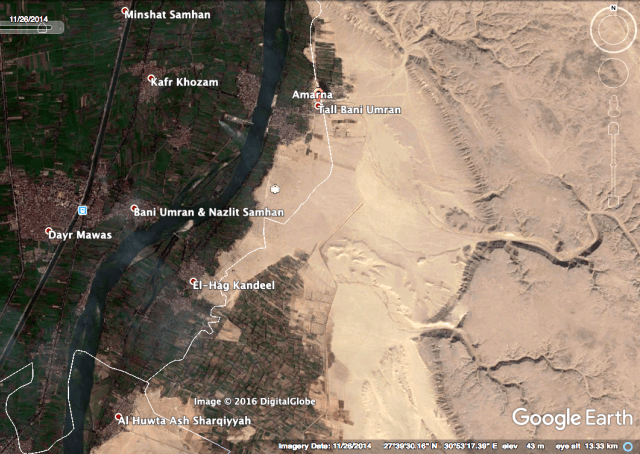
screenshot-2016-12-12-01-18-48Satellite image of the site showing the essences of the geography at Amarna: the river and, to the east, the cultivation,  low desert plain, great arc of cliffs, high desert beyond.

map_large

Map of the ancient city taken from the Amarna Project website (here). The photograph below was taken in the area of the North Palace 

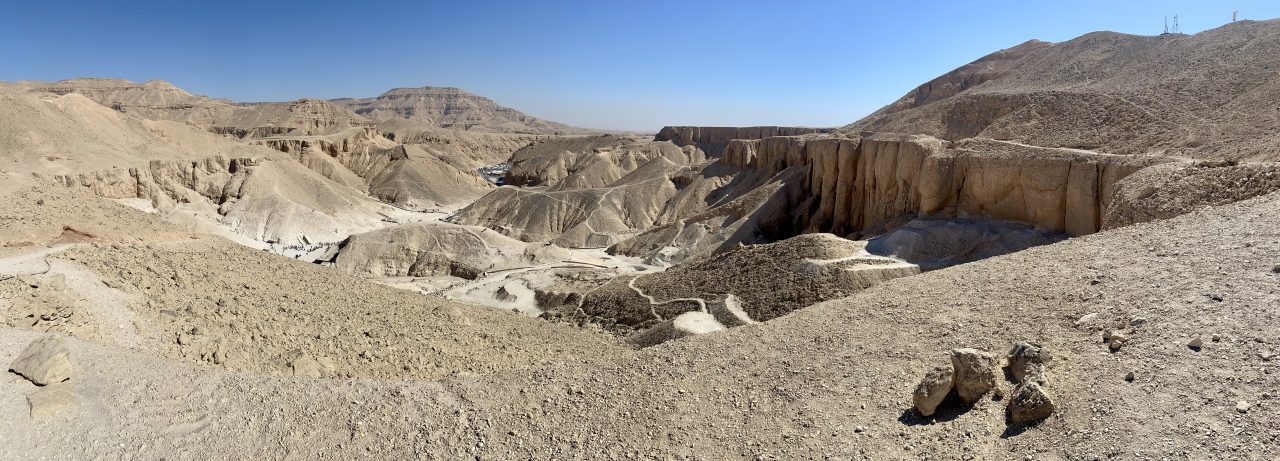
img_3889-ed-50cm

The view from the ground: looking towards the camera, ready to do some walking shots through the cultivation with the cliffs in the background

The site is also home to the people of the modern village of Et-Till Beni Amra whose name was corrupted and became ‘Tell el-Amarna’ the name we know the site best by today. Further to the south of Et-Till are the villages of El-Hagg Qandil, El-Amariya and El-Hawata esh-Sharqiya (or El-Hawata).

People lived here in the time of Akhenaten, and people live here now.

I was there to help make a documentary with a crew, Nick and Lina, from Blink Films and with our expert contributor, Dr Anna Stevens. We filmed at the north cemetery, the Workmen’s Village, and two unfeasibly lovely riverside locations; we ate two delicious and very Egyptian lunches at the local resthouse; and we drove and hiked around the site inbetween times, all the while getting the benefit of Anna’s expert knowledge and guidance.

Travelling through the site

Entering the site from the main road leading into the nearby town of Mallawi you immediately know you have arrived somewhere. Heading south along a newly tarmacked road, the fields and, beyond, the river are on your right; the desert is to your left, the cliffs beyond getting further away as the great crescent-shaped desert plain opens out towards the east. The arrangement seems almost too good to be truly natural. You can see exactly why Akhenaten chose this new place to be his capital, you just wonder why no-one had had the idea before him…

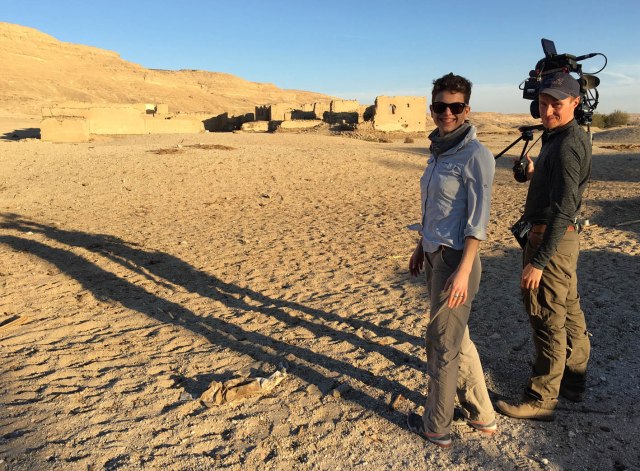
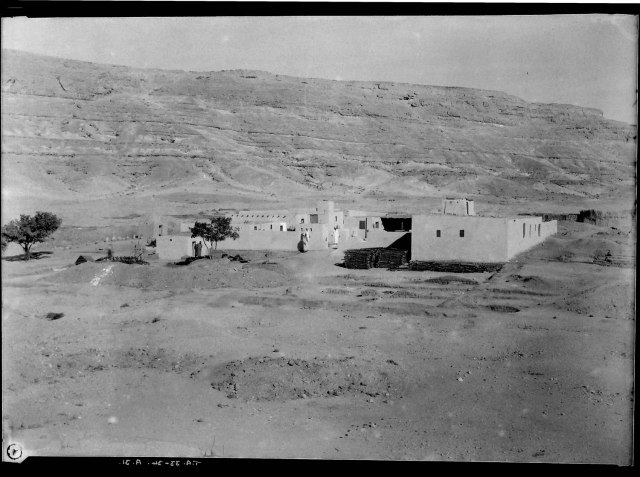
One of the first buildings you see on the desert is the ancient house which was rebuilt by the Egypt Exploration Society’s team in the 1920s for use as a base during their excavations, most famously those led by John Pendlebury and co from the beginning of the 1930s.
img_3925-ed-50cm

Lina and Nick in front of the EES house of the 1920s and 30s
ta_33-34_a_film_0031-ed-300dpi-1500px

The EES house while it was still in use. Photograph taken during the 1933-4 season at the site, reproduced courtesy of the Egypt Exploration Society.

Very close by is the North Riverside Palace which may well have been the main residence of the royal family in Akhenaten’s time. From here, after a while, the new road comes to coincide with the ancient royal road. As we drove, Anna, let us know when we had reached the Central City, where Akhenaten built his Great Palace, the Great and Small Aten Temples and various administrative buildings, the ruins of which lie all around. Remembering undergraduate lectures I asked if we were about to see the bridge across the street which some have speculated may have included a ‘window of appearance’ for the royal couple to present themselves to their people – just at the moment when we passed that exact spot. Being somewhere familiar without ever having been there before, it’s like meeting someone famous…

The ruins sit in and around clusters of modern houses, cultivated land, a cemetery – all the elements you would expect of any settled area, and all of which are expanding rapidly in an easterly direction across the desert, eating into, and destroying, the remains of the ancient city. It’s sad from an archaeological perspective, but people need houses to live in, fields on which to grow their crops, and somewhere to bury their dead.
2016-12-08-15-43-20-4

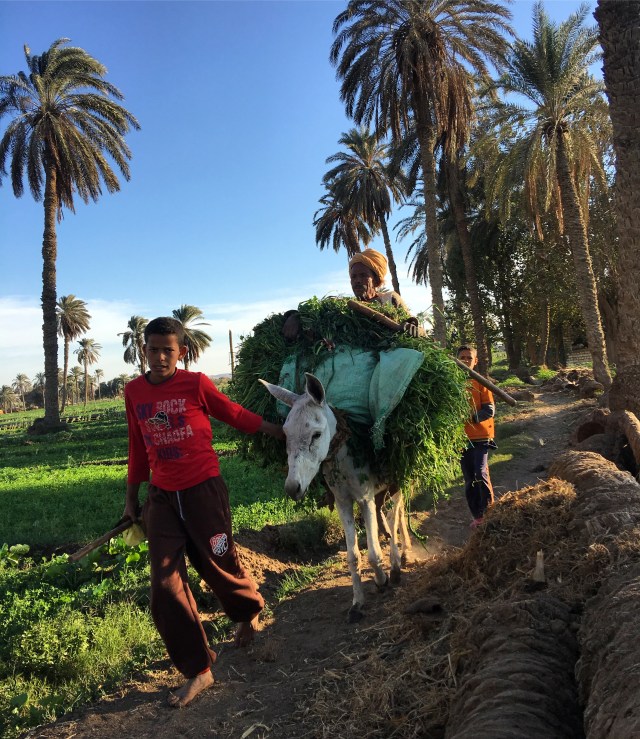
It was such a privilege to be able to film in these beautiful fields with the generous permission of the locals who, unfussed, carried on with their work around us

People and their stories

Amarna is all about people – ancient and modern – and their stories. The site helps us to tell the tale of Akhenaten and Nefertiti, but the current Amarna Project has focused more on the unrivalled opportunity it presents to study a fully-fledged, purpose-built city at a very precise moment in time: Akhetaten came into being in just a few years, according to Akhenaten’s very deliberate plan; and it was abandoned again almost as quickly after the end of his reign, as part of the transition back to the old ways. Crucially, the desert plain on which the city was built was never reoccupied to anything like the same extent, and the remains of the city simply lay there largely undisturbed beneath a thin layer of drift sand for a few thousand years until explorers and scholars began to take an interest in the beginning of the 19th century. Along with literally thousands of buildings and material objects the city also provides the opportunity to study the people who built the whole thing, and made it work.

dsc_1716-ed-1500px

Lina and Nick capture Anna’s arrival at the Workmen’s Village where the craftsmen who cut the elite tombs at Amarna lived

For many years, although the richly decorated rock-cut tombs of the Amarna elite were well known, the cemeteries of the ordinary people lay undiscovered. This changed in recent years with the discovery of what have become known as the south and north cemeteries.

dsc_1683-ed-1500px

Anna explains a little of what we can learn of the ordinary people of Amarna at the North Cemetery

Anna was with the crew and me in part to tell the story of the excavation of these crucially important burial grounds which began in 2006. During a first visit to the north cemetery for a reccy, she told us how privileged she felt to have the opportunity to excavate the graves of the people of Akhetaten. The very human connection she feels with the ancients was clear, and it now seems obvious having spoken to Anna just how incredible it is to be able to get to know something of these people’s lives, and how each came to an end, often at very young ages, perhaps after some suffering from illness or over-work, from the careful recording and interpretation of their graves and remains.

Thinking about the people – who, though far removed from us in terms of time, geography, beliefs etc., were nonetheless people just as we are – set me thinking about the city in quite a different way, made it feel a little closer, a little more alive. It’s difficult not to see a connection between this and the friendly relations Anna has with so many of the people, villagers, dig-house staff, antiquities inspectors, police, and guardians who live and work at Amarna now.

Amarna under threat

Some many lives intertwined… People, ancient and modern, locals and foreigners… City, villages and landscape. It’s such a special place, one of Egypt’s great places, one of the world’s great places. And yet the archeological site is disappearing as the locals have no choice but to make use of it for their own needs. The local Ministry of Antiquities inspectorate and Amarna Project are desperately under-funded, despite the celebrity of Akhenaten and Nefertiti. A single fragment of a statue of the period was due to be sold at auction recently for $600,000; an entire season of excavation and conservation work costs a tiny fraction of that and yet the Project struggles to find the funds it needs, relying on small grants and crowd-funding. Listening to Anna, with all her knowledge expertise, energy and passion, and seeing the excellent relations she has with friends and colleagues all around her, one can be hopeful that in future the ancient city will be preserved in its (still, largely) unspoilt desert landscape, and that the modern inhabitants will be able to able to live good lives in and around it without threatening that. But it’s by no means assured.

screenshot-2016-12-18-14-36-41-ed

Satellite image of the Central City at Amarna (click here to view the area in Google Maps). The massive rectangular enclosure of the Great Aten temple has recently been built over by the buildings of a modern cemetery (small rectangular shapes towards the top of the image). The dark green cultivated areas at its north-eastern corner demonstrate the extent to which the desert can be reclaimed for agriculture, threatening to envelope the temple completely.

I wanted to write something to share my excitement at waking up to these stories – of the ancient people, their modern counterparts, and the incredible work (Project Director) Professor Barry Kemp, Anna and their colleagues are doing – but also to say something about the urgent need for us not to be complacent about this wonderful place. Please read more about the site and the Project (here), and please consider supporting it if you can (here).

A new role… with the Robert Anderson Research Charitable Trust

So, I have new role… I am delighted to announce that I have been appointed Director of the Robert Anderson Research Charitable Trust (RARCT) with effect from March 2017. Up to that time I will be learning the ropes as ‘Director designate’.

The Trustees’ announcement is here.

The Trust is a wonderful organisation whose work I have admired for some time. Its purpose is ‘to offer postgraduate students and visiting academic staff accommodation and financial support for short periods of intensive research in London’. Since its establishment in 1989 it has brought dozens of students and scholars, mostly from the Middle East and Eastern Europe, under its wing in London, providing them with the opportunity to make use of specialist libraries and the Trust’s network of academic contacts to further their studies. Many of its visitors have been archaeologists from Egypt, reflecting the founder’s interests, and indeed its work provided some of the inspiration for the Egypt Exploration Society’s programme of scholarships, which I helped to establish in recent years.

2015-03-03-14-28-03

Robert Anderson and me in his kitchen, March 2015

The Trust’s founder, Dr Robert Anderson, was an extraordinary man, of wide-ranging interests, and many and varied talents. He was an Egyptologist and also a musician, equally at ease whether reading a hieroglyphic inscription or conducting an orchestra. Robert was also a friend of mine and a great source of inspiration and encouragement to me in my work. When he died last year, aged 88, but still very actively involved in the work of his Trust, tributes poured in from his many friends, colleagues and students around the world. My own was published in Egyptian Archaeology earlier this year (and is reproduced here courtesy of the Egypt Exploration Society). He left behind a rich legacy in the books, articles and other works he wrote, in the many students whose lives were enriched by his teaching, and of course in the Trust.

screenshot-2016-10-25-11-58-14

My tribute to Robert in Egyptian Archaeology

I’m really excited to have been given this opportunity. The Trust’s work is rooted in values which one could be forgiven for thinking are becoming lost in today’s world: the exchange of ideas between people of different nationalities and cultures, particularly those coming from some of the most troubled parts of the world; an emphasis on knowledge, scholarship and expertise, particularly in the arts and humanities; and the provision of accommodation in parts of London that are increasingly reserved only for the very wealthiest in society.

In these difficult times, the value of this work seems likely only to increase. I can’t wait to get started and look forward to sharing more of the Trust and its work with you as we go along.

Leaving the EES

After more than fifteen wonderful years working for the Egypt Exploration Society, as Director for the last four-and–a-half, I have decided to step down with effect from October this year. My last official engagement will be the Annual General Meeting on 15 October.

QUS15 Chris visits Quesna 2-4-15 (8) ED ED

I’m off! (Thanks to Geoffrey Tassie for the photo).

The Society has changed a great deal in the last few years, and I like to think I will be leaving it in good shape. More importantly though, I will be leaving it in the very capable hands of the Trustees and staff and, of course, of my successor, who will be appointed in the next few weeks.

This has been a big decision for me, one I have arrived at after a great deal of thinking over the course of several months. But it is the right one for lots of reasons.

A new challenge

I was appointed to lead the Society on a certain journey because I had the skills required. That journey is now complete, and it is time for the Society to embark on a new phase.

The EES would never have existed without the passion and enthusiasm of its founders, and their ability to inspire the same feelings in others. Its achievements are the result of the commitment of its archaeologists, staff, supporters and others. In the same way, the EES needs a Director who is bursting with ideas and energy. That was how I felt a few years ago when I began the job, but it’s impossible to sustain that level of energy forever, and it’s time for a new challenge.

That challenge is ready and waiting in fact. I’ll be leaving the EES to focus on the various pieces of work (a book or two, more media work etc.) and organizations (including the International Association of Egyptologists) to which I have committed in recent years but which, while they are complementary to my EES role, I have been unable to pursue to the extent that I would like. The challenge will be to tackle a few of these projects as a freelancer while exploring a few new possibilities as well.

The next EES

As I mentioned above, the EES is about to embark on the next phase of its history. My role as Director was to create the busy, dynamic, modern and eminently supportable organisation we all wanted the EES to be. In the last few years my colleagues and I have:

  • Overhauled the way we support fieldwork in Egypt
  • Modernised our publications and communications, especially online
  • Dramatically improved out activities in Egypt and support for Egyptian colleagues
  • Raised awareness of the Society and its work through the media and online
  • Professionalised our research facilities – the archive and library in particular
  • Professionalised our systems and processes and improved efficiency

Just about all of this has been undertaken with a view to making the Society more supportable and/or financially sustainable. However the financial situation remains very challenging, and having explored all the possibilities we had wanted to explore, and fixed a number of problems behind the scenes, it is now time for us to look at alternative means of ensuring the Society can continue to deliver its mission “to explore ancient Egyptian sites and monuments, to create a lasting record of the remains, to generate enthusiasm for, and increase knowledge and understanding of, Egypt’s past and to raise awareness of the importance of protecting its heritage.”

A fond farewell

I was 22 years old when I became Librarian and Membership Secretary at the EES, just three months after finishing my Master’s degree in Egyptology at the University of Birmingham. It was my first and so far only real job. Doughty Mews has been a home of sorts for almost half my life since then. It’s been a wonderful experience, richly rewarding in far more ways than I could ever have imagined. I arrived as an aspiring Egyptologist and leave as an experienced charity CEO. I have enormous affection for the Society and would not be leaving if I did not think that it had a very bright future ahead of it. I will of course continue to be a loyal subscriber and have every confidence that I will be able to enjoy my membership just as much as I did when I was a student. Knowing the Society’s supporters as well as I do, I am sure they will all want to continue supporting the organisation through the transition to the next phase. Lastly, I’d like to thank those supporters. Although I have thoroughly enjoyed my work for the EES I cannot pretend that every single day has been a walk in the park… There have been frustrations, disappointments and difficult characters to deal with, but these things have always been outweighed by a near-constant stream of smiles, messages of support and positive comments about the work the Society is doing. The EES would not exist without its supporters and it has been an absolute privilege to work for an organisation which inspires people around the world to offer that support. It keeps us going, and propels us forward, spiritually, emotionally, and financially(!). Thank you.

The Daleks Visit Ancient Egypt (confessions of an Egyptologist, pedant and Dr Who fan)

Screenshot 2016-02-08 12.50.14.png

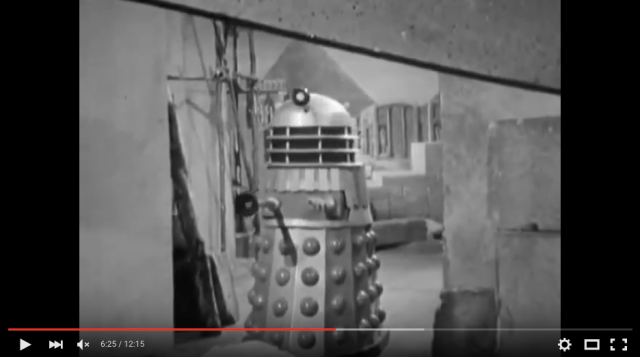
A little while ago, Dr Who writer, information goldmine, and pal, Simon Guerrier, sent an unusual question to mission control at the EES: when did the Daleks’ visit to ancient Egypt in the epic story The Daleks’ Masterplan take place? There is no official line but I thought I could give Simon a view, so I set about watching the one episode in question, and made a few notes. I had suspected the designs would be too bad for it to have been clear what dateable sources they were based on, but in fact they were pretty good. It’s just unfortunate that the sources used range across a couple of millennia of Egyptian history, leaving the Egyptologist shouting ‘the Egyptians never…!’ and ‘anachronism!’ at the TV a few times… Still I managed to give Simon a date and thought the evidence I used to make my case might be of interest.

Screenshot 2016-02-06 12.37.40

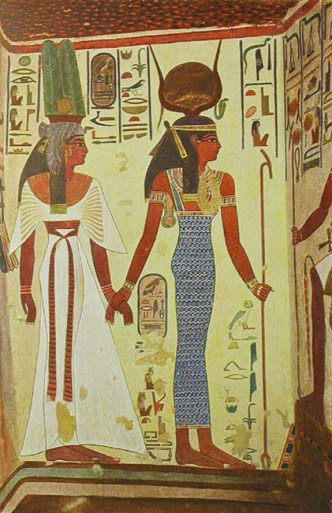
As the episode opens, the viewer finds themselves inside the stereotypical, richly decorated Egyptian-style interior. The painted walls are inspired by the Tomb of Nefertari (b. 1291 d. 1256 BC, so says Wikipedia), reign of Ramesses II, early 19th Dynasty, as in this photo of the real thing:

Tomb_of_Queen_Nefertari   Image from here.

Screenshot 2016-02-08 01.15.09

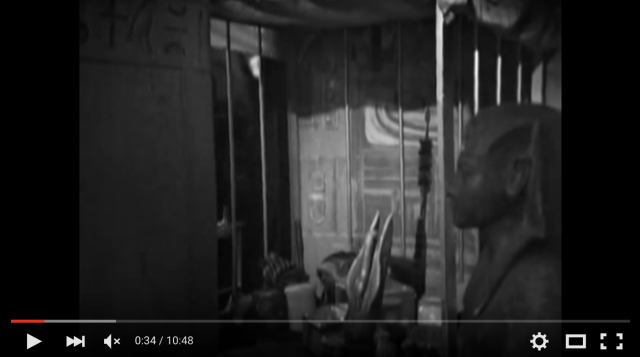
The room is cluttered with treasures, as in the tomb of Tutankhamun (reigned 1332-1323 BC, late 18th Dynasty) when it was first discovered. The pair of ears(?) in this shot recalls the glorious reclining Anubis buried with the boy king.

2E2F2B3000000578-3307795-image-m-118_1446850746673

Image (copyright, The Griffith Institute, Oxford and gloriously reconstructed in colour by Dynamichrome) taken from here.

Screenshot 2016-02-06 12.38.16

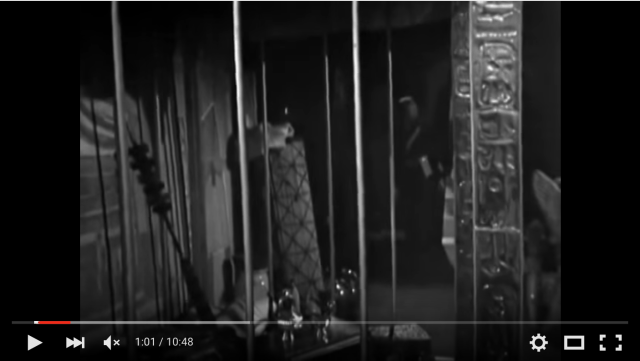
The inscription on the pillar here appears to have been neatly done but is difficult to read. Its appearance is that of beaten gold, echoing more of Tutankhamun’s treasures especially the massive golden shrines perhaps. I can’t think of any evidence of pillars this thin having been encased in beaten gold however…


XZL74098

Image from here.

Screenshot 2016-02-06 12.39.46

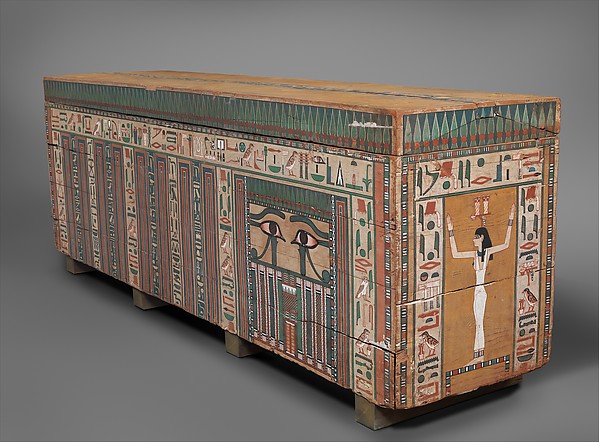
The supposed mummy here is in fact the story’s bad guy, the Meddling Monk. The humour in our heroes’ realisation that they are not about to be menaced by the living dead after all, is intentional, but the flimsy metallic appearance of the coffin presumably isn’t. The design on the outside isn’t bad, however, and recalls coffins characteristic of the Middle Kingdom (2000-1700 BC), such as this one now in the Metropolitan Museum of Art, New York.

DP354909

Image from here.

Screenshot 2016-02-06 12.41.42

I got quite excited at this point because of the very visible horizontal cartouche in the background. The signs seem good which is unusual for a TV / film set but I can’t quite make sense of them. I think they are a slightly fudged version of Nefertari’s cartouche, and therefore in keeping with the decoration visible elsewhere here. The beginning of the vertical cartouche with the yellow (presumably) background visible beneath, confirms it.

Images from here and here.

Screenshot 2016-02-06 12.42.31

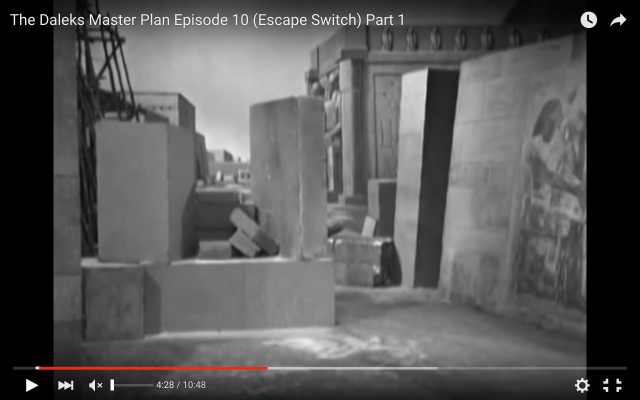
Slightly later in the episode we find ourselves outdoors, apparently amongst a group of monumental stone buildings. The relief on the wall to the right (although it ought to be on the inside of the building not the outside) is reminiscent of the classic Old Kingdom (2686-2181 BC) scene of the deceased seated, typically, before a table piled high with offerings, like this one from the tomb of Niankhkhnum and Khnumhotep at Saqqara:

niankhnumt16

Image from here.

The row of cobras along the top of the building in the background recalls the south tomb in the Step Pyramid enclosure (3rd Dyn, 2650 – 2575 BC):

CNV00161 ED

Photo my own (at last!).

Screenshot 2016-02-06 12.44.03

The style of the wigs here recalls an Old Kingdom (2686-2613 BC) type, as depicted in this famous statue from Saqqara:

185735135 Image from here.

Screenshot 2016-02-06 12.45.29

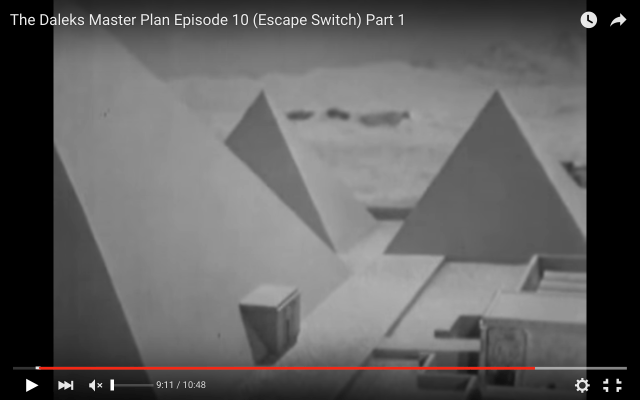
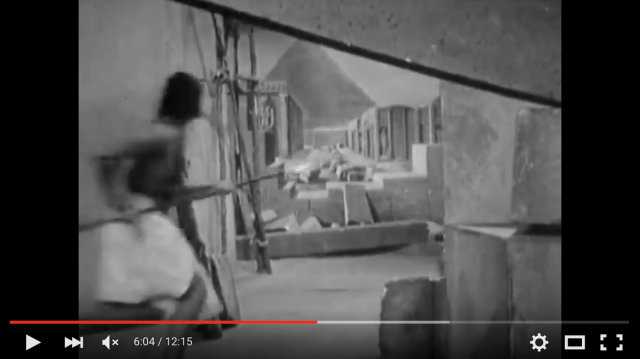
An aerial shot seems to confirm that we are at a pyramid site. One very large pyramid with two smaller ones visible suggests this is probably intended to be Giza but the entrance is ‘wrong’, being of a kind only found later in much smaller tombs e.g. at Deir El Medina (19th and 20th Dynasties, 1292-1077 BC), like this one:

pyramid tombs

Image from here.

Screenshot 2016-02-06 12.46.25

This relief seems well done and has the feel of the Late Period (Dynasties 26 to 30, 672-332 BC) – but I’m struggling to find a clear parallel (can anyone help?). This kind of scene would normally, I think, be found on smaller scale, inscribed on e.g. a naos or other kind of shrine. The inscriptions, though generally well done, do not obviously give anything away.

Screenshot 2016-02-06 12.54.24

The buildings below and to the right of the pyramid in this shot strongly recall the reconstructed chapel buildings in the Step Pyramid enclosure (3rd Dynasty, 2686–2613 BC):

EGY 98 ISO 100 Roll 1 021

Photo my own.

Screenshot 2016-02-08 12.50.47.png

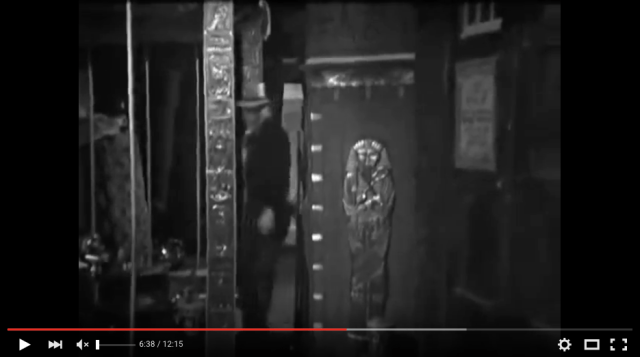
Towards the end of the episode we return to the location of the opening scenes. As the Doctor approaches the TARDIS (at right) he passes a wooden cabinet(?) with a metallic image of pharaoh, presumably intended to look like gold. Although it looks like no genuine artefact I know of, the iconography is obviously that of Tutankhamun, as this coffinette of his shows:

5_2_s_Exhibits_PastExhibits_Tut_Cofinette.jpg   Image from here.

One final bit of something to go on occurs in dialogue, at approx. 10.00: “…the same mortals that build war machines that throw fire. When Hyksos returns, you’ll see the end of your.. gods.” The Hyksos were a race of foreigners who settled in Egypt during the Second Intermediate Period (1650-1550 BC) and came to rule at least the Delta and northern Nile Valley if not the entire country. They introduced horses and chariotry and other military tech which may be where the ref to ‘war machines’ comes from. ‘Hyksos’ in the story seems to refer to one individual however; the words ‘hyksos’ derives from the ancient Egyptian ‘heka khasut’ meaning ‘ruler of foreign lands’ and it may just be that this was the name given to this particular individual by the Egyptians in the story, but in that case there may be no connection with the Second Intermediate Period group. In any case the reference should probably be disregarded as a dating criterion.

So, in conclusion…

There’s quite a clash of sources from different periods. The opening scenes appear to take place inside a New Kingdom tomb, but also feature a Middle Kingdom coffin (it could have been re-used…). The exterior shots show the episode to have taken place at a pyramid site, the pyramids probably being of the Old Kingdom; these scenes exhibit mostly influences from that period – 3rd through 6th Dynasties (2686-2181 BC) – as you’d expect for a pyramid site, but also one or two things that seem much later. Such sites were in use until much later periods so it could be that the episode takes place at a site dominated by Old Kingdom architecture but in a much later phase of its history. Having said that, the Old Kingdom stuff all seems in pretty good nick, so I prefer to think of it as having been set at that time, as most of the evidence suggests, and just to accept that the other stuff is anachronistic and the mistake of the BBC set designers… Sooo, I gave Simon a date of 2,300 BC – late enough in the period for considerable numbers of smaller, non-royal mastaba tombs to have sprung up around the pyramids, but not at the very end of the period when such sites were falling out of use. Does that seem fair? Do let me know what you think 🙂

By the way, Simon was asking as part of some research for a forthcoming book which I’m really looking forward to seeing: Whographica by Simon Guerrier, Steve O’Brien and Ben Morris will be published in September (2016) by BBC Books.